
Church of St Mary, Tenby, Pembrokeshire
Address
Church of St Mary, High St, Tenby SA70 8APOverview
The window highlighted here is one of 10 selected by Sarah Lear, as part of a special Theme dedicated to the work of Karl Parson.
A full list of the windows chosen Sarah can be found by following the link above, where you will also find a paper by Sarah introducing the artist. Details of all the windows selected by both Sarah and other contributors can be found on Karl Parsons’ artist page.
Highlight
North aisle window - 'Receiving the Crown of Life'Artist, maker and date
Designed by Karl Parsons and made at Lowndes & Drury, 1917Reason for highlighting
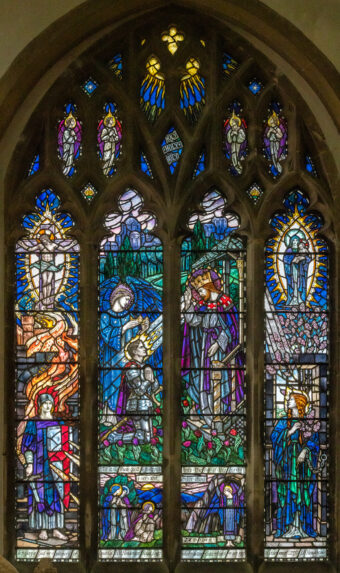
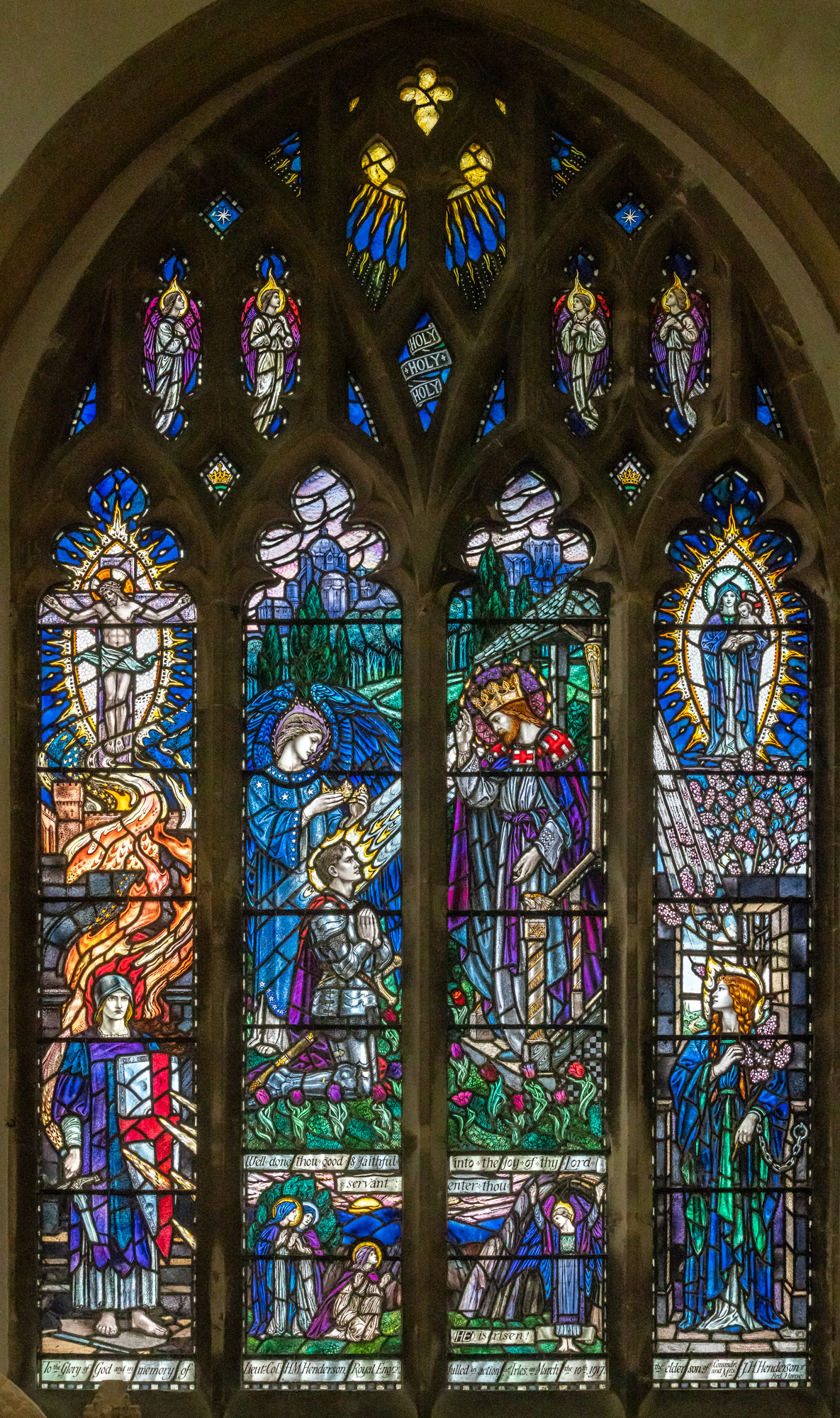
This window fulfils the dual functionality of a tender memorial to Lieut-Col H.M. Henderson yet one that ‘lives’ thus imbuing the church with light and hope.[1] Redeeming the unknown, and in all probability, unpleasant nature of the soldier’s premature death, Parsons creates a window riffing on the themes of promise, resurrection and paradise.
Parsons has used all four lights to create a wide range of images framing a Crown of Life scene. Spanning the central two apertures, the principal scene depicts a youthful and crowned Christ in profile, leaning from the steps of a rather grand enclosure raising his right hand in blessing. Henry, kneeling diagonally below him, as befits theological hierarchy, is dressed in the armour of a medieval knight and is seen also praying in profile. A sapphire blue angel, head turned in deference to Christ, with beautiful acid etched gown, crowns Henry’s fiery halo. From Christ’s benediction gesture emanates a diagonal beam of glass showing the sanctification that the soldier receives. Above and behind the three key players is a winding country road, fringed with trees, escorting towards the stately buildings of Jerusalem. The grass beneath the knight and Jesus are studded with tulips. Directly below this image is a biblical quote – Well done thou good & faithful servant: enter thou into the joy of the Lord.
In the traditional space of an altarpiece predella, directly below Christ and Henry, is a smaller scene showing three women and an angel at the empty tomb with the explanatory legend ‘HE is risen!’ The allegories of Hope, to the right, and Fortitude flank the central scene in the outer lights.[2] Hope, chained in a prison-like cell, receives another blessing beam and, clutching a blossoming branch, turns her head towards Henry. A helmeted Fortitude bears a Resurrection flag-covered shield offering protection from the fiery arrows of life and is backed by sinuous flames leaping above her.
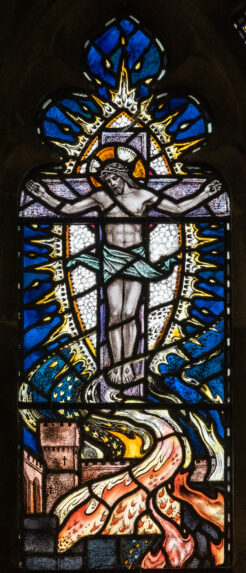
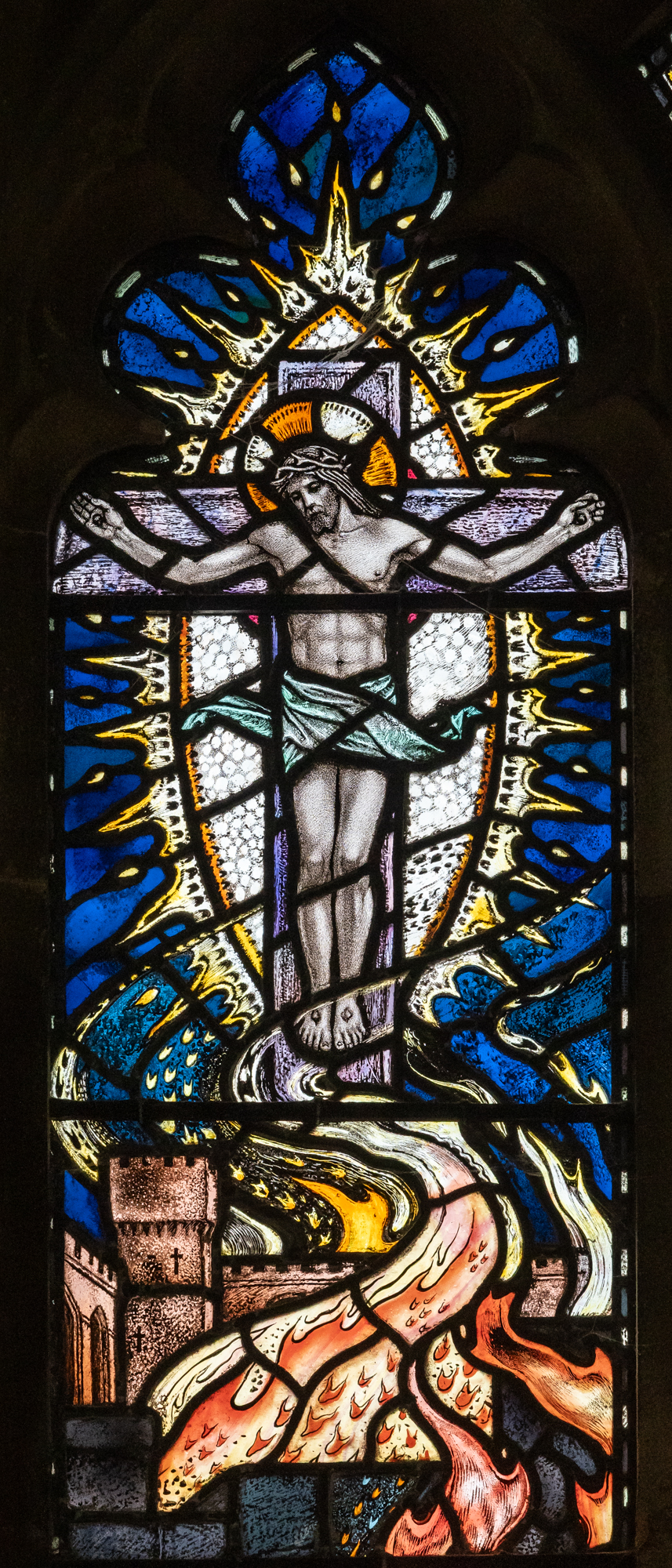
Parsons adds two mandorlas, or vesica piscis, above the allegorical figures. In the left hand light is the crucified Christ; the other bears a standing Virgin and child. Four tiny angels, with fiery haloes, pray in the tracery either side of a minute central light with a trinitarian repetition of Holy referencing Isaiah 6:3. By using the top five tracery lights to form a semi-circle, Parsons depicts the radiant beams of the sun, symbolising God the Father, emanating onto the scenes below.
Memorials were also used as substitute graves: and the unveiling of them as surrogate funerals. The prominent position of the window – on the northern wall at eye level near the porch – would have rendered it immediately obvious to all who entered. Henry’s memory would remain alive and become, in the words of Neil Moat, a ‘repository of memory’ for the lost son.[3] Through the new image showing the next part of Henry’s life, not only was his old life remembered and validated and his manner of dying legitimised, relatives would have both physical space and spiritual hope; thus new and positive memory making was facilitated.[4]
[1] Alan Borg explains that many war memorials were designed as ‘living’ memorials – to recall for current and future generations the sacrifice of war in Alan Borg, War memorials : from antiquity to the present (London: Leo Cooper, 1991). 84
[2] Fortitude is sometimes described as Courage and certainly this iconography has been known under that name. Parsons himself called her Fortitude so it seems sensible to use his terminology.
[3] Neil Moat, First World War Memorial Stained Glass in Britain, 2006, BA Dissertation, University of Newcastle-upon-Tyne. 9-10
[4] Thomas Kupper, “Amateur Stained Glass in English Churches, 1830-80,” 19: Interdisciplinary studies in the long nineteenth century 2020, no. 30 (2020), https://doi.org/10.16995/ntn.2895.
Artist/maker notes
Karl Parsons (1884-1934) was born in Peckham, South London, and grew up in a Christian household. His sister, the garden painter Beatrice Parsons, was involved in apprenticing him to the leading Arts and Crafts master craftsman, Christopher Whall. Parsons learnt much from Whall, working on the incredible Gloucester cathedral Lady Chapel windows, following his master’s footsteps to teaching at the Central school of Arts & Crafts and providing the illustrations for Whall’s famous text Stained Glass Work in 1905.
They began to disagree on Whall’s commission for Johannesburg cathedral and Parsons established his own studio at Lowndes and Drury’s Glass House in 1908. His first commissions for St. Alban’s, Hindhead are impressive and although he never achieved the fame and success of Whall, his creative iconographic work is peppered with signature motifs – such as flames, animals, children and plaited hair – and there is much use of lavish deeply coloured tones of superb quality Norman slab glass. These combine to make spectacular windows and he was able to capture light and movement in an idiosyncratic manner. After learning his trade and gaining experience in a superb workshop, Parsons came into his own by advancing Whall’s beautiful work with his own subtle twists to create stunning Arts and Crafts windows.
Sources:
Cormack, Peter, Arts & Crafts Stained Glass (Yale University Press, 2015)
Cormack, Peter, Karl Parsons 1884-1934, exhibition catalogue (London: William Morris Gallery, 1987)
Lowndes & Drury was formed in 1897, by the artist Mary Lowndes (1857-1929) and the craftsman Alfred John Drury (1868-1940), with the aim of providing facilities for independent artists to design and make stained glass windows. They moved from cramped conditions in Chelsea to newly purpose-built premises, The Glass House, Fulham in 1906. The firm continued after the founders’ deaths, under Alfred Drury’s son, Victor, until he retired in the early 1970s. However, The Glass House premises continued in use under Carl Edwards and subsequently his daughter, Caroline Benyon, until she moved her studio to Hampton in 1992.
Source: The Journal of Stained Glass, Vol. XLI, 2017
Other comments
This was the second of three commissions by Parsons for this church, as J.D. Coleridge, also architect of his first big commission in St. Alban’s, Hindhead, put forward his name for window work. His first, in 1909, was a simple – and cheap – image of the Virgin Mary in the central panel of a three light aperture.[1] To commemorate the death of Henry’s mother, Bessie Henderson, in 1919 Parsons was asked to make an Opus sectile image; evidently his work clearly pleased the family.
[1] Martin Crampin, Stained glass at the Church of St Mary the Virgin, Tenby (Aberystwyth: Sulien Books, 2014). 11-12