


Church of All Saints, Eastchurch, Kent
Address
Church of All Saints, 3 High St, Eastchurch, Sheerness ME12 4DEOverview
The window highlighted here is one of 10 selected by Sarah Lear, as part of a special Theme dedicated to the work of Karl Parson.
A full list of the windows chosen Sarah can be found by following the link above, where you will also find a paper by Sarah introducing the artist. Details of all the windows selected by both Sarah and other contributors can be found on Karl Parsons’ artist page.
Highlight
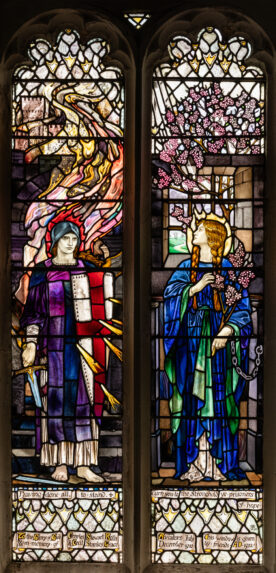
Two light window of Fortitude and Hope, south aisleArtist, maker and date
Designed by Karl Parsons and made at Lowndes & Drury, 1912Reason for highlighting
Karl Parsons was asked to make a memorial window for All Saints’ Church, Eastchurch for Charles Stewart Rolls and Cecil Stanley Grace, early British aviators who lost their lives in aircraft accidents in July and December 1910. The Rolls and Grace memorial window, as it became known, was dedicated by the Archbishop of Canterbury on 26th July 1912 and was even mentioned in The Times. This venue had been chosen as much of their flying had been based at the local aerodrome which had witnessed the first controlled flight by a British pilot on British soil and is the site of the later 1955 Memorial to the Home of Aviation.
Hope is represented chained by the left wrist to a prison wall and holding a branch of a blossoming shrub. Parsons based both allegorical figures on stained glass and painted designs by Edward Burne-Jones of Morris & Co. An early version of both figures can be seen in the 1872-78 Morris windows at Jesus College, Cambridge. Burne-Jones released an oil painting of Hope in 1896 for Mrs. George Marston Whitin of Whitinsville, Massachusetts which is now in the collection of the Museum of Fine Arts, Boston. Parsons adapted the blossom branch so that his sprig grows from outside the prison cell suggesting the divine presence at work. He also used plaits for Hope, which he does elsewhere in glass, like Peace in Christ Church, Fulham, but is an unusual feature in glass of this era. Hope’s head is shown seen in a preliminary sketch and is based on Doris Dommette who was also used as a model for Arthur Rackham’s drawings of Alice in Wonderland. [1]
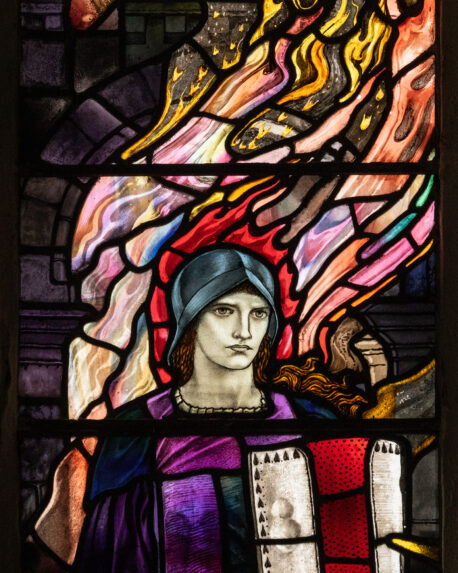
Of particular note are the beautifully executed flames in streaky glass surrounding Fortitude’s head which showcase the Norman slab glass which was beloved of the Arts and Crafts designers. In Christopher Whall’s window in St. Michael and All Angels, Ledbury in 1905, the figure of Fortitude is very similar to this one. Tracing the image through the Morris & Co.’s iterations shows that, in Ledbury, this was the first time flames appear licking behind the figure and it is highly likely Parsons drew this when still apprenticed to Whall. Fortitude bears her flag-covered shield to protect the British against the arrows of the enemy.
[1] Peter Cormack, Karl Parsons: [An exhibition of his stained glass work, held at the] William Morris Gallery, ed. William Morris Gallery (London: Waltham Forest Libraries & Arts Department, 1987). 12
Sources:
Bell, Malcolm, Sir Edward Burne-Jones : A Record and Review 4th ed (London: G. Bell & Sons, 1895)
Cormack, Peter, Arts & Crafts Stained Glass (Yale University Press, 2015)
Cormack, Peter, Karl Parsons 1884-1934, exhibition catalogue (London: William Morris
Gallery, 1987)
Artist/maker notes
Karl Parsons (1884-1934) was born in Peckham, South London, and grew up in a Christian household. His sister, the garden painter Beatrice Parsons, was involved in apprenticing him to the leading Arts and Crafts master craftsman, Christopher Whall. Parsons learnt much from Whall, working on the incredible Gloucester cathedral Lady Chapel windows, following his master’s footsteps to teaching at the Central school of Arts & Crafts and providing the illustrations for Whall’s famous text Stained Glass Work in 1905.
They began to disagree on Whall’s commission for Johannesburg cathedral and Parsons established his own studio at Lowndes and Drury’s Glass House in 1908. His first commissions for St. Alban’s, Hindhead are impressive and although he never achieved the fame and success of Whall, his creative iconographic work is peppered with signature motifs – such as flames, animals, children and plaited hair – and there is much use of lavish deeply coloured tones of superb quality Norman slab glass. These combine to make spectacular windows and he was able to capture light and movement in an idiosyncratic manner. After learning his trade and gaining experience in a superb workshop, Parsons came into his own by advancing Whall’s beautiful work with his own subtle twists to create stunning Arts and Crafts windows.
Sources:
Cormack, Peter, Arts & Crafts Stained Glass (Yale University Press, 2015)
Cormack, Peter, Karl Parsons 1884-1934, exhibition catalogue (London: William Morris Gallery, 1987)
Lowndes & Drury was formed in 1897, by the artist Mary Lowndes (1857-1929) and the craftsman Alfred John Drury (1868-1940), with the aim of providing facilities for independent artists to design and make stained glass windows. They moved from cramped conditions in Chelsea to newly purpose-built premises, The Glass House, Fulham in 1906. The firm continued after the founders’ deaths, under Alfred Drury’s son, Victor, until he retired in the early 1970s. However, The Glass House premises continued in use under Carl Edwards and subsequently his daughter, Caroline Benyon, until she moved her studio to Hampton in 1992.
Source: The Journal of Stained Glass, Vol. XLI, 2017