
Bradford Cathedral, West Yorkshire
Address
Cathedral Church of St Peter, 1 Stott Hill, Bradford BD1 4EHTheme
Overview
The cathedral has a fascinating mix of Victorian and twentieth century glass by Morris, Marshall, Faulkner & Co.; Heaton, Butler and Bayne; Kempe; Shrigley & Hunt; Hardmans, Powells and A. K. Nicholson.
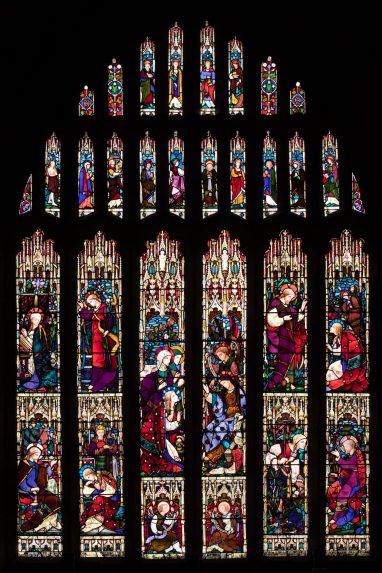
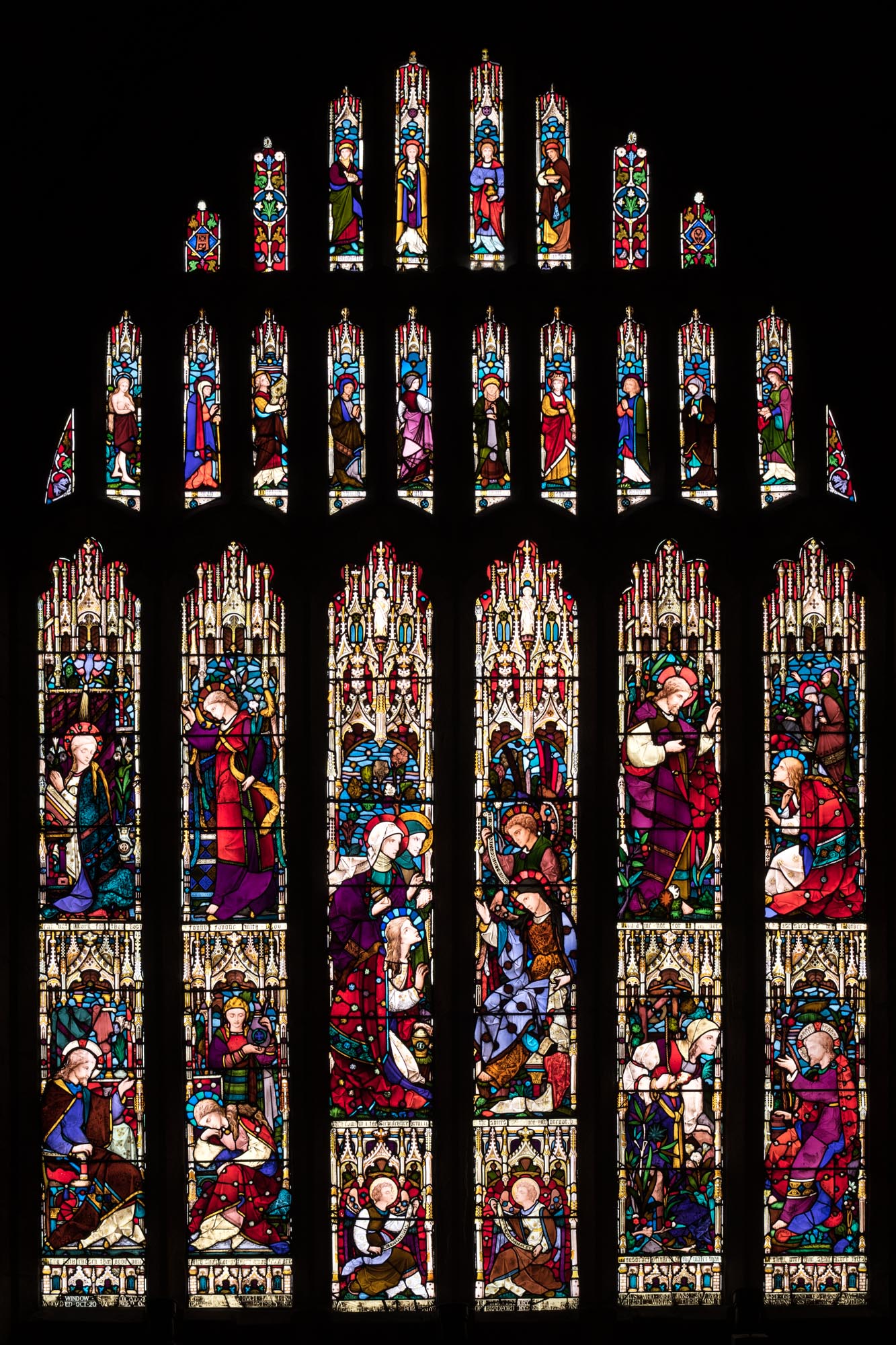
The Victorian glass is led by three excellent windows from the 1860s made for the then Parish Church – The stunning west window, described below, and two windows by Morris, Marshall, Faulkner & Co. The first from 1863 was only the firm’s third commission and contains designs by William Morris, Edward Burne-Jones, Dante Gabriel Rossetti, Peter Paul Marshall, Ford Madox Brown and Philip Webb. The second, made in 1864, is largely to designs by Morris and Burne-Jones along with single panels designed by Ford Madox Brown, Philip Webb and, uniquely, the painter Albert Joseph Moore, who created the central image of Salvator Mundi. Neither window is in its original position, having been moved following the rebuilding of the east end in 1958-63. The original seven light window from 1863 has been divided between three windows in the newly built Lady Chapel, while the 1864 window has been divided between three locations.
The main 20th century work is a memorial of 1921 to the 6th Battalion the West Yorkshire Regiment in Arts & Crafts idiom by A J Davies.
Highlight
West windowArtist, maker and date
Heaton, Butler & Bayne, c.1866Reason for highlighting
The west window is a fine example of the work of Robert Bayne and Alfred Hassam. The vibrant purples and reds, and the new way in which the figures engage with each other and with people in the church reflects the influence of Alfred Hassam, a brilliant young artist and designer, whose life was cut tragically short by TB in 1869.
Artist/maker notes
Heaton, Butler & Bayne
Clement Heaton (1824-82) and James Butler (1830-1913) went into partnership in London in 1855. A close relationship with the firm of Clayton & Bell led to Clayton’s outstanding pupil, Robert Turnill Bayne (1837-1915), joining the firm in 1862. Bayne, along with his younger colleague, Alfred Hassam (1843-69) drove the firm’s development, and their windows from 1862 – c.1868 placed them in the top rank for that most creative period.
One of the largest and most prolific studios of the nineteenth century, the business survived until the death of RT Bayne’s grandson Basil Richard Bayne in 1953.
Further reading:
Angels & Icons: Pre-Raphaelite Stained Glass 1850-1870 by William Waters (Seraphim Press Ltd 2012)
Nineteenth century Norfolk stained glass by Haward, Birkin (University of East Anglia / Centre of East Anglian Studies, 1984)
Victorian Stained Glass by Martin Harrison (Barrie & Jenkins Ltd, 1980)
Comments by
Peter Hildebrand