


Church of St Alban, Hindhead, Surrey
Address
Church of St. Albans, Tilford Road, Hindhead Surrey, GU26 6RBOverview
The window highlighted here is one of 10 selected by Sarah Lear, as part of a special Theme dedicated to the work of Karl Parson.
A full list of the windows chosen Sarah can be found by following the link above, where you will also find a paper by Sarah introducing the artist. Details of all the windows selected by both Sarah and other contributors can be found on Karl Parsons’ artist page.
Highlight
Five early windowsArtist, maker and date
Karl Parsons, 1908-10Reason for highlighting
This church has the largest collection of works executed by Parsons completed over the period from 1908-1910. They were amongst his first commissions after he had set up his own studio having left his apprenticeship with Whall. All of these windows testify to his great skill and draughtsmanship and showcase some of his best work.
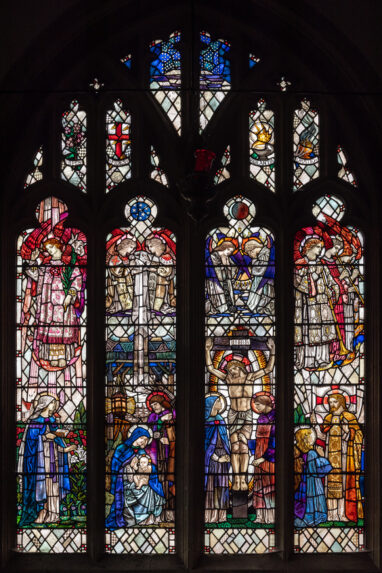
The East window combines four great central mysteries of the Faith: Annunciation, Crucifixion, Nativity and the appearance to Mary Magdalene and was a thank offering for spiritual blessings received. These bear many similarities to his work with Whall, see for example the pink hearts on Gabriel’s robe like those of Whall’s 1905 smaller angels at St. Michael and All Angels, Ledbury. Above these, the four little lights represent Hope (a flowering shrub), Faith (the Shield of Faith warding off the fiery darts of the Evil One), Watchfulness (the burning lamp), and Prayer (a censer with its cloud of incense). At the top of the tracery manna is seen falling as heavenly food for God’s people. As usual, Parsons adds contemporary details including Mary walking in front of a hotel, now flats, at the corner of Wood Road/Tilford Road in the first lancet. It seems that there is no star in the Nativity scene until you note the little bunch of flowers Joseph is carrying which is Ornithogalum umbellatum, the Star of Bethlehem flower. Even Mary at the foot of the Cross has her cloak fastened with a heart, carefully split in two.
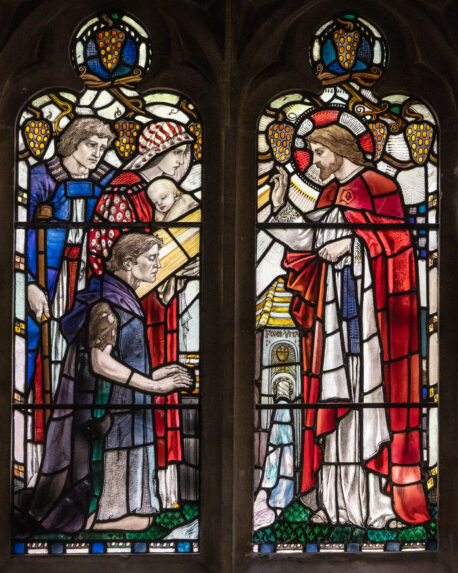
The Healing window was the first erected in the autumn of 1907, not long after the church was consecrated. It was given as a thanksgiving by people who had been restored to health through the gift of healing, and in memory of the life and ministry of James Moore Hickson, (1868–1933) an occasional visitor to Hindhead who had a worldwide healing ministry in the early Twentieth Century. The subject is Jesus the healer of his people in soul and body sending his Church into the world, and we see the power coming from him as he raises his hand in blessing. Water flows from the ‘fountain of life’. Unusual details include the stylised grapes, which bear a strong resemblance to Louis Davis’s work at St. Mary & St. Nicholas Church in Littlemore c.1900, unusual headwear and decorative details of the woman and the lifelike modelling of the baby.
The 1909 Holy Communion window is unusual because of its ambiguously androgynous priest, who appears to sport a bun by way of hairstyle? The kneeling figure in the congregation in armour is the Patron, St. Alban. With him are: Queen Bertha of Kent; William of Wykeham, the Bishop of Winchester (who founded Winchester College in 1393, a model of which he holds in his hands with his school motto ‘manners makyth man’; and Caedmon (the earliest English Christian poet of Whitby Abbey who died in c.680). In front kneel children at their first communion. Jesus is offering up his hands, offering himself to the Father, while from his body flows a ray of light onto the altar, in which we see the dove as a symbol of the Holy Spirit. Above, on the left, is the company of angels praising God. At the top is a vine – a symbol of the life which flows from our Lord to his people.
Here, as in the Healing window, Parsons uses an Arts and Crafts trope to illustrate theology – the beam of light, in this case carrying the dove of the Holy Spirit, crosses the stone mullions with ease. Christopher Whall’s Annunciation shows a similar beam across three lights in the Lady Chapel of Gloucester Cathedral. God’s power is not limited by stone.
The two small two-light North windows were also created by Karl Parsons. The subjects are: 1.The Mother and Child: ‘Thou shalt call his name Jesus’ 2.Christ and the children: ‘He blessed them’ 3.The commission to Peter: ‘feed my sheep’ 4. Our Lord in Glory: ‘In the midst of the throne’.[1]
[1] From the notes on stained glass available in St. Albans, Hindhead
Artist/maker notes
Karl Parsons (1884-1934) was born in Peckham, South London, and grew up in a Christian household. His sister, the garden painter Beatrice Parsons, was involved in apprenticing him to the leading Arts and Crafts master craftsman, Christopher Whall. Parsons learnt much from Whall, working on the incredible Gloucester cathedral Lady Chapel windows, following his master’s footsteps to teaching at the Central school of Arts & Crafts and providing the illustrations for Whall’s famous text Stained Glass Work in 1905.
They began to disagree on Whall’s commission for Johannesburg cathedral and Parsons established his own studio at Lowndes and Drury’s Glass House in 1908. His first commissions for St. Alban’s, Hindhead are impressive and although he never achieved the fame and success of Whall, his creative iconographic work is peppered with signature motifs – such as flames, animals, children and plaited hair – and there is much use of lavish deeply coloured tones of superb quality Norman slab glass. These combine to make spectacular windows and he was able to capture light and movement in an idiosyncratic manner. After learning his trade and gaining experience in a superb workshop, Parsons came into his own by advancing Whall’s beautiful work with his own subtle twists to create stunning Arts and Crafts windows.
Sources:
Cormack, Peter, Arts & Crafts Stained Glass (Yale University Press, 2015)
Cormack, Peter, Karl Parsons 1884-1934, exhibition catalogue (London: William Morris Gallery, 1987)
Other comments
Christopher Whall completed a window in 1909 for the East window of the Good Shepherd Chapel. The image of Jesus, the Good Shepherd, is seen holding a lamb in his arms in the centre light. The side lights represent scenes from Psalm 23. This is very similar to a commission at St. Ethelbert, Herringswell, Suffolk in 1902.