
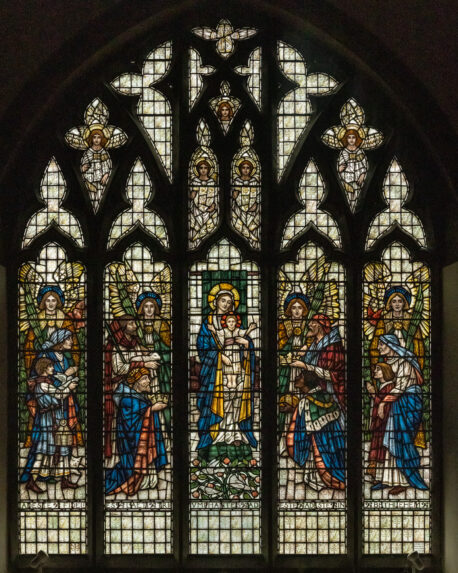
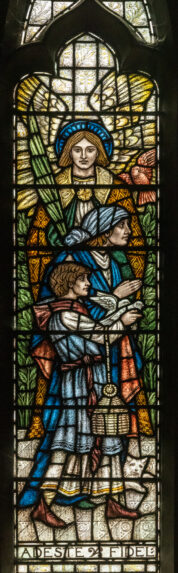


Church of St Anselm, Hatch End, Pinner, London.
Address
Church of St Anselm, Westfield Park, Pinner HA5 4JLRecommended by
Highlight
West windowArtist, maker and date
Designed by Selwyn Image and made by James Powell & Sons, 1915Reason for highlighting
Hatch End is a cornucopia of Arts & Crafts art. Image’s window may not even be the most spectacular glass in the church. It strikes, for Arts & Crafts glass, a somewhat sombre and sober note – fittingly, perhaps, since Image was, unusually among his contemporaries, religiously committed. This is serious work. And, aesthetically, pointing towards the spikey graphic rigours of Modernism.
The church epitomises something quintessential about the Arts & Crafts – that it was comradely, friendly, more interested in good fellowship than in competition. The window stands for the way in which Arts & Crafts friends and colleagues came together to adorn a building in a co-operative spirit – even if, as here, they did so serially rather than contemporaneously. They didn’t work shoulder-to-shoulder, but they were marching to the same harmonious drummer.
Artist/maker notes
Selwyn Image (1849-1936) was a priest, a poet, and a wide-ranging designer and artist: stained glass, mosaic, wallpaper, furniture, embroidery, book illustration and book binding. At New College, Oxford, he studied drawing under Ruskin. In 1873 he was ordained priest, and served at All Hallows, Tottenham and St Anne’s, Soho. He resigned from the priesthood in 1882 to devote himself wholly to art. In 1883 he co-founded the Century Guild with Arthur Heygate Mackmurdo (1851-1942) and Herbert P. Horne (1864-1916). He was a regular contributor to its periodical, The Hobby Horse. Image was Slade Professor of Fine Art at Oxford 1910-16.
Source: Mitchell, N. Rebecca. “Selwyn Image (1849-1930)” Y90s Biographies. Yellow Nineties 2.0, edited by Lorraine Janzen Kooistra, Ryerson University Centre for Digital Humanities, 2021, https://1890s.ca/image_bio/.
James Powell & Sons was formed when James Powell purchased Whitefriars Glass, an old established glass works, in 1834. His sons developed the business to be one of the major firms of the Victorian and Edwardian eras. Especially notable is their work with Charles Winston in the 1840s and 1850s to improve the quality of glass available, and the many fine designers with whom they worked. The company’s innovations extended beyond stained glass, with the company developing a formidable reputation in a number of fields, including tableware glass, where Whitefriars Glass remains highly collectable. The stained glass department finally closed in 1973, and the company in 1980.
Sources:
James Powell & Sons, Whitefriars by Jacqueline Banerjee, PhD, Associate Editor, The Victorian Web
Victorian & Edwardian Stained Glass by Marta Galicki (Historic England, reprinted by Morris & Juliet Venables, 2001)
Other comments
Elsewhere in the church there are marvels.
The catalyst, and prime mover, was the glass designer Louis Davis, who moved to Pinner by 1896. He lived near the new church, designed by the otherwise obscure F. E. Jones, who had earlier worked in partnership with W. S. Weatherley. The land was donated by Thomas Blackwell of the Crosse & Blackwell company.
The East Window (Louis Davis, 1903) is the life of St Anselm (also with his dog, representing the Benedictine Order of St Bernard), setting out from his birthplace and ascending Harrow Hill to consecrate the new church. William Rufus encourages Anselm to accept the Archbishopric of Canterbury.
The Baptistry window (Louis Davis, 1915) includes clear ruby glass from Ypres Cathedral, destroyed in November 1914, the first year of the Great War. A boyish Christ is adored by two blushing angels. There are more Davis windows in the side Chapel (1932), and the Holy Spirit chapel (1910), which includes a memorial to William Blake.
There is Arts & Crafts woodwork too. The extraordinary rood screen (1901) is the work of Charles Spooner and his wife Minnie Dibdin Spooner (known always as Dinah), who designed the figures. They were carved by Joseph Phillips (b. 1866), the leading woodcarver at Armitage of Altrincham. Spooner also designed the Great War memorial reredos (1921) and the baptistry screen (1938).