
Church of St Catherine, Hoarwithy, Herefordshire
Address
Church of St Catherine, Hoarwithy, Hereford HR2 6QQRecommended by
Highlight
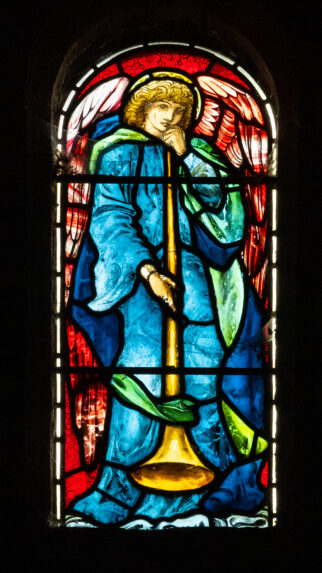
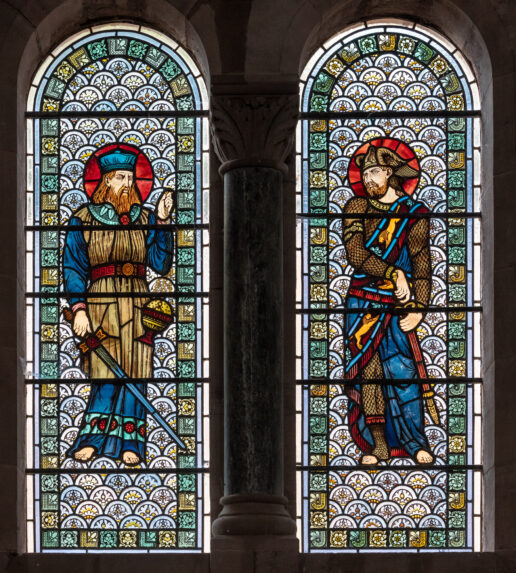
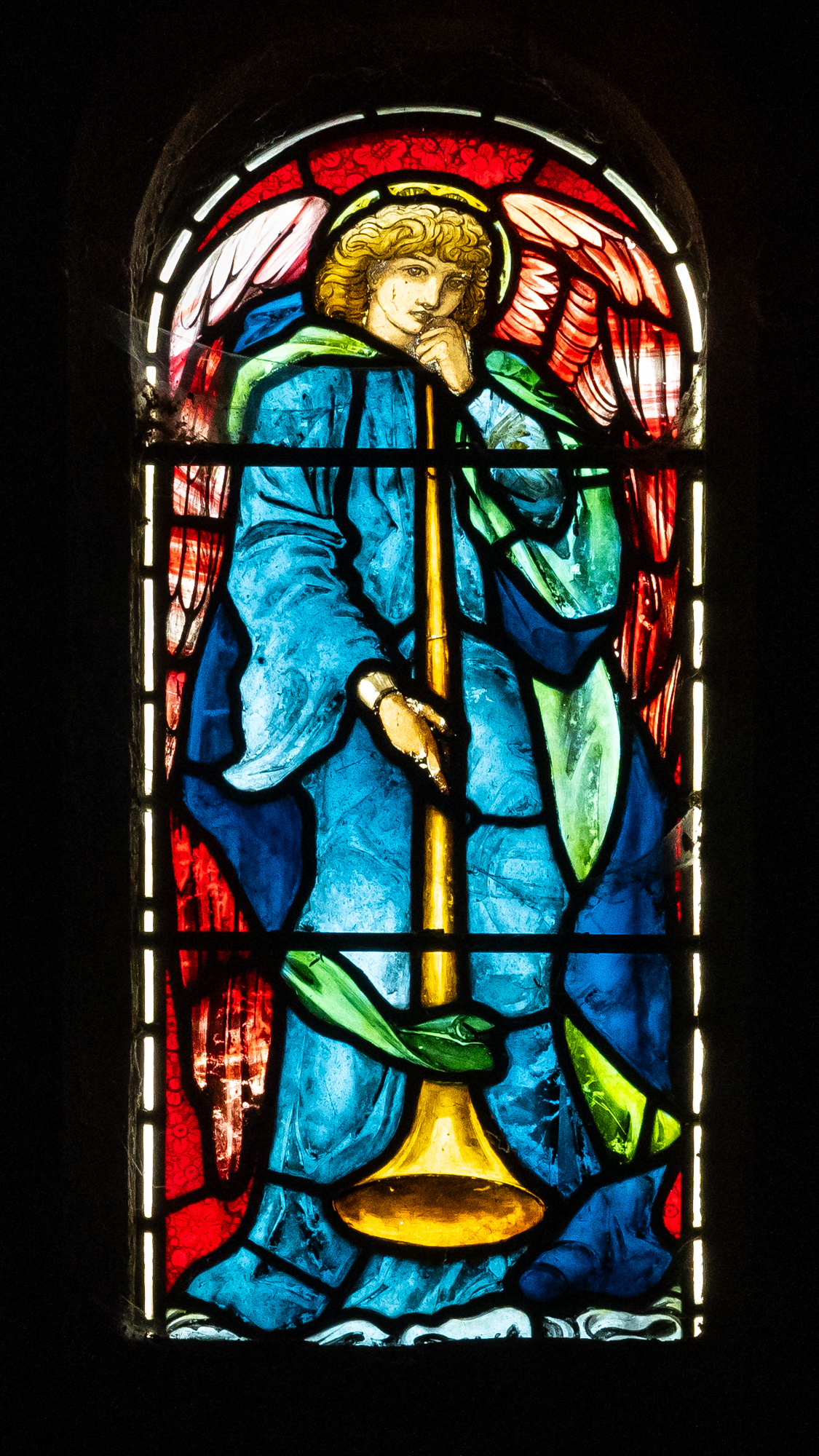
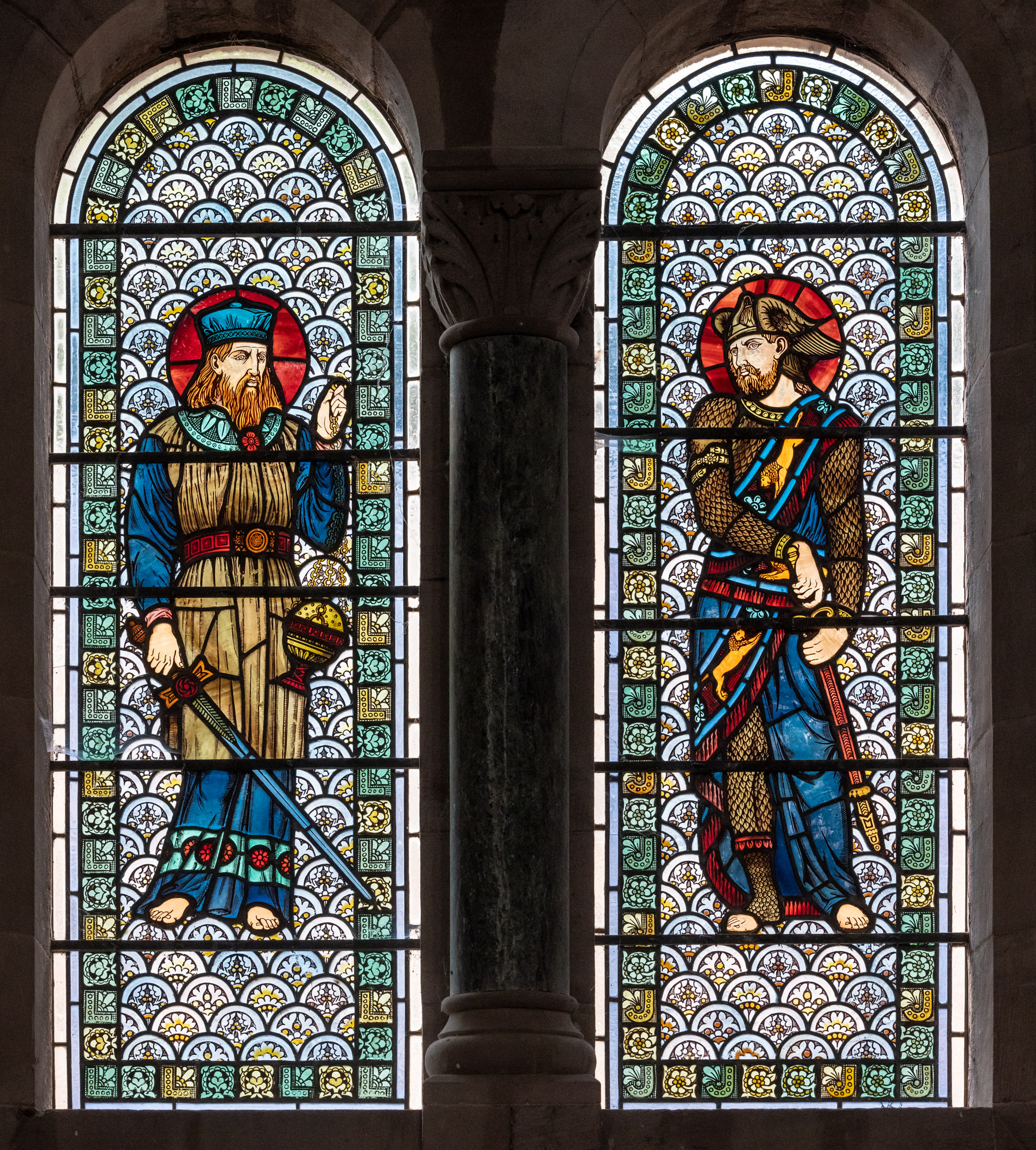
The high west window and north nave windowArtist, maker and date
The high west window was designed by Edward Burne-Jones and made by Morris & Co (1879). The north nave window (c.1885) was designed by H A Kennedy and made by Stephen Belham & Co.Reason for highlighting
One does not, to be candid, come to Hoarwithy for its glass. But the glass is an intriguing part of the rackety, idiosyncratic story of the church itself (see below).
The west wall is pierced by nine small windows. The topmost, neck-achingly hard to see well, is by Morris & Co, thought to be designed by Burne-Jones, though the face has a distinctly Morris look. It depicts a rather coy angel about to blast on a huge brass instrument – more Alpine horn than trumpet – vivid, and with glorious red streaky flashed glass in the wings.
This colourful window is perhaps a response by Morris to criticism by the church’s architect, J.P. Seddon, writing in the Ecclesiastical Art Review the previous year. Cormack notes that there Seddon accused Morris of making windows that were “no more than ‘transparencies’ – a term that was often associated with Georgian enamelled windows, which for most Victorian stained glass connoisseurs represented the very nadir of the craft.” [1]
All the other windows in the church were made by S. Belham & Co., a London firm of builders and decorators who worked closely with Seddon. The best are an eye-catching pair of windows in the north nave designed by H. A. Kennedy. They are thought to represent either Levi and Judah (he has lions on his sash), or Joshua and Ezekiel. The figures have red halos – associated with flame, and sometimes indicating strong emotion. The figure on the right has a distinctly oriental look, with a fanciful helmet.
[1] Arts & Crafts Stained Glass by Peter Cormack (Yale University Press for the Paul Mellon Centre for Studies in British Art, 2015) p.20
Artist/maker notes
Sir Edward Coley Burne-Jones (1833-98) was born in Birmingham and studied at Exeter College, Oxford where he met William Morris, with whom he developed a lifelong friendship. Together they created hundreds of stained glass windows that collectively stand as one of the finest artistic achievements of their time. The stature of this formidable artist and designer was recognised after his death when he became the first artist to be given a Memorial Service at Westminster Abbey.
Morris & Co. (1875-1940) was the successor to original business of Morris, Marshall, Faulkner & Co. William Morris had always been the driving force behind the ‘Firm’ and he finally determined to remove his earlier partners and to take the business into his own hands, with Burne-Jones as principal designer. The business flourished and continued after Morris’s death, when it also continued to use Burne-Jones’s designs. It finally closed in 1940.
Sources:
For a brief overview of the two companies see Morris & Co on Wikipedia
The Last Pre-Raphaelite: Edward Burne-Jones and the Victorian Imagination by Fiona McCarthy, Faber & Faber, 2011.
William Morris: A Life for Our Time by Fiona MacCarthy (Faber & Faber, 1994)
Burne-Jones Special Issue, The Journal of Stained Glass, Vol. XXXV, 2011
Damozels & Deities Pre-Raphaelite Stained Glass 1870-1898 by William Waters and Alastair Carew-Cox (Seraphim Press Ltd, 2017)
Hugh Arthur Kennedy (1854-1905) was not only a glass designer, but a playwright and novelist. He studied Fine Art at the Slade School under Sir Edward Poynter.
Kennedy was a founder member of The Fifteen, a loose artistic collective/club lead by Walter Crane, which merged with the St George’s Art Society in 1884 to form the Art Workers Guild, focal point of the Arts & Crafts in London.
Kennedy worked with S. Belham & Co on a number of projects, in particular the west window (1877) of All Saints’ Church, Langport, Somerset, which Cormack says may be claimed as the first ‘Arts & Crafts window’ in view of its ‘richly variegated glass, forceful leading and vigorous painting style.’
Sources:
Arts & Crafts Stained Glass by Peter Cormack (Yale University Press for the Paul Mellon Centre for Studies in British Art, 2015)
Damozels & deities, Pre-Raphaelite Stained Glass 1870-1898 by William Waters (Seraphim Press, 2017)
Belham & Co. was a London firm of builders and decorators, founded in 1865 by Stephen Belham (1827-91). Their resident designer was Henry Gibbons Murray (1852-1929), who set up his own business after Belham’s death.
They often used the fine quality glass of made by Jesse Rust (c.1826-1895) and worked with the architect J.P. Seddon.
Source: Arts & Crafts Stained Glass by Peter Cormack (Yale University Press for the Paul Mellon Centre for Studies in British Art, 2015)
Other comments
The church was built by Revd William Poole (1819-1902), who inherited vast estates all over England. He used the rents from his northern lands to fund the ‘beautification’ – effectively rebuilding – of Hoarwithy church. His architect was John Pollard Seddon (1827-1906), at the time the leading church architect in South Wales.
It reflects Poole’s eccentric but devout character – in the apsidal roof, Christ Pantocrator in vivid mosaic (1893) by Ada Currey at James Powell & Sons; columns of grey marble veined with red, resting on costly Egyptian porphyry bases; the altar white marble inlaid with lapis lazuli and a tiger’s eye cross. Outside, eye-catching carving – drip-mouldings of curious design: a hand holding a lizard, a fist, a snail. And a towering campanile and a cloistral walk open to the elements – an eccentric splash of Italianate glamour in deepest Herefordshire.
Two sets of windows were added after those highlighted above. The nine windows of 1890 in the west wall below the Morris window are, by comparison, anaemic – the colours purposely muted, at the client’s behest, inspired by something the architect saw in Bordeaux cathedral. They represent patriarchs and prophets, and were made by H. G. Murray of S. Belham & Co. Finally, in 1904 the apse windows – Christ and the Evangelists – were designed by the architect as a memorial to his by-then-deceased client and were made by H. G. Murray.