


Church of St Martin of Tours, Epsom, Surrey
Address
Church of St Martin of Tours, Church Street, Epsom, KT17 4PYOverview
The window highlighted here is one of 10 selected by Sarah Lear, as part of a special Theme dedicated to the work of Karl Parson.
A full list of the windows chosen Sarah can be found by following the link above, where you will also find a paper by Sarah introducing the artist. Details of all the windows selected by both Sarah and other contributors can be found on Karl Parsons’ artist page.
Highlight
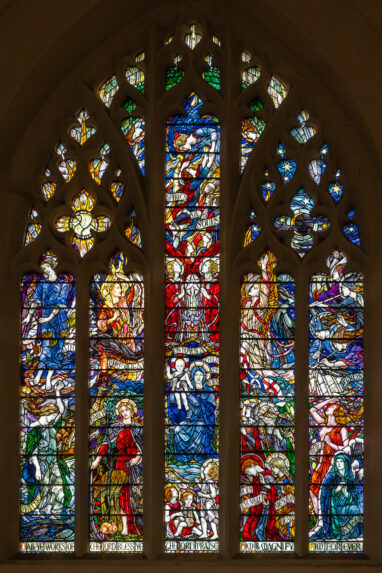
Benedicite window, north wall of the north transeptArtist, maker and date
Designed by Karl Parsons and made at Lowndes & Drury, 1926Reason for highlighting
This 1926 window superbly demonstrates Parsons’ energy, creativity and ability to create movement in glass.
Parsons himself described this masterpiece as ‘a glittering web of light and colour.’[1] The five light north facing window is in the 1908 church extension and the underlying plaque commemorates the lives of Harley Mair Greville and the premature combat deaths of his son Gordon Harley Greville (d. 1918) and son-in-law William Morris Vincent (d. 1917). The legend running across the window explains the theme of the window as the first verse of the Benedicite canticle: O all ye Works of the Lord, bless ye the Lord : praise him, and magnify him for ever.
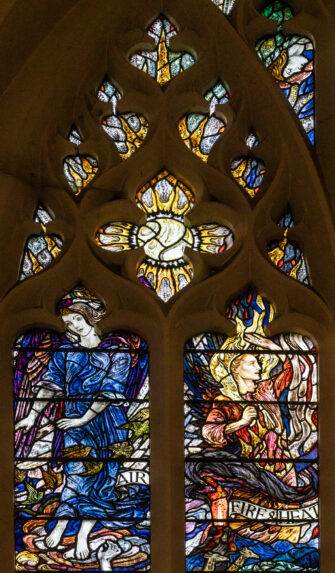
Parsons has created an entirely distinct mood with his glass. He appears to do away with all usual compositional rules, neglecting even to add the common structural element of a thin border of white glass and, in order to decode the image, the explanatory notes from the Parish Magazine are vital. At every turn here there is movement created by a variety of elements: limbs are raised forming serpentine shapes, rivers meander, figures dance, flames leap and loop, descriptive banderoles curve, angelic ribbons coil, drapery flutters, smoke curls from an erupting volcano, the frosty cage of Winter contains dripping icicles and even flowing locks twist and spiral unexpectedly.
Within this curving chaos, a closer look reveals that Parsons has cleverly orchestrated this design. For example, a vesicle-esque construct just above the Virgin’s head forms the apex of a triangle in mostly whiter tones of glass created by the lifting of Water’s left hand, continued by the Fire and Heat banderole descending through the St. George flags and paler tones of Summer’s flesh. This is reinforced at a lower level by the symmetrical motion of the deer and giraffes with the Saints’ heads. Horizontal lines are created through the balance of the heads from Air to the highest Wind, with Fire and Day slightly lower and at the middle level through Water, Earth, the three Saints and Summer. Each light is complete in itself, although they are designed to work as one image. In the lower half of the window, interest is sparked by the network of gazes whilst in the central light, despite the acceleration of the Holy Spirit’s hurtling dive, the majority of figures swirl, twist and clamour higher. There is an ascending spiral amongst the Spirits and Souls who look up towards heaven. In this Epsom design, all the elements work in an interwoven format. As the writer in the Epsom Parish magazine put it: ‘in a remarkable manner the idea of praise is conveyed to us, as that which is vigorous, living and shared in by all God’s works.’[1]
[1] St Martin of Tours, Epsom Parish Magazine 1926
Artist/maker notes
Karl Parsons (1884-1934) was born in Peckham, South London, and grew up in a Christian household. His sister, the garden painter Beatrice Parsons, was involved in apprenticing him to the leading Arts and Crafts master craftsman, Christopher Whall. Parsons learnt much from Whall, working on the incredible Gloucester cathedral Lady Chapel windows, following his master’s footsteps to teaching at the Central school of Arts & Crafts and providing the illustrations for Whall’s famous text Stained Glass Work in 1905.
They began to disagree on Whall’s commission for Johannesburg cathedral and Parsons established his own studio at Lowndes and Drury’s Glass House in 1908. His first commissions for St. Alban’s, Hindhead are impressive and although he never achieved the fame and success of Whall, his creative iconographic work is peppered with signature motifs – such as flames, animals, children and plaited hair – and there is much use of lavish deeply coloured tones of superb quality Norman slab glass. These combine to make spectacular windows and he was able to capture light and movement in an idiosyncratic manner. After learning his trade and gaining experience in a superb workshop, Parsons came into his own by advancing Whall’s beautiful work with his own subtle twists to create stunning Arts and Crafts windows.
Sources:
Cormack, Peter, Arts & Crafts Stained Glass (Yale University Press, 2015)
Cormack, Peter, Karl Parsons 1884-1934, exhibition catalogue (London: William Morris Gallery, 1987)
Lowndes & Drury was formed in 1897, by the artist Mary Lowndes (1857-1929) and the craftsman Alfred John Drury (1868-1940), with the aim of providing facilities for independent artists to design and make stained glass windows. They moved from cramped conditions in Chelsea to newly purpose-built premises, The Glass House, Fulham in 1906. The firm continued after the founders’ deaths, under Alfred Drury’s son, Victor, until he retired in the early 1970s. However, The Glass House premises continued in use under Carl Edwards and subsequently his daughter, Caroline Benyon, until she moved her studio to Hampton in 1992.
Source: The Journal of Stained Glass, Vol. XLI, 2017
Other comments
The other stained glass windows in the church have been well documented on the Epsom & Ewell History Explorer website. It includes the interesting history of the glazing of the east window. Originally glazed by Thomas Willement in 1824, it was re-glazed by a local artist, Francis A Oldaker in 1892, before finally being replaced by a window by Christopher Webb in 1923. The Oldaker window was relocated to the south transept, while two roundel from the Willement window are now in the vestry.