
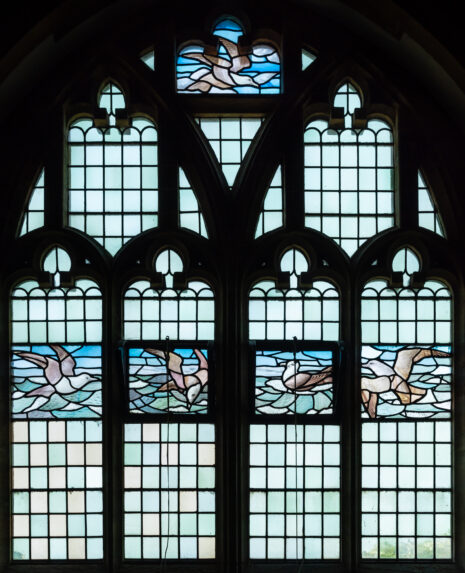

Church of St Mary, Lynton, Devon
Address
Church of St Mary, Church Hill, Lynton EX35 6EDRecommended by
Highlight
North nave window fifth from the westArtist, maker and date
Heywood Sumner, date unknownReason for highlighting
Glass attention at Lynton tends to focus on a tiny window in the Lady Chapel, by Christopher Whall. But the aisles windows are infinitely more fascinating.
Glass in the Arts & Crafts is often cloyingly rich in colour and excessive in ambition – under the heady Pre-Raphaelite influence of Burne-Jones, and increasingly reflecting the sensual melodrama of cinema and illustrated magazines – images of Theda Bara and Rudolph Valentino lurk behind the womanly angels of Henry Holiday, and Mabel Lucy Attwell peeks out from behind Veronica Whall. It can all be a bit too much.
But these windows are so different in intention and language – restrained, tactful, natural: like a set of water-colours by a studious and observant naturalist, or a great illustrator. They are so realistic, may they even have been based on photographs? And they are so delightfully non-ecclesiastical. Are there gulls in the Bible? I doubt it.
Our webmaster does not permit inclusion of plain glass windows enlivened only by clever leading – so I must turn your gaze from the enchanting Benedicite window, presumably by Wilson – bison, camel, aardvark (?), deer, lioness (?) and wolf, plus abstracted fishes, birds and a lurking snake.
Nearby is the gem: a flock of four gulls – three in vivid flight, one bobbing on the waves – in pale, watery tones of green, blue, brown, and grey. They were designed by Heywood Sumner (1853–1940). These are windows not to rest your eye on, but to look through, and let them bring the skyscape in. There are plenty of real – and sharp-eyed, opportunist – gulls in Lynton, but none has the charm of these four benevolent free spirits of the sea.
Other comments
Lynton’s medieval parish church was comprehensively restored (re-imagined, almost) by Henry Wilson, 1891-1906. The original designs were by his master, midwife to the Arts & Crafts, John Dando Sedding, who died before the work was started. Wilson took over, and effectively rebuilt the church.
Wilson also designed the Hume memorial window, 1909, in the north aisle. It was made by Shrigley & Hunt and includes the faces of the four youngest sons of the vicar at the time of the restoration, in the main figures, with their sister appearing over the right-hand shoulder of the first figure. The faces of the three eldest sons were used as models for the east window of the Lady Chapel by Veronica Whall.