
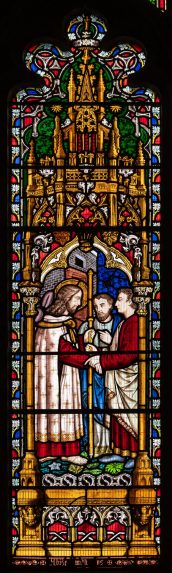
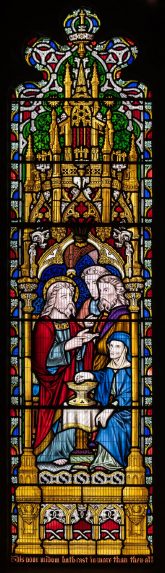
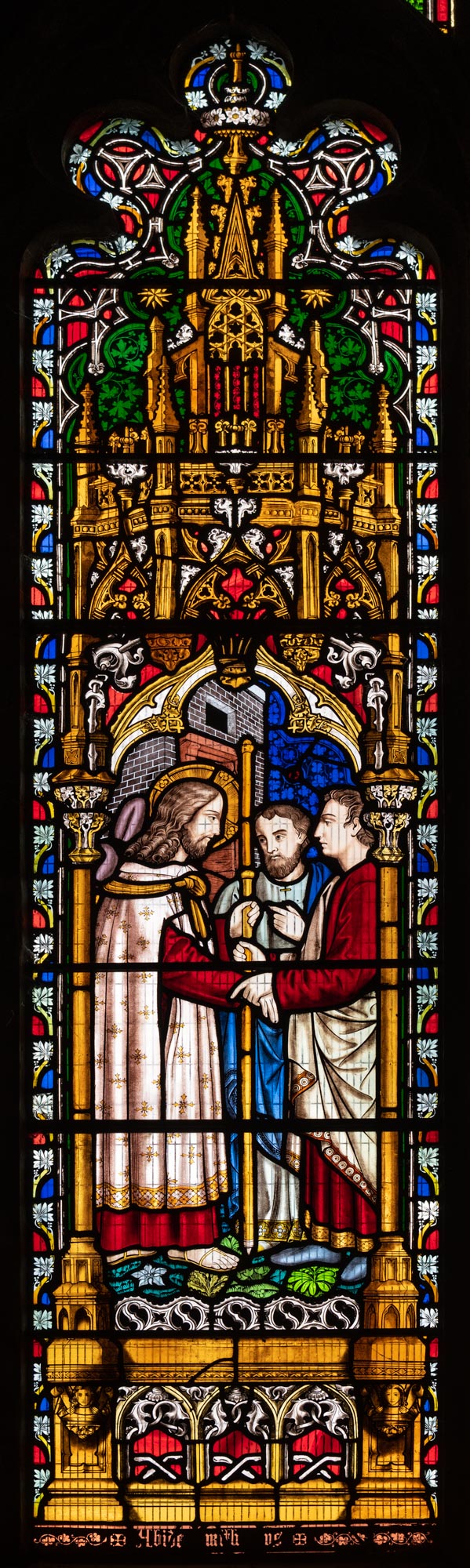
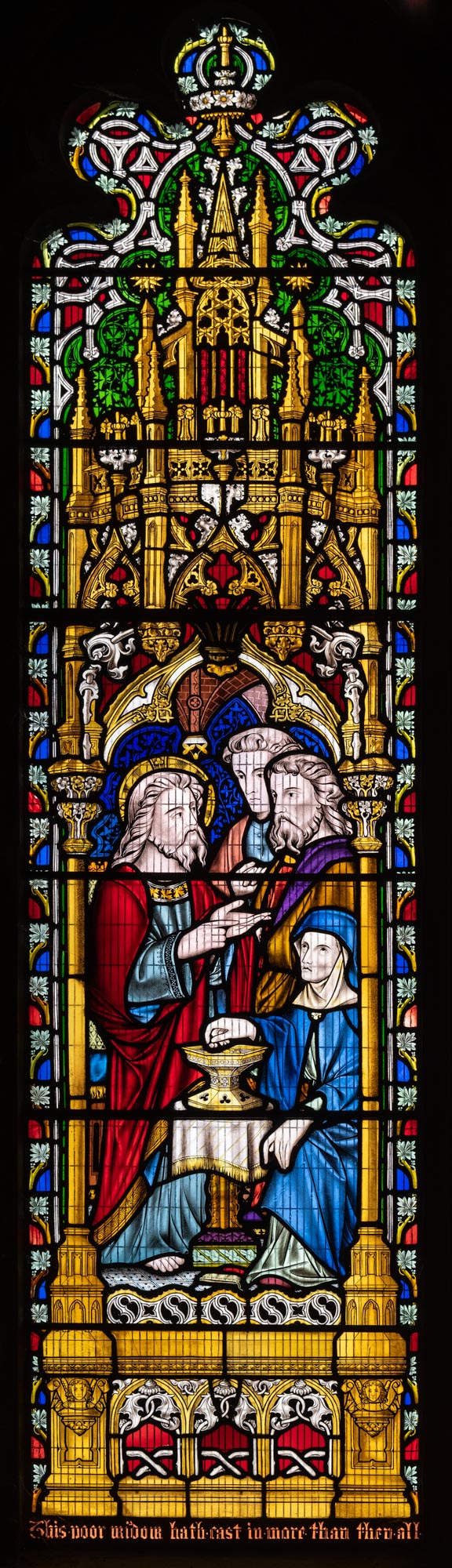
Church of St Nicholas, Cholderton, Wiltshire
Address
Church of St Nicholas, Cholderton, Salisbury, Wiltshire SP4 0DWRecommended by
Highlight
Scheme of six windows on the north and south sides of the nave and anti-chapelArtist, maker and date
Horwood Brothers, 1858-1860Reason for highlighting
The windows bring a satisfying unity to the main body of the church. Most of the designs, including that of the Widow’s mite, have similar features and may have been designed by Alfred Bell. This was a period when Clayton and Bell did not have their own workshop and leased their designs to other firms, including the Horwood Brothers. The windows in the ante-chapel, however, are all copied from pre-existing artworks. Jesus with the two disciples at Emmaus is based on a fresco in the Convento di San Marco in Florence by Fra Bartolomeo (1472-1517). The original only shows the three figures down to the waist but lower halves have been added in the stained glass to make them complete. The Good Shepherd is copied from Johann Friedrich Overbeck (1789-1869). They also copied the two principal figures of the Prodigal Son by Eduard von Steinle (1810-1886) and ‘Christ knocking at the door of the soul’ by Philipp Veit (1793-1877). The Horwoods occasionally copied entire pictures but more frequently just some elements, particularly in their earlier years. They were not alone in this as many of their contemporaries were doing much the same.
Artist/maker notes
Horwood Brothers was in business for about 40 years from 1856. They were based initially in Mells and later in Frome, Somerset. Their work is typical of a regional firm of the period and is mainly to be found in Somerset and Wiltshire though they did carry out commissions elsewhere in England, Wales, Ireland and overseas.
Of the three Horwood brothers, Edwin (1834-92), Harry (1838-1917) and Mark (1840-1904), Harry is particularly notable for the considerable success he enjoyed in North America, where he is still remembered via the Horwood Stained Glass Museum
Other comments
The building of the church, which replaced a much smaller one, was driven by the Revd Thomas Mozley. He was a fellow of Oriel College and the church has the feel of an Oxford College chapel. As a result the body of the church is quite narrow, so that on a sunny day the Horwood windows on the south side create a spectacular colour wash on the north wall.
The Horwood windows completed the glazing of the church, which had begun in 1850 with east and west windows by Michael O’Connor, and two chancel windows by Charles Clutterbuck, the latter unfortunately suffering from paint loss.
There are excellent notes on the building of the church by Brigadier Michael Clarke MBE on the church website.