


Church of St Peter, Bardon Hill, Leicestershire
Address
Church of St Peter, Bardon Road, Bardon Hill, Coalville LE67 1TDOverview
The window highlighted here is one of 10 selected by Sarah Lear, as part of a special Theme dedicated to the work of Karl Parson.
A full list of the windows chosen Sarah can be found by following the link above, where you will also find a paper by Sarah introducing the artist. Details of all the windows selected by both Sarah and other contributors can be found on Karl Parsons’ artist page.
Highlight
East windowArtist, maker and date
Designed by Karl Parsons and made at Lowndes & Drury, 1930Reason for highlighting
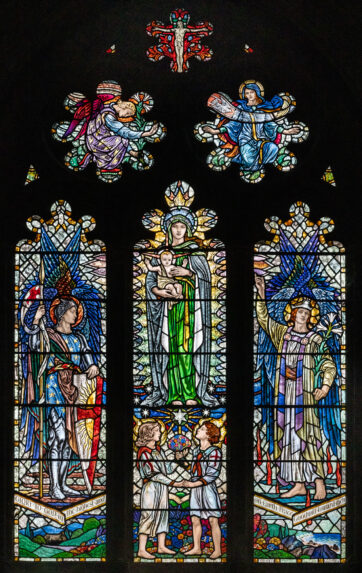
Parsons was responsible for the design of the east window, in memory of John Breedon and his wife Harriet Selby Everard. The three main lights show the Madonna and Child flanked by Archangels Michael and Gabriel, with predella scenes of geographical sites, presumably significant to the family. The main focus of the window does not, perhaps, display his most innovative work. Instead it is the tracery where his best design lies showcasing his mastery of spatial dynamics creating a flowing, distinctive and unusual image.
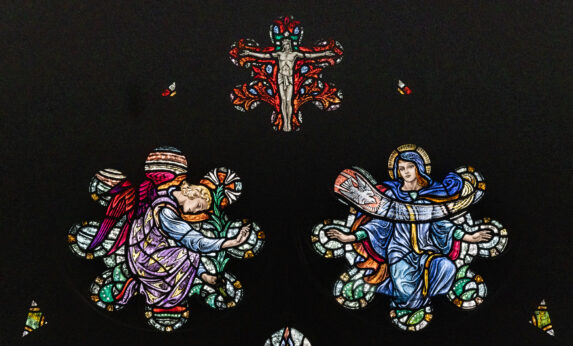
These three panels include an exquisite sextet Crucifixion, while the Annunciation images of Gabriel meeting Mary, occupy an octet each, and are set against a background of stylised flowers evocative of lily of the valley. This section bears his trademark deep colours and expression of movement in a manner reminiscent of the lyrical grace of Renaissance art. The angel kneels, lily in hand, and blesses with his classic poise and a titian Mary, also on her knees to suit the space constraint, receives the Holy Spirit sweeping across her light towards the slight opening in her golden edged garments.
The repetitive use of coral coloured glass backing the dove in both lights helps propel the bird’s flight. Implausible though it may seem, Parsons here shows movement through the stone mullion by using what Arts and Crafts glass specialist, Peter Cormack, calls the ‘expressive function of the lead line.’[1] He achieves this with wider than usual lead lines to enhance the drama of the moment. Harry Clarke, a close friend of Parsons, also used strongly supportive lead lines at Balbriggan in his Visitation where they supported his careful use of an angled shaft of pink glass to emphasize the gaze, across the mullion, between Mary and Elizabeth and create ‘temporal movement.’[2] This Annunciation shows Parsons at his best, where in the height of the action, his glass flaunts theological power.
[1] Peter Cormack, “Recreating a Tradition: Christopher Whall (1849-1924) and the Arts and Crafts renascence of English Stained Glass,” in Art and the national dream : the search for vernacular expression in turn-of-the-century design ed. Nicola Gordon Bowe (Blackrock, Co. Dublin: Irish Academic Press, 1993). 20
[2] Kelly Sullivan, “Harry Clarke’s Modernist Gaze,” Éire-Ireland (St. Paul) 47, no. 3 (2012), https://doi.org/10.1353/eir.2012.0022.
Artist/maker notes
Karl Parsons (1884-1934) was born in Peckham, South London, and grew up in a Christian household. His sister, the garden painter Beatrice Parsons, was involved in apprenticing him to the leading Arts and Crafts master craftsman, Christopher Whall. Parsons learnt much from Whall, working on the incredible Gloucester cathedral Lady Chapel windows, following his master’s footsteps to teaching at the Central school of Arts & Crafts and providing the illustrations for Whall’s famous text Stained Glass Work in 1905.
They began to disagree on Whall’s commission for Johannesburg cathedral and Parsons established his own studio at Lowndes and Drury’s Glass House in 1908. His first commissions for St. Alban’s, Hindhead are impressive and although he never achieved the fame and success of Whall, his creative iconographic work is peppered with signature motifs – such as flames, animals, children and plaited hair – and there is much use of lavish deeply coloured tones of superb quality Norman slab glass. These combine to make spectacular windows and he was able to capture light and movement in an idiosyncratic manner. After learning his trade and gaining experience in a superb workshop, Parsons came into his own by advancing Whall’s beautiful work with his own subtle twists to create stunning Arts and Crafts windows.
Sources:
Cormack, Peter, Arts & Crafts Stained Glass (Yale University Press, 2015)
Cormack, Peter, Karl Parsons 1884-1934, exhibition catalogue (London: William Morris Gallery, 1987)
Lowndes & Drury was formed in 1897, by the artist Mary Lowndes (1857-1929) and the craftsman Alfred John Drury (1868-1940), with the aim of providing facilities for independent artists to design and make stained glass windows. They moved from cramped conditions in Chelsea to newly purpose-built premises, The Glass House, Fulham in 1906. The firm continued after the founders’ deaths, under Alfred Drury’s son, Victor, until he retired in the early 1970s. However, The Glass House premises continued in use under Carl Edwards and subsequently his daughter, Caroline Benyon, until she moved her studio to Hampton in 1992.
Source: The Journal of Stained Glass, Vol. XLI, 2017