


Church of St Peter, Hale, Cheshire
Address
Church of St Peter, 233 Ashley Rd, Hale, Altrincham WA15Recommended by
Highlight
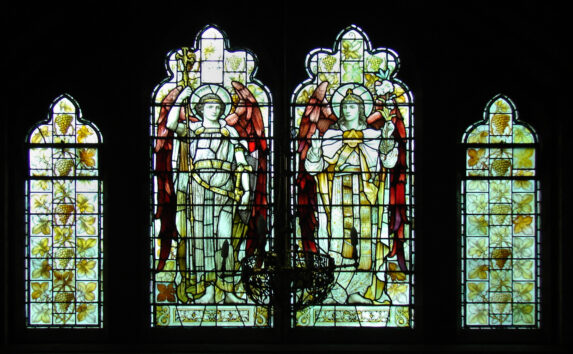
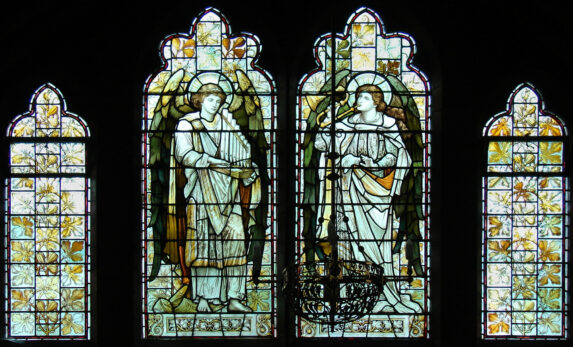
The clerestory windowsArtist, maker and date
Designed by Walter J Pearce of the Northern Art Workers Guild and made by Heaton, Butler and Bayne c.1897Reason for highlighting
It is conventional to be a bit sniffy about Heaton, Butler and Bayne. They were prolific and often pedestrian. They were successful and ubiquitous, which gives the sense that they were a heartless production line delivering predictable correctness for people with money but no imagination. But at Hale there is something else going on. The designing genius was – reportedly at least – Walter Pearce. The entire conception of this extensive set of windows is not ecclesiastical, and certainly not pedagogic or instructive, but theatrical, even operatic. If Edwardian glass has a character different from Victorian, and not quite somehow yet Arts & Crafts, it is something to do with Henry James’s Golden Age – money, glitz and glamour. These angels are not welcoming and warm, like Burne-Jones’s, or fey, like Henry Holiday’s – they are grand, aristocratic, exalted. And, being high above our heads, we cannot but look up and be a little dazzled.
Artist/maker notes
Walter J. Pearce (1856-1942) was orphaned at 10, and apprenticed to a painter and decorator in Somerset at 14, worked in his twenties at a church furnishers, Cox, Sons, Buckley & Co., who by 1862 had a stained glass works in Covent Garden, where it is thought Pearce trained. He moved to Manchester around 1890: by 1899 he was described as ‘Stained Glass Artist’.
He was a founder member of the Northern Art Workers Guild (NAWG) (1896-1912) alongside Edgar Wood, architect of Middleton Methodist church (which also has interesting glass, albeit on a small scale). From 1898 to 1917 Pearce taught in the Painting and Decorating Department of Manchester Municipal School of Art, latterly becoming its Head. He published two books: Stencils and Stencilling (1895) and Painting and Decorating (1898), which ran to seven editions. Pearce was Master of the NAWG in 1903. He was a Fellow of the British Society of Master Glass Painters. There is a complete scheme of elaborate flower windows by Pearce at Didsbury URC church.
Other comments
There is Aestheticism on every hand – the massy chandeliers might be from a Rhode Island ballroom; the altar has panels of greenery-yallery lilies; the lectern is not an eagle, but a lissom angel. The choir stalls are smart and crisp.
The Great War Memorial Baptistery is another unexpected stroke – rich marble and a glittering glass mosaic designed by Pearce (he patented a method for applying gold leaf to the back of the glass tesserae to give extra sparkle), with battle honours, and Christ walking on the waters to save a drowning sailor in a neat suit, all painted by Pearce.