
Church of St Philip, Leicester
Address
Church of St Philip, 2A Stoughton Drive North, Leicester, LE5 5UBOverview
The window highlighted here is one of 10 selected by Sarah Lear, as part of a special Theme dedicated to the work of Karl Parson.
A full list of the windows chosen Sarah can be found by following the link above, where you will also find a paper by Sarah introducing the artist. Details of all the windows selected by both Sarah and other contributors can be found on Karl Parsons’ artist page.
Highlight
East windowArtist, maker and date
Designed by Karl Parsons and made at Lowndes & Drury, 1921Reason for highlighting
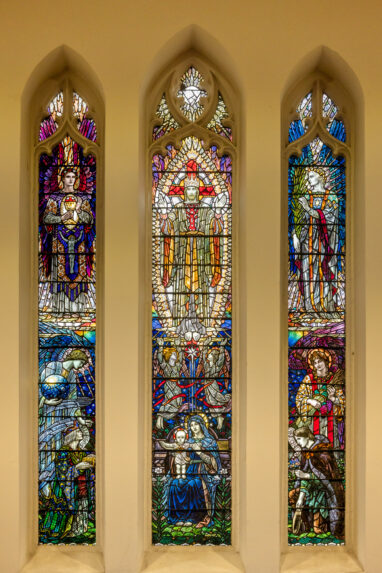
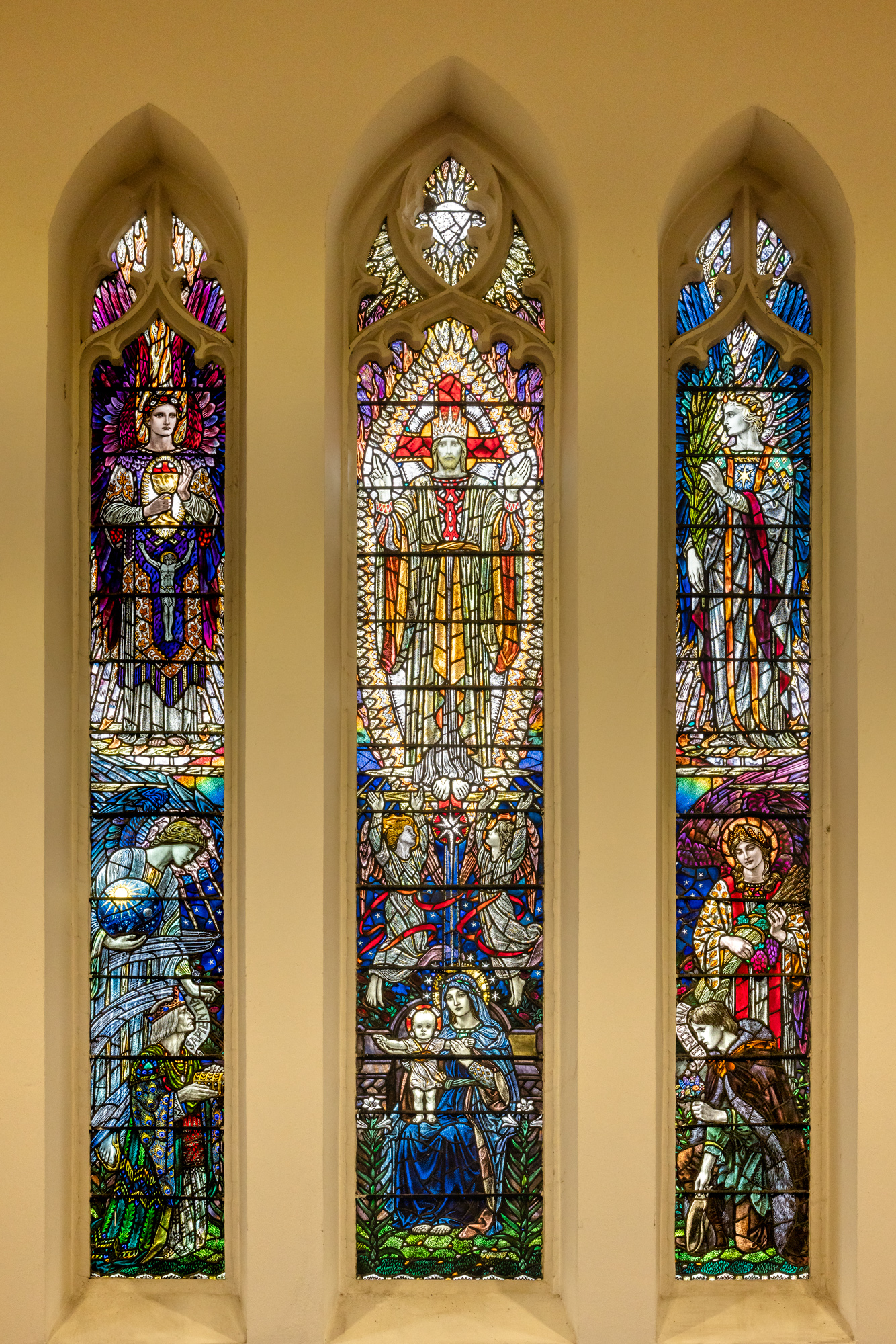
We have notes from Parsons himself on this window and as one reads, not only does one understand his iconography, but we also get a real sense of his spirituality.
“The Nativity group, below the dancing Angels, contains nothing but the simplest of thoughts. It has only to be remembered, here as elsewhere, that the treatment is purely symbolic; that no attempt has been made at the literal representation of an historic scene. I have not thought of it as something which happened once, long ago; but as something that is; as an aspect of eternal truth.
The lilies and roses, and the stars round the virgin’s head are well known traditional emblems. They have all an obvious significance – that of the perfect beauty of stars and flowers; and an obvious appropriateness side by side with the supreme manifestation of the spirit of beauty. Like so many other symbols, however, their meaning unfolds and deepens under contemplation. These, too, are paths.
The Shepherd-boy (Innocentia), on the right, stands for humanity’s direct approach to God through the Earth which is His. He is told in unmistakable terms: “Unto you a Child is born.” His is the way of Nature and the Heart; of humility and simplicity, easy and unquestioning. My Shepherd brings a nosegay of wild flowers and wears a red-brown cloak coma in colour like fertile earth, the grey fur lining of which might be thought of as the skin of some wolf killed in the act of ravening the fold.
The Angel of Earth, bearing corn and grapes – the physical elements of the Sacrament – smiles down on him. She is that patient, tranquil Spirit, unhurried and unfailing coma who rewards the peaceful labours of agriculture, and who, in a season, re-clothes in serene beauty the most hideous battleground. She wears the red stole, representing, in herself, eternal service, and, to us, that:
“All service ranks the same with God.”
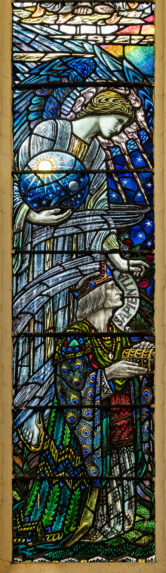
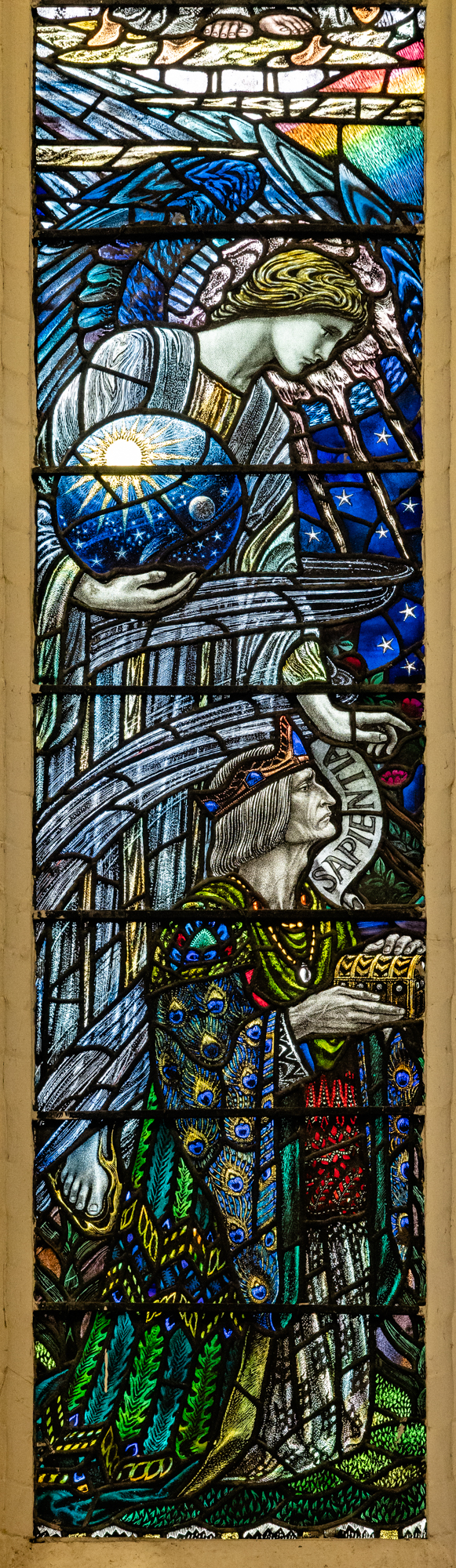
The King (Sapientia), on the left, is imagined here as a type of those who pursue the devious and difficult road of the Head, the Intellect, Science, Learning, etc. He receives no direct revelation. A rumour, a strange star – these are his guides. But Reason’s torch can help him only to the gates of Mystery. There it expires, and he must make a voluntary self-surrender and become as a little child before he can proceed further. Then, when the Light comes, it is from above, and not from within himself through his pride of intellect. The Angel of the Heavens, bearing the Universe, is pointing the way. The down-raying halo is his illumination. I have kept the colour of this panel cold in comparison with its opposite. This, the sheathing vapour and other details support the general ideas outlined above.
The Rainbow is the sign of Divine clemency overarching the visible Presence of Peace on Earth. Its seven prismatic colours are manifestation of everlasting Truth tempered to our human understanding. In the window it stretches throughout the three lights – a bright arch of which the golden figure of Christ, the Source of Light, is the keystone. It is my hope that this luminous Figure will dominate the whole design.
Left and right stand Angel Figures symbolising Love and Victory respectively. Love holds the Chalice and His vesture is embroidered with the Crucifix and Vine. He is rose-crowned and flame-haloed.
Victory bears the Palm of triumph, gilded, as it were, by the Central Glory.
The topmost tracery openings are filled by a symbol of the Trinity.”
Source: Parsons, Karl, Unpublished letter
Artist/maker notes
Karl Parsons (1884-1934) was born in Peckham, South London, and grew up in a Christian household. His sister, the garden painter Beatrice Parsons, was involved in apprenticing him to the leading Arts and Crafts master craftsman, Christopher Whall. Parsons learnt much from Whall, working on the incredible Gloucester cathedral Lady Chapel windows, following his master’s footsteps to teaching at the Central school of Arts & Crafts and providing the illustrations for Whall’s famous text Stained Glass Work in 1905.
They began to disagree on Whall’s commission for Johannesburg cathedral and Parsons established his own studio at Lowndes and Drury’s Glass House in 1908. His first commissions for St. Alban’s, Hindhead are impressive and although he never achieved the fame and success of Whall, his creative iconographic work is peppered with signature motifs – such as flames, animals, children and plaited hair – and there is much use of lavish deeply coloured tones of superb quality Norman slab glass. These combine to make spectacular windows and he was able to capture light and movement in an idiosyncratic manner. After learning his trade and gaining experience in a superb workshop, Parsons came into his own by advancing Whall’s beautiful work with his own subtle twists to create stunning Arts and Crafts windows.
Sources:
Cormack, Peter, Arts & Crafts Stained Glass (Yale University Press, 2015)
Cormack, Peter, Karl Parsons 1884-1934, exhibition catalogue (London: William Morris Gallery, 1987)
Lowndes & Drury was formed in 1897, by the artist Mary Lowndes (1857-1929) and the craftsman Alfred John Drury (1868-1940), with the aim of providing facilities for independent artists to design and make stained glass windows. They moved from cramped conditions in Chelsea to newly purpose-built premises, The Glass House, Fulham in 1906. The firm continued after the founders’ deaths, under Alfred Drury’s son, Victor, until he retired in the early 1970s. However, The Glass House premises continued in use under Carl Edwards and subsequently his daughter, Caroline Benyon, until she moved her studio to Hampton in 1992.
Source: The Journal of Stained Glass, Vol. XLI, 2017
Other comments
The only other stained glass in the church is in a light box opposite the east wall and was cartooned by Harry Stammers for Powells, 1938.