


The Chapel, Harris Manchester College, Oxford
Address
The Chapel, Harris Manchester College, Mansfield Road, Oxford OX1 3TDRecommended by
Highlight
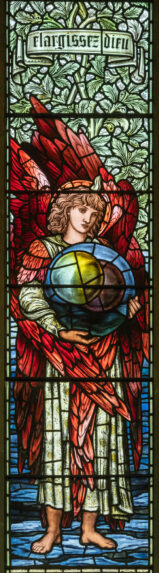
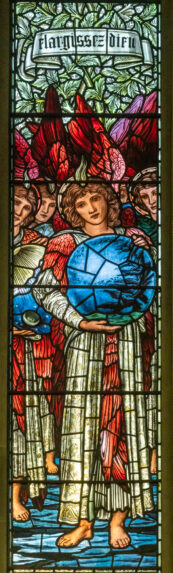
The Six Days of Creation windows in the liturgical south wallArtist, maker and date
Designed by Edward Burne-Jones and made by Morris & Co. Ltd, 1896Reason for highlighting
Burne-Jones window schemes work best when in large numbers – as at Brampton. Here, in the intimate setting of an Oxford college chapel, they cluster and overwhelm. Their completeness and intensity demand attention.
The six Creation windows show angels carrying the Earth on each succeeding day, with the previous days’ angels gathered behind. The angels are supposedly modelled on May Morris.
Artist/maker notes
Sir Edward Coley Burne-Jones (1833-98) was born in Birmingham and studied at Exeter College, Oxford where he met William Morris, with whom he developed a lifelong friendship. Together they created hundreds of stained glass windows that collectively stand as one of the finest artistic achievements of their time. The stature of this formidable artist and designer was recognised after his death when he became the first artist to be given a Memorial Service at Westminster Abbey.
Morris & Co. (1875-1940) was the successor to original business of Morris, Marshall, Faulkner & Co. Morris was always the driving force behind the ‘Firm’, and the change of name reflected his taking the business fully under his personal control, without partners, and with Burne-Jones as principal designer. The business continued after Morris’s death, and continued to use Burne-Jones designs right up until it finally closed in 1940.
Sources:
For a brief overview of the two companies see Morris & Co on Wikipedia
The Last Pre-Raphaelite: Edward Burne-Jones and the Victorian Imagination by Fiona McCarthy, Faber & Faber, 2011.
William Morris: A Life for Our Time by Fiona MacCarthy (Faber & Faber, 1994)
Burne-Jones Special Issue, The Journal of Stained Glass, Vol. XXXV, 2011
Damozels & Deities Pre-Raphaelite Stained Glass 1870-1898 by William Waters and Alastair Carew-Cox (Seraphim Press Ltd, 2017)
Other comments
The iconography of the Chapel is assertively Unitarian – no Holy Ghost; no Annunciation (too miraculous); the Virgin Mary labelled ‘Mary the Mother’. And a quote from The Rime of the Ancient Mariner by Coleridge, at that time a Unitarian preacher, in the fourth light of the above window.
The design for the Days of Creation windows first appeared in six paintings by Burne-Jones at the Grosvenor Gallery in 1877 – an exhibition which established Burne-Jones’s artistic national pre-eminence. In much reduced form they can also be seen in the tracery of the west window at All Saints, Middleton Cheney, and the tracery of the east window of the north chapel at the Church of St Editha, Tamworth.
All the other windows in the Chapel were designed by Burne-Jones, with the exception of the figures of St Joseph and Mary Magdalen in the east window, which were designed by William Morris.
While most of the windows re-use earlier designs, the liturgical west window contains 3 figures designed specifically for the chapel in early 1896. These are the figures in the middle 3 lights, representing the College’s motto: Truth, Liberty & Religion.
The chapel (1891-3) was designed by Thomas Worthington, Manchester Unitarians’ then first choice architect. (The originally Presbyterian college moved from Manchester to Oxford in 1889.)
There is also a scheme of eccentric and exotic bench ends (1897), almost excessively naturalistic, by Pearson and Brown of Eccles.