
Old Saint Paul’s Episcopal Church , Edinburgh
Address
Old Saint Paul's Episcopal Church, 63 Jeffrey Street, Edinburgh, EH1 1DHOverview
The window highlighted here is one of 10 selected by Sarah Lear, as part of a special Theme dedicated to the work of Karl Parson.
A full list of the windows chosen Sarah can be found by following the link above, where you will also find a paper by Sarah introducing the artist. Details of all the windows selected by both Sarah and other contributors can be found on Karl Parsons’ artist page.
Highlight
North aisle window of the Lady ChapelArtist, maker and date
Designed by Karl Parsons and made at Lowndes & Drury, 1913Reason for highlighting
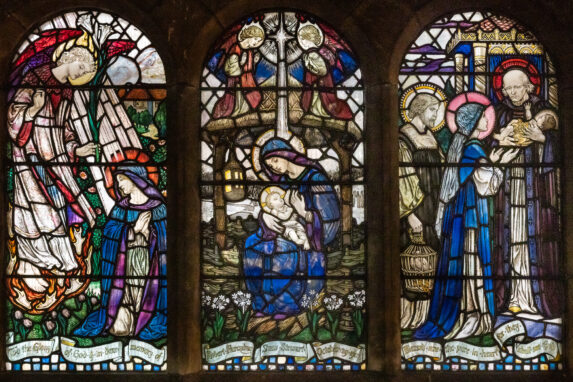
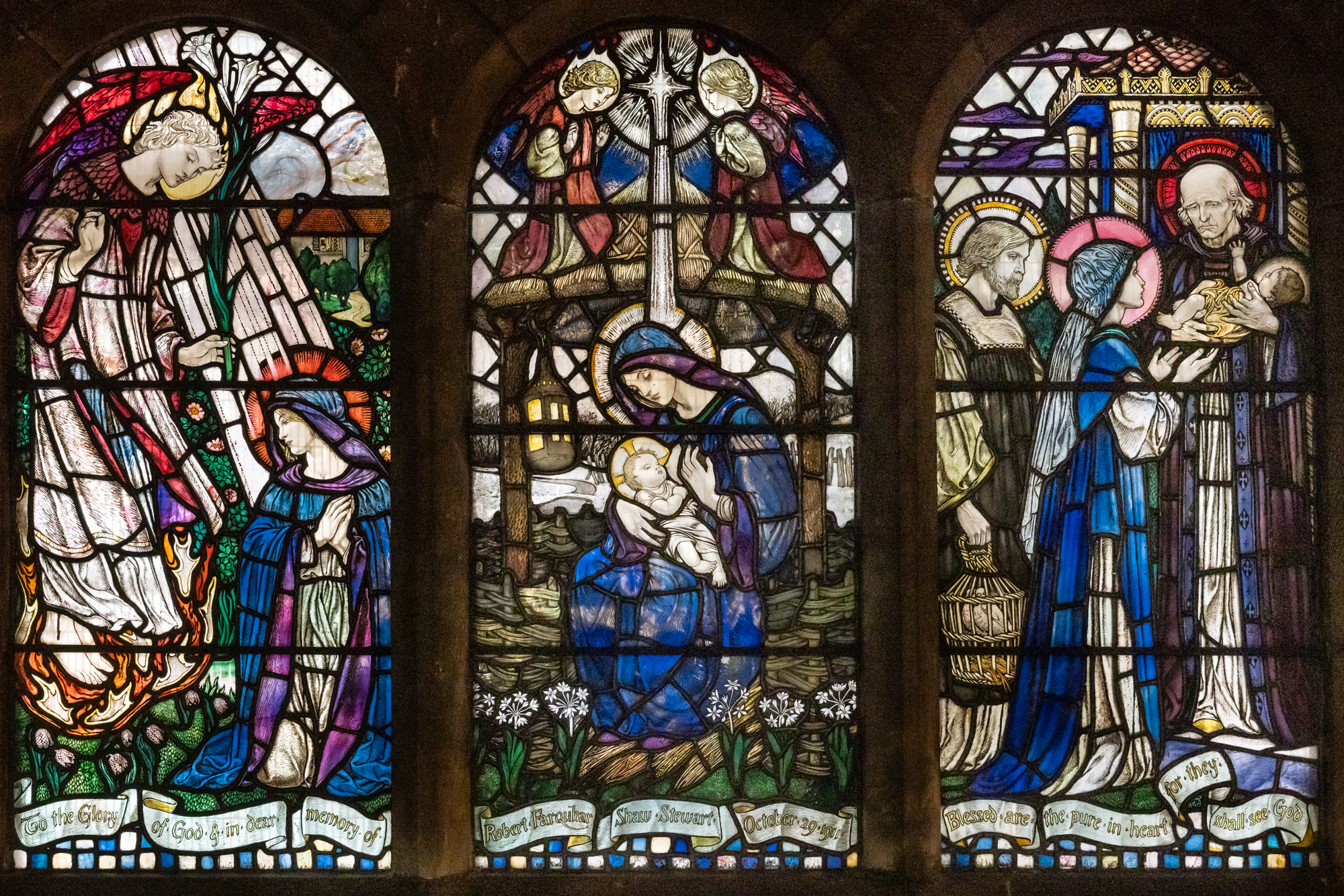
Parsons honours the Virgin with three scenes from her life; the Annunciation, the Nativity and the Presentation at the Temple. Mary, clad in stunning sapphire and purple robes, with varying halo tone, is the picture of the perfect mother. In all three scenes, Parsons uses the rich colour of the blues, reds and purples to provide continuity across the window in wings, feet, robes, haloes and clouds, balancing colours and designs. The repeated use of his chequerboard tiny quarries also links the scenes. This makes all the more obvious the contrast with the clever use of white glazing demonstrating the divine power of the Holy Spirit. Gabriel’s glimmering gown links him with this power and his flaming feet reinforce this angelic nature. A composed Joseph takes his traditional secondary position and he bears a cage with the usual doves. The floral elements are exquisite and can be identified as Fritillaria melagris and dog roses in the first light and the Star of Bethlehem in the second.
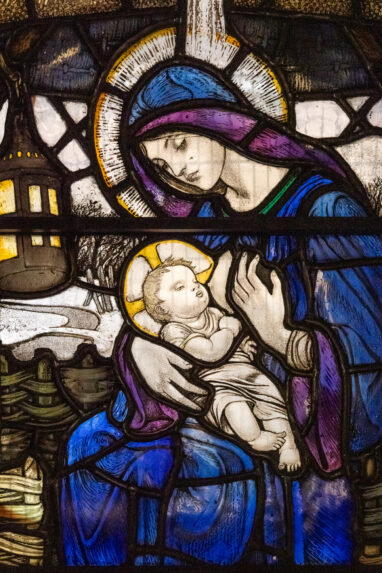
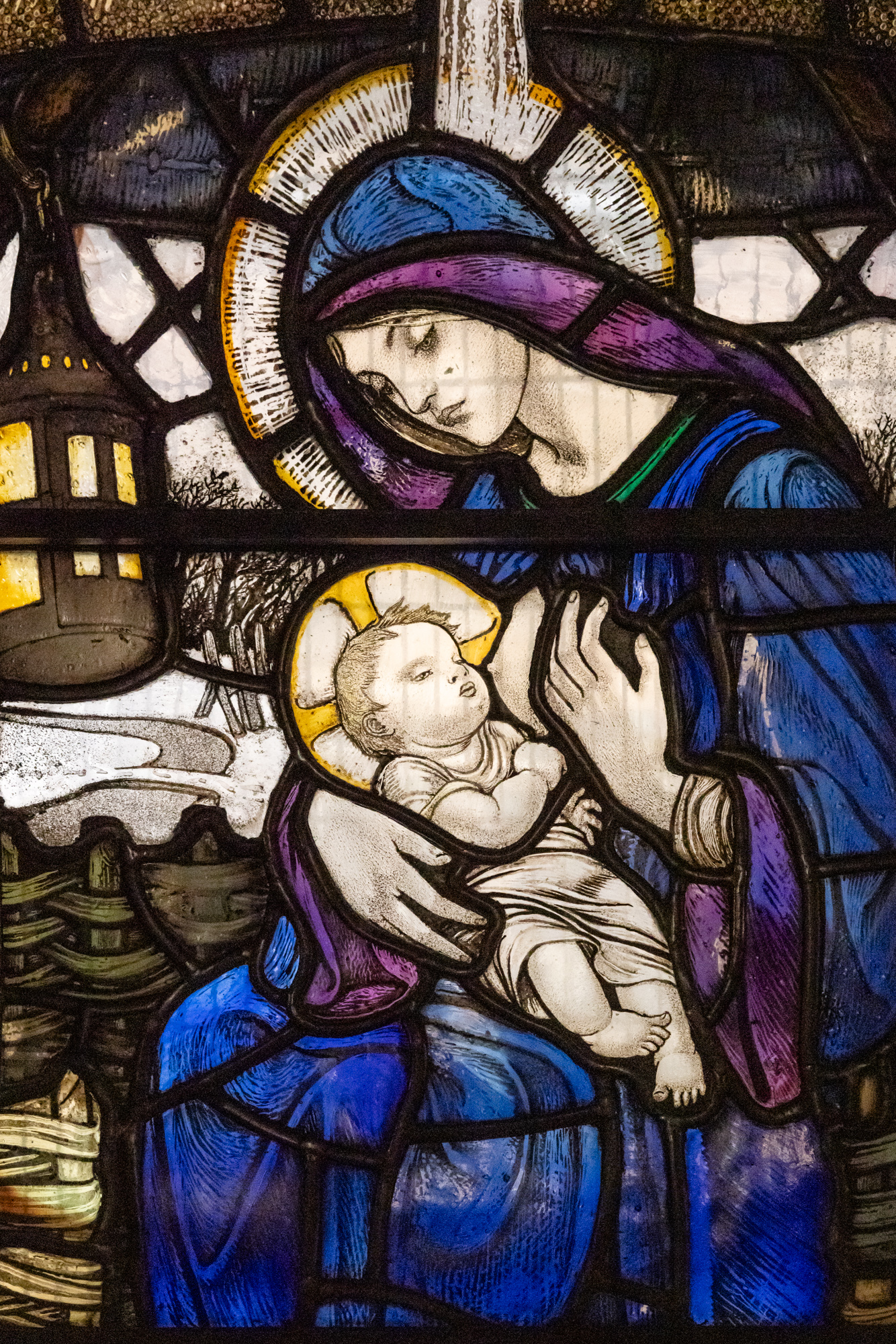
The most unusual feature for glass in this period is to see the Virgin nursing. The iconography of the Madonna Lactans was common in Medieval and early Renaissance times but it is very unusual in the religiously conservative medium of Edwardian glass. This was a bold move by Parsons. He repeated the scene in the church of St. John the Baptist, now decommissioned and used as a residential home in Rudmore, Portsmouth in 1916. In both scenes, we see Mary in profile with Christ, on her lap, who is about to suckle. Although the composition is almost identical, with the stable scene and Star of Bethlehem, the cartoon was not repeated exactly in Portsmouth. Supported by the thatch are a pair of child angels with the star shining onto the Virgin’s head. Mary’s left hand reaches to her gown to reveal her right breast. Although the iconography has a clear theological and devotional history, this had fallen away over a century before Parsons. The lactating Virgin is not referenced in Anna Jameson’s Legends of the Madonna nor is it mentioned in the index of Sewter’s catalogue of Morris & Co’s stained glass which were standard iconographical sources of the time. Both windows were made before Parsons took his Chartres trip in July 1924 which could have been another inspirational possibility.
It could have been simply that the birth of his two daughters, in 1908 and 1911, crystalised this idea in his head and he observed the theological insights that could be evoked. Perhaps this mother Mary, whom Parsons chose to depict, stems from his own lived experience, awareness of maternity or influential reading? As yet, we can only ponder this image and wonder.
Artist/maker notes
Karl Parsons (1884-1934) was born in Peckham, South London, and grew up in a Christian household. His sister, the garden painter Beatrice Parsons, was involved in apprenticing him to the leading Arts and Crafts master craftsman, Christopher Whall. Parsons learnt much from Whall, working on the incredible Gloucester cathedral Lady Chapel windows, following his master’s footsteps to teaching at the Central school of Arts & Crafts and providing the illustrations for Whall’s famous text Stained Glass Work in 1905.
They began to disagree on Whall’s commission for Johannesburg cathedral and Parsons established his own studio at Lowndes and Drury’s Glass House in 1908. His first commissions for St. Alban’s, Hindhead are impressive and although he never achieved the fame and success of Whall, his creative iconographic work is peppered with signature motifs – such as flames, animals, children and plaited hair – and there is much use of lavish deeply coloured tones of superb quality Norman slab glass. These combine to make spectacular windows and he was able to capture light and movement in an idiosyncratic manner. After learning his trade and gaining experience in a superb workshop, Parsons came into his own by advancing Whall’s beautiful work with his own subtle twists to create stunning Arts and Crafts windows.
Sources:
Cormack, Peter, Arts & Crafts Stained Glass (Yale University Press, 2015)
Cormack, Peter, Karl Parsons 1884-1934, exhibition catalogue (London: William Morris Gallery, 1987)
Lowndes & Drury was formed in 1897, by the artist Mary Lowndes (1857-1929) and the craftsman Alfred John Drury (1868-1940), with the aim of providing facilities for independent artists to design and make stained glass windows. They moved from cramped conditions in Chelsea to newly purpose-built premises, The Glass House, Fulham in 1906. The firm continued after the founders’ deaths, under Alfred Drury’s son, Victor, until he retired in the early 1970s. However, The Glass House premises continued in use under Carl Edwards and subsequently his daughter, Caroline Benyon, until she moved her studio to Hampton in 1992.
Source: The Journal of Stained Glass, Vol. XLI, 2017
Other comments
The church website has a useful guide to the church including details of the other stained glass windows, which can be accessed here. Of particular note are two windows by Herbert Hendrie, 1934, at the top of the Calvary Stair, which have the advantage of being able to be seen at close quarters.