


St Andrew's United Reformed Church, Frognal, Hampstead, London NW3
Address
St Andrew’s United Reformed Church, 107 Frognal Lane, London NW3 7DYRecommended by
Highlight
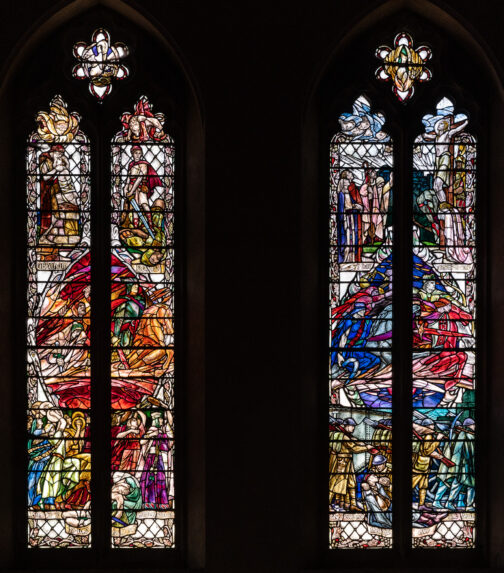
The Sacrifice window, north wall of the north transeptArtist, maker and date
Douglas Strachan, 1922Reason for highlighting
Strachan had windows in five buildings in London. All but one of them were destroyed in the Blitz. What’s left is at St Andrew’s URC, where eight windows glow.
A pair of large lancets in the north transept, filled with figures and bustling energy – The Sacrifice window – are dedicated as a War memorial.
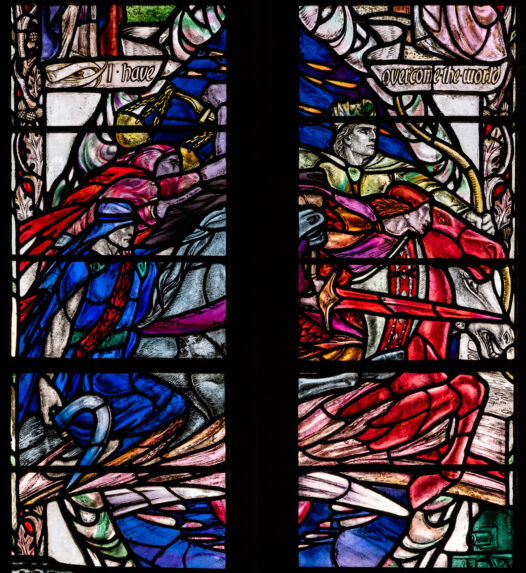
Strachan’s windows are unexpectedly bellicose. The upper lights show examples of biblical sacrifice, culminating in Calvary: “I have overcome the world”. But the lower scenes are vigorous and triumphally pugnacious: “Sing ye to the Lord for he hath triumphed gloriously”.
Yes, the wounded appear at the bottom of both windows, but above them figures march resolutely off to our right – sappers and dancers, with plunging caparisoned chargers above. Not quite the sombre spirit of the Cenotaph.
Artist/maker notes
Robert Douglas Strachan (1875-1950) was born in Aberdeen and initially trained as an artist. Indeed Strachan admitted later in life that he had been slow to realise that stained glass would be the best outlet for his artistic vision. It was a vision that enabled him to become the foremost British stained glass artist of the generation after Christopher Whall. From 1909 to 1911 he was head of the Crafts Section at the recently founded Edinburgh College of Art, before handing over to his brother, Alexander, through pressure of work. His windows are found throughout Scotland and England, and are recognisable for their bold use of colour, and strong sculptural design and use of lead. Overseas he is renowned for his windows at the Peace Palace in The Hague, The Netherlands.
Sources:
In Praise of Douglas Strachan by Peter Cormack, Journal of Stained Glass, Vol. XXX, 2006
Arts & Crafts Stained Glass by Peter Cormack (Yale University Press for The Paul Mellon Centre for Studies in British Art, 2015)
ECA Glass Alumni Exhibition Catalogue
Other comments
The other windows by Strachan are in the clerestory, two from 1923 in the south clerestory and four from 1935 in the north clerestory.
After Strachan, the most prolific artist here was Henry James Salisbury, who made eight windows for the church between 1906 and 1923, including the large west window.
There is also a lovely, small, intimate window by Margaret Chilton, in the north aisle, portraying an angel (what looks like two halos is a stylised river), strumming a harp (or lute), and with multi-coloured wings enfolding a diving kingfisher, singing finches, lambs, oak twigs, white roses, poppies, and a diminutive figure who may be Harvest or Fecundity. In the border, bells and organ pipes. The window can be seen here.
The text is verse 6 of Psalm 150, the Benedicite, a canticle which seems especially to have resonated with Arts & Crafts makers, with its all-embracing inclusiveness, exaltation of the natural world, and starry-eyed optimism. (e.g. the sgraffiti by Heywood Sumner at St Mary, Llanfair Kilgeddin, Monmouthshire; Henry Holiday’s windows at All Saints, Stamford, Lincolnshire; and the choir stalls by Henry Wilson at Welbeck Abbey, Nottinghamshire.) In its spirit of ecstatic, celebratory praise, the window is a controlled riot of exuberant life, seemingly spontaneous and even improvisational, but – of course – disciplined and restrained.