
Church of St Peter upon Cornhill, London EC3
Address
Church of St Peter upon Cornhill, Cornhill, London EC3V 3PDRecommended by
Highlight
A pair of north nave memorial windowsArtist, maker and date
Designed by Hugh Easton and made by Hendra & Harper, 1960Reason for highlighting
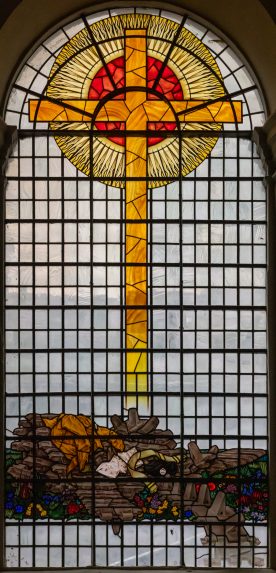
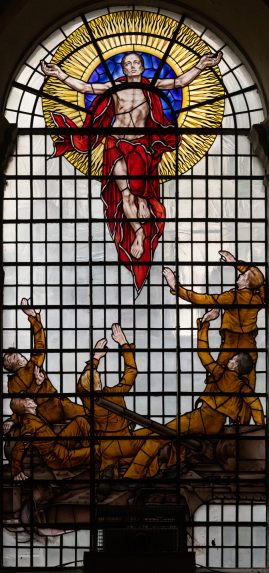
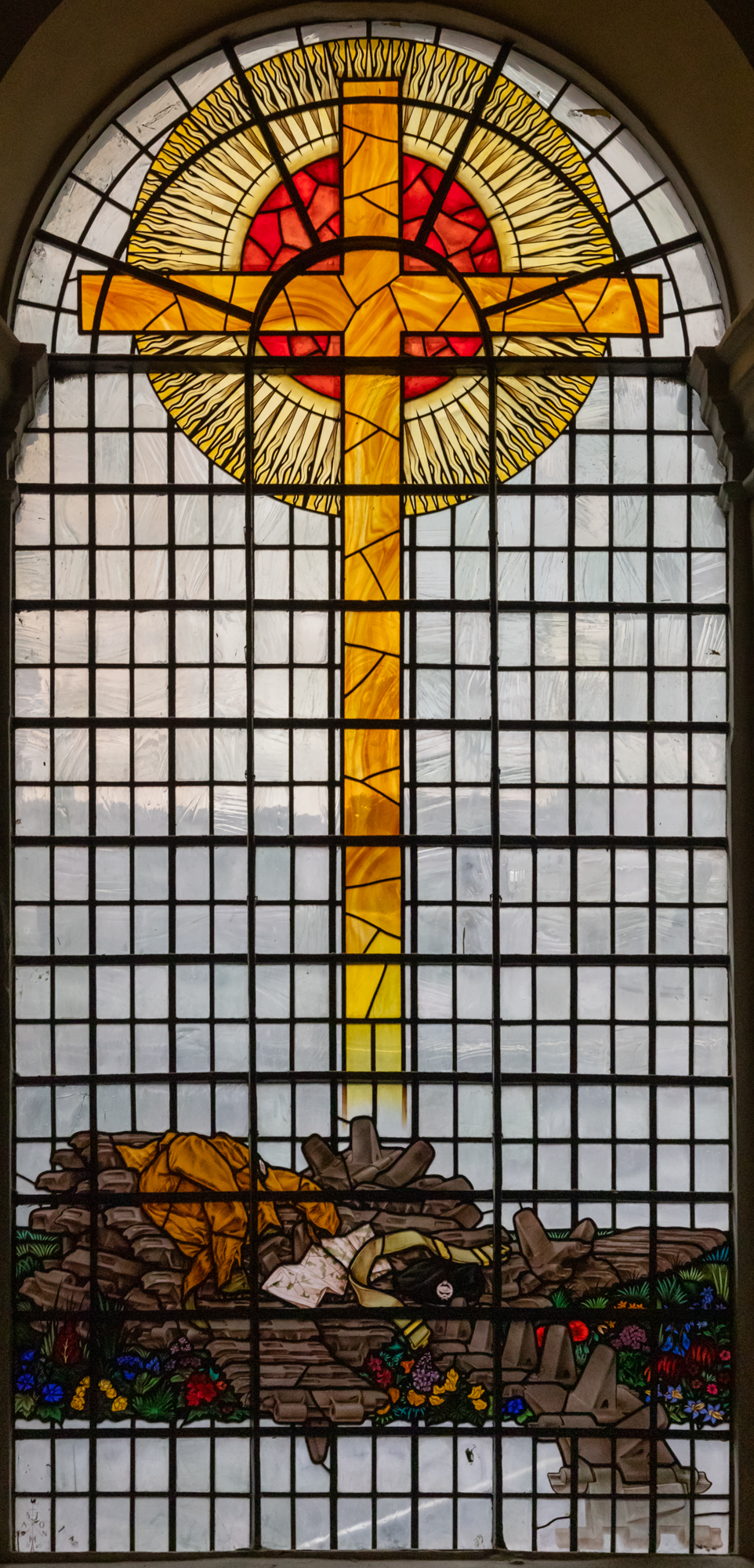
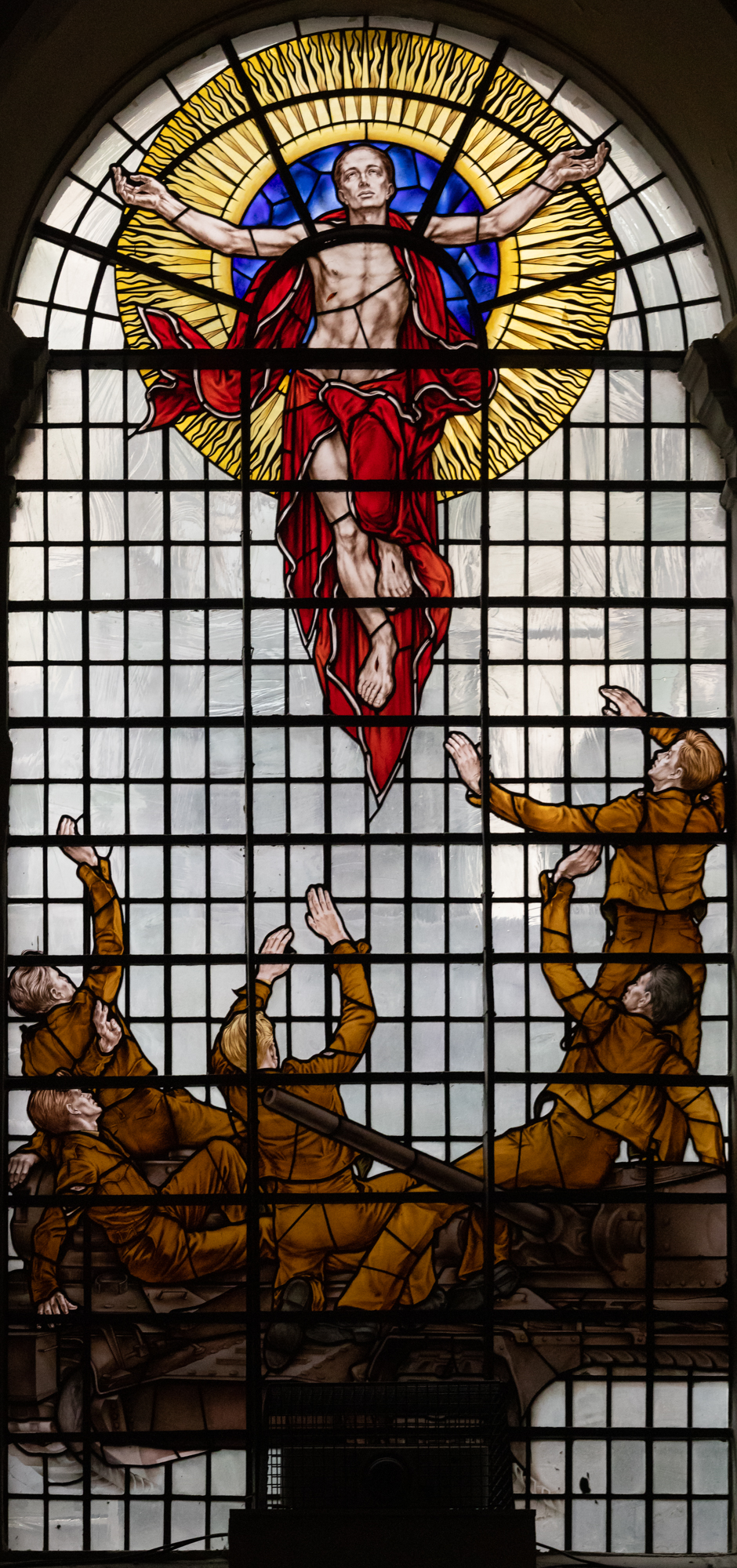
These are powerful memorial windows commemorating the fallen of the Royal Tank Regiment, this being the Regimental church between 1954 and 2007.
In the north aisle of the nave, at the foot of a single cross blazing with golden light we discover tank traps, an abandoned map and uniform of the regiment including its signature black beret with silver badge. A poignant reminder of the casualties of war.
In the companion window to the east uniformed soldiers standing upon a tank are shielding their eyes witnessing either the Ascension or the Resurrection. This striking mix of everyday realism with the sacred would have been felt by some at the time as shocking or incongruous within a place of worship.
Artist/maker notes
Hugh Ray Easton (1906-65) was born in London and trained in Guildford with Ninian Comper’s former pupil, W. H. Randoll Blacking.
In the early 1930’s he established his first studio in Cambridge, with his windows being made until 1935 by the local firm of W.H. Constable & Co. However, he soon discovered that if he found “an artist who could paint and interpret one’s drawings, a far greater technical mastery was achieved.” This ultimately led to all his design’s being realised by Hendra and Harper.
“Stylistically Easton’s work derives from Sir Ninian Comper and his pupil Christopher Webb with whom Easton was on ‘weekly visiting’ terms at Webb’s Orchard House Studio in St Albans.”
Source: Hugh Easton by Caroline Swash, 2004 – Oxford Dictionary of National Biography
Hendra & Harper is most closely associated with the work of Hugh Easton, producing all his greatest windows, including his famous Battle of Britain window in Westminster Abbey.
The two partners, Robert Leslie Hendra (1912-1968) and Geoffrey Felix Harper (1913-66) first met in at Easton’s London studio. Hendra had trained with Martin Travers and started working for Easton in the early 1930s. While Harper joined later in 1935 following his initial training in stained glass at John Hardman &Co.
Following the war, and with encouragement from Easton, they formed a partnership with a studio in Harpenden, making all Easton’s windows along with the partners’ own stained glass, engraved glass, painted ceilings, and murals.
Source: A Life in Glass – Portrait of a Stained Glass Artist – The life and work of Geoffrey Felix Harper by Francesca Stevens (2018)
Other comments
The above windows are echoed on the south side of the nave by two windows from the Nicholson Studio. To the east is a dramatic Christ in Majesty above soldiers in old and new uniforms of 1951, designed by G E R Smith, and to the west a Gunner down on one knee dominates a window of 1960, designed by Margaret Florence Pawle.
The east windows in a very different idiom are on the life of Christ by Charles A Gibbs, 1872.