


Carmelite Shrine of St Jude, Faversham, Kent
Address
Carmelite Shrine of St Jude, Tanners Street, Faversham, Kent ME13 7JWRecommended by
Highlight
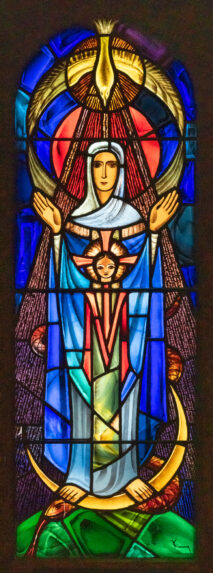
Untitled window of Mary and the Christ Child with the Holy Spirit or the Immaculate ConceptionArtist, maker and date
Richard King, made at his own studio, 1954–7Reason for highlighting
In the years 1954 to 1957 Richard King created a series of windows for the Shrine of St Jude, and between them they show a certain evolution in his style. This window, possibly one of the earlier ones, demonstrates King’s strong design sensibility with the composition composed of a series of prominent circles, arcs and diagonal lines. Unusually, King did not provide a title so his biographer, Ruth Sheehy, has named it ‘Untitled window of Mary and the Christ Child with the Holy Spirit or the Immaculate Conception’ which reflects the unconventional iconography combining symbolism of the incarnation and redemption with the Immaculate Conception. Centrally located in the window is the large ‘M’ for Mary integrated with the red cross which forms part of the infant Christ’s halo, a reminder that King maintained a parallel career as a successful graphic artist.
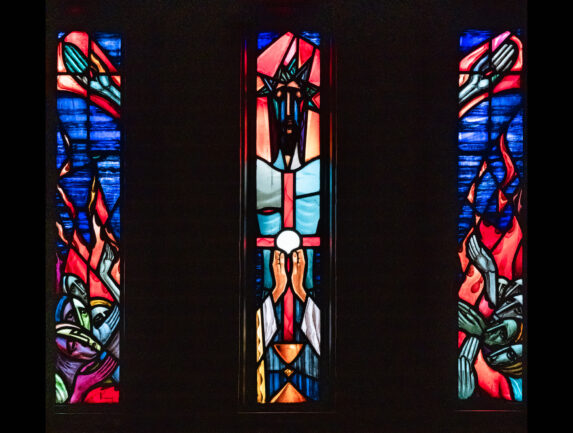
Among King’s other windows at the shrine worth singling out, and one that is totally different in terms of mood, technique and style, is his expressionistic 3-light, The Crucifixion with Priest Celebrating the Eucharist and Souls in Purgatory on Either Side.
Artist/maker notes
Arguably Richard King (1907–1974) had not one but two distinct stained glass careers, separated by a decade-long sabbatical from the craft. In 1928 Harry Clarke invited him to join his studio where he would learn the craft. Despite Clarke’s ongoing struggle with tuberculosis, King was a ready student and quickly learned how to work in the easily recognisable style of his master. After Clarke’s untimely death three years later much of the responsibility fell on King’s shoulders, and those of his friend, William Dowling; together they diligently maintained the classic Clarke style while also slowly modifying it, almost imperceptibly, to contemporary tastes. When the position of manager became vacant in 1935 Richard King took the helm and for the next five years, continued to design and oversee many major commissions but left in 1940, perhaps finding the continued pressure to maintain the Clarke legacy too stultifying.
By the late 1940s King was ready to return to stained glass, though this time on his own terms and he built a studio in his back garden in County Dublin. Although one can discern vestiges of Harry Clarke’s distinctive style, what King seems to have mainly carried forward from his period at Clarke’s was his deep knowledge of religious iconography. King’s new aesthetic was mainly informed by modernism, and although he rarely travelled abroad, for inspiration he looked to German and French artists such as Georges Rouault, and later, Alfred Manessier, Gabriel Loire, Anton Wendling and Georg Meistermann.
Sources:
Ruth Sheehy, The Life and Work of Richard King: Religion, Nationalism and Modernism (Reimagining Ireland series), (Peter Lang, 2020)
Ruth Sheehy’s biographical note on King in the Gazetteer of Irish Stained Glass (Irish Academic Press, 2021)
Other comments
There is a total of nine windows by Richard King in the Shrine of St Jude: Our Lady of Mount Carmel (3-lights. Window severely damaged in a fire of 2004 and recreated in 2005); The Crucifixion with priest celebrating the Eucharist and souls in Purgatory on either side (3 lights); and the following single-lights
Untitled window of Mary and the Christ Child with the Holy Spirit or the Immaculate Conception; God the Father; The Resurrection of Christ; St Brocard; St Simon Stock; The Prophet Eliseus (or Elisha); The Prophet Elias (or Elijah). All windows designed and painted by King between 1954 and 1957 in his studio, Dalkey, County Dublin.