King, Richard
Arguably Richard King (1907–1974) had not one but two distinct stained glass careers, separated by a decade-long sabbatical from the craft. In 1928 Harry Clarke invited him to join his studio where he would learn the craft. Despite Clarke’s ongoing struggle with tuberculosis, King was a ready student and quickly learned how to work in the easily recognisable style of his master. After Clarke’s untimely death three years later much of the responsibility fell on King’s shoulders, and those of his friend, William Dowling; together they diligently maintained the classic Clarke style while also slowly modifying it, almost imperceptibly, to contemporary tastes. When the position of manager became vacant in 1935 Richard King took the helm and for the next five years, continued to design and oversee many major commissions but left in 1940, perhaps finding the continued pressure to maintain the Clarke legacy too stultifying.
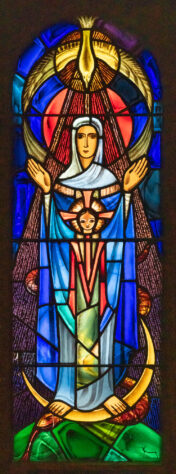
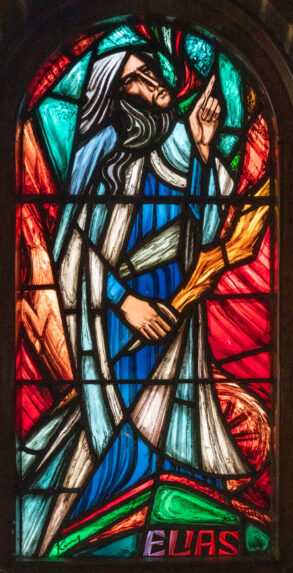
By the late 1940s King was ready to return to stained glass, though this time on his own terms and he built a studio in his back garden in County Dublin. Although one can discern vestiges of Harry Clarke’s distinctive style, what King seems to have mainly carried forward from his period at Clarke’s was his deep knowledge of religious iconography. King’s new aesthetic was mainly informed by modernism, and although he rarely travelled abroad, for inspiration he looked to German and French artists such as Georges Rouault, and later, Alfred Manessier, Gabriel Loire, Anton Wendling and Georg Meistermann.
Sources:
Ruth Sheehy, The Life and Work of Richard King: Religion, Nationalism and Modernism (Reimagining Ireland series), (Peter Lang, 2020)
Ruth Sheehy’s biographical note on King in the Gazetteer of Irish Stained Glass (Irish Academic Press, 2021)