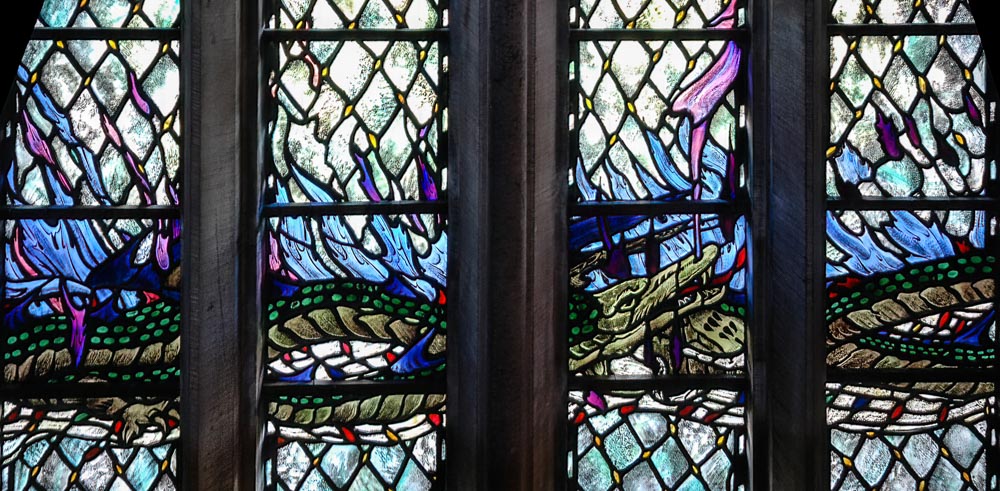
Davis, Louis
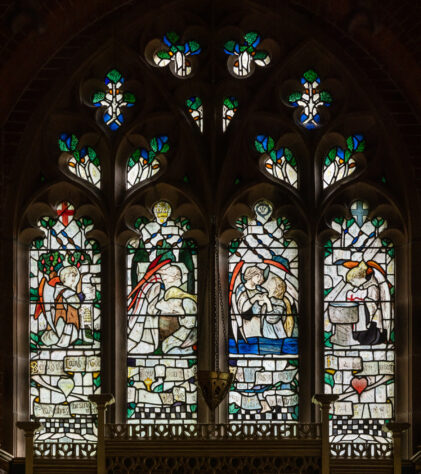
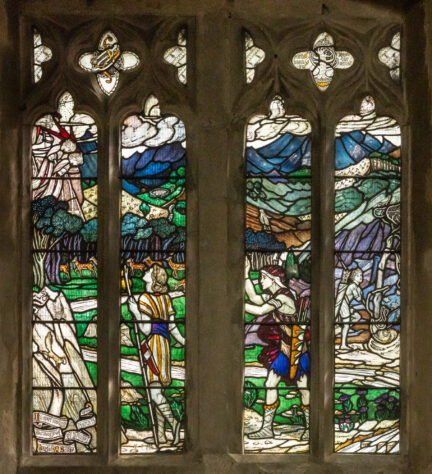
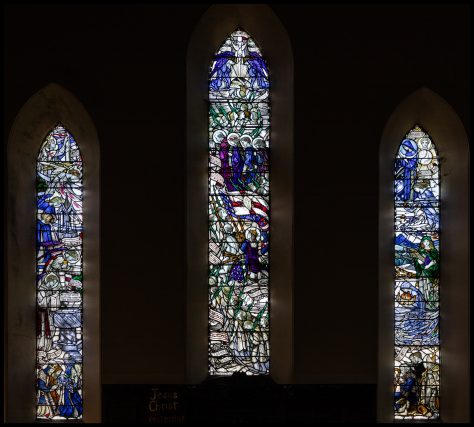
Louis Davis (1860-1941) was an English watercolourist, book illustrator and stained-glass artist. As Cormack notes, “Amongst English artists of the Arts and Crafts progressive school of stained glass, only Louis Davis approached Christopher Whall’s pre-eminent position.”
Davis was born and raised in Abingdon, where his artistic talent was recognised by the local school. His early career involved watercolours and book illustrations, but he was increasingly drawn to stained glass and by 1891 he had become one of Christopher Whall’s first students. Lodging and working with Whall in Dorking led to a firm friendship, reflected in one of Whall’s children being named Louis.
In 1893 Davis moved to Pinner where he had a house and studio built, which would be his base for the rest of his life. Davis worked with a number of firms, including being one of the first to work with Lowndes & Drury. However, his most productive partnership was with James Powell & Sons. They could not only supply the high quality glass he demanded, but also, through Thomas Cowell (1870-1949) they provided an experienced and skilful painter, who became a sympathetic collaborator.
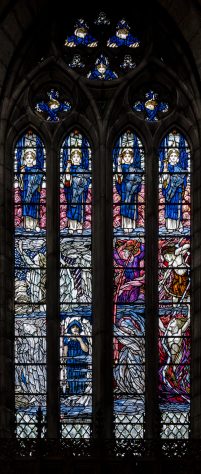
Many of Davis’s most important commissions are in Scotland, including Paisley Abbey, St Colmon Parish Church, Colmonell and Dunblane Cathedral, all of which came through a close relationship with the architect Robert Lorimer (1864-1929) to whom he was introduced by Whall in the summer of 1896.
Sadly the Dunblane commission marked the end of Davis’s fully creative career as he and his wife, Edith, were both nearly asphyxiated by a faulty anthracite heating stove at their home in Pinner. Although Edith recovered, Davis health was permanently compromised resulting in designs being adaptations and reworkings of earlier designs.
Sources:
Arts & Crafts Stained Glass by Peter Cormack (Yale University Press for the Paul Mellon Centre for Studies in British Art, 2015)
Louis Davis on Wikipedia