


St Colmon Parish Church, Colmonell, South Ayrshire
Address
St Colmon Parish Church, Manse Rd, Colmonell KA26 0SARecommended by
Highlight
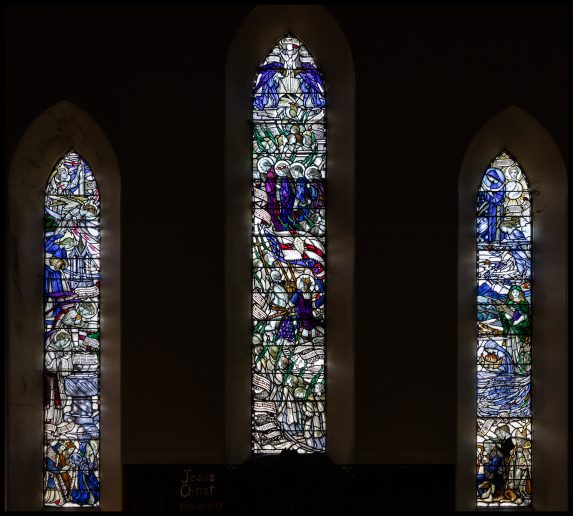
Three lancet Benedicite windows above the pulpitArtist, maker and date
Designed by Louis Davis and made by James Powell & Sons, 1910Reason for highlighting
A fantastic example of Louis Davis’s work. Although each of the three lights is a separate design, each interacts with the other with a rhythm that unifies the whole design.
Artist/maker notes
Louis Davis (1860-1941) was an English watercolourist, book illustrator and stained-glass artist. As Cormack notes, “Amongst English artists of the Arts and Crafts progressive school of stained glass, only Louis Davis approached Christopher Whall’s pre-eminent position.”
Davis was born and raised in Abingdon, where his artistic talent was recognised by the local school. His early career involved watercolours and book illustrations, but he was increasingly drawn to stained glass and by 1891 he had become one of Christopher Whall’s first students. Lodging and working with Whall in Dorking led to a firm friendship, reflected in one of Whall’s children being named Louis.
In 1893 Davis moved to Pinner where he had a house and studio built, which would be his base for the rest of his life. Davis worked with a number of firms, including being one of the first to work with Lowndes & Drury. However, his most productive partnership was with James Powell & Sons. They could not only supply the high quality glass he demanded, but also, through Thomas Cowell (1870-1949) they provided an experienced and skilful painter, who became a sympathetic collaborator.
Many of Davis’s most important commissions are in Scotland, including Paisley Abbey, St Colmon Parish Church, Colmonell and Dunblane Cathedral, all of which came through a close relationship with the architect Robert Lorimer (1864-1929) to whom he was introduced by Whall in the summer of 1896.
Sadly the Dunblane commission marked the end of Davis’s fully creative career as he and his wife, Edith, were both nearly asphyxiated by a faulty anthracite heating stove at their home in Pinner. Although Edith recovered, Davis health was permanently compromised resulting in designs being adaptations and reworkings of earlier designs.
Sources:
Arts & Crafts Stained Glass by Peter Cormack (Yale University Press for the Paul Mellon Centre for Studies in British Art, 2015)
Louis Davis on Wikipedia
James Powell & Sons was formed when James Powell purchased Whitefriars Glass, an old established glass works, in 1834. His sons developed the business to be one of the major firms of the Victorian and Edwardian eras. Especially notable is their work with Charles Winston in the 1840s and 1850s to improve the quality of glass available, and the many fine designers with whom they worked. The company’s innovations extended beyond stained glass, with the company developing a formidable reputation in a number of fields, including tableware glass, where Whitefriars Glass remains highly collectable. The stained glass department finally closed in 1973, and the company in 1980.
Sources:
James Powell & Sons, Whitefriars by Jacqueline Banerjee, PhD, Associate Editor, The Victorian Web
Victorian & Edwardian Stained Glass by Marta Galicki (Historic England, reprinted by Morris & Juliet Venables, 2001)
Other comments
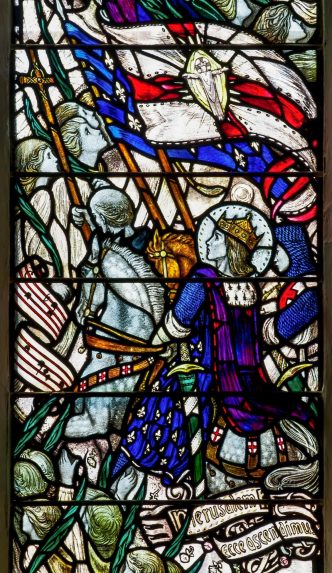
Before he received the commission for the Benedicite windows Davis had already made a single light, Nativity window (1903) and windows for the porch and the organ chamber. Shortly after completing his work at St Colmon, Davis worked on his most famous commission, the six magnificent choir windows at Dunblane Cathedral, where as here he was assisted by Powell’s most experienced and skilful painter, Thomas Cowell. A war memorial window, also made by Powells, was added in 1919-20.
Davis’s window is complimented on the north wall by a window on the theme of The Good Shepherd by Douglas Strachan c.1925.