

Dunblane Cathedral, Stirling
Address
The Cathedral Church of St Blaan and St Laurence, The Cross, Dunblane, Stirling FK15 0AQOverview
Dunblane Cathedral dates back to the 12th century, with most of what stands being constructed during the bishopric of Clement in the 13th century.
Its stained glass holds considerable riches. The highlight is Louis Davis’ choir windows noted below, but his nave windows are also very arresting, with their light pallet and predominant blues. Other highlights include Gordon Webster’s luminous portrait of Bishop Clement (1964), hidden in the Clement Chapel (it is said to be one of his favourite compositions and was a gift to the cathedral) and his large scale north aisle window on the theme of the Compassion of Christ (1968); Clayton and Bell’s Great West Window (1906) with its Tree of Jesse and elaborate angels; and Douglas Strachan’s Baptism of Christ (1926) a lean and disciplined composition, and one of three windows in the cathedral by this master artist.
Highlight
Six windows in the south wall of the choirArtist, maker and date
Designed by Louis Davis and made by James Powell & Sons, 1912-15Reason for highlighting
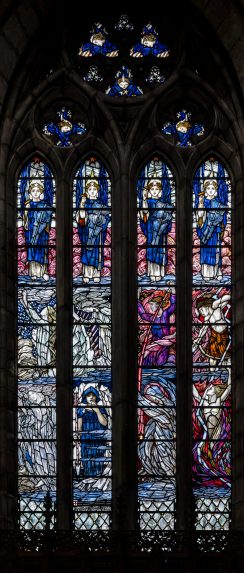
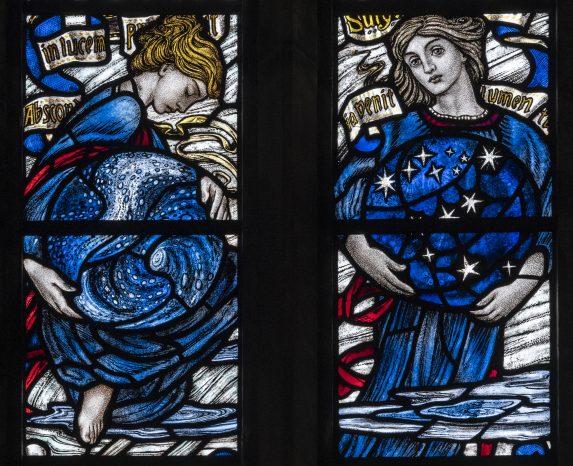
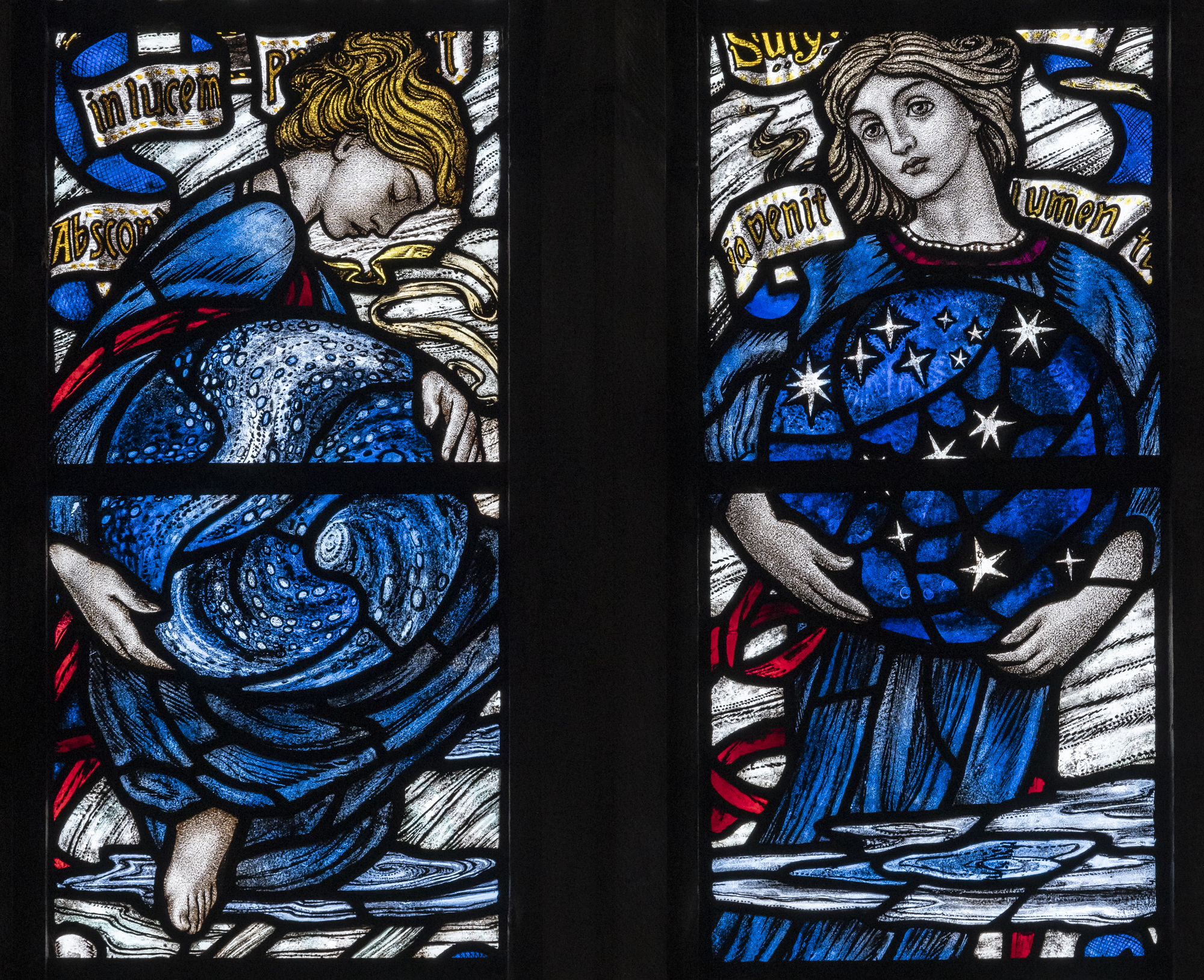
The highlight of the cathedral’s stained glass is undoubtedly the six magnificent choir windows by Louis Davis. Commenced in 1912 they took three and a half years to complete and represent his final major work. The theme is the Benedicite, which Davis had also taken for his windows at St Colmon’s church, Colmonell, South Ayrshire.
The four largest windows, each of four lights, are titled Humanity, Earth, Chaos and Allegory. They are flanked by two light windows with archangels.
As can be seen in the image of the ‘Chaos’ window shown opposite, the lowest part of the window is normally hidden from view. However, a rare image of the lower section of the ‘Chaos’ window can be seen on the Artist Page for Louis Davis.
Other comments
A contemporary guide to the windows published by The Medici Society noted that:- The “ Benedicite ” windows are supreme evidence of Mr. Davis’s power to inspire collaboration. The chemical researches and experience of Mr. Harry Powell, enlisted by the artist in the attempt to rival old glass, have, as has been said, equalled its beauty. Mr. Lyon is a glass-blower whose swift and daring skill and faith in the unexhausted possibilities of his craft rank him with the men to whose initiative is due the development of the material. To Mr. Cowell, who is in fundamental sympathy with Mr. Davis’s ideals, and follows his way of feeling with intuitive apprehension, the windows owe far more than the excellent painting which is his accredited part in them. He is intermediary between the artist and all who carry out the work, finding in the execution of Mr. Davis’s requirements genuinely creative scope, and more than content thus immeasurably to increase the artist’s productive capacity.
Artist/maker notes
Louis Davis (1860-1941) was an English watercolourist, book illustrator and stained-glass artist. As Cormack notes, “Amongst English artists of the Arts and Crafts progressive school of stained glass, only Louis Davis approached Christopher Whall’s pre-eminent position.”
Davis was born and raised in Abingdon, where his artistic talent was recognised by the local school. His early career involved watercolours and book illustrations, but he was increasingly drawn to stained glass and by 1891 he had become one of Christopher Whall’s first students. Lodging and working with Whall in Dorking led to a firm friendship, reflected in one of Whall’s children being named Louis.
In 1893 Davis moved to Pinner where he had a house and studio built, which would be his base for the rest of his life. Davis worked with a number of firms, including being one of the first to work with Lowndes & Drury. However, his most productive partnership was with James Powell & Sons. They could not only supply the high quality glass he demanded, but also, through Thomas Cowell (1870-1949) they provided an experienced and skilful painter, who became a sympathetic collaborator.
Many of Davis’s most important commissions are in Scotland, including Paisley Abbey, St Colmon Parish Church, Colmonell and Dunblane Cathedral, all of which came through a close relationship with the architect Robert Lorimer (1864-1929) to whom he was introduced by Whall in the summer of 1896.
Sadly the Dunblane commission marked the end of Davis’s fully creative career as he and his wife, Edith, were both nearly asphyxiated by a faulty anthracite heating stove at their home in Pinner. Although Edith recovered, Davis health was permanently compromised resulting in designs being adaptations and reworkings of earlier designs.
Sources:
Arts & Crafts Stained Glass by Peter Cormack (Yale University Press for the Paul Mellon Centre for Studies in British Art, 2015)
Louis Davis on Wikipedia
James Powell & Sons was formed when James Powell purchased Whitefriars Glass, an old established glass works, in 1834. His sons developed the business to be one of the major firms of the Victorian and Edwardian eras. Especially notable is their work with Charles Winston in the 1840s and 1850s to improve the quality of glass available, and the many fine designers with whom they worked. The company’s innovations extended beyond stained glass, with the company developing a formidable reputation in a number of fields, including tableware glass, where Whitefriars Glass remains highly collectable. The stained glass department finally closed in 1973, and the company in 1980.
Source: James Powell & Sons, Whitefriars by Jacqueline Banerjee, PhD, Associate Editor, The Victorian Web
Comments by
Iain Galbraith and Peter Hildebrand