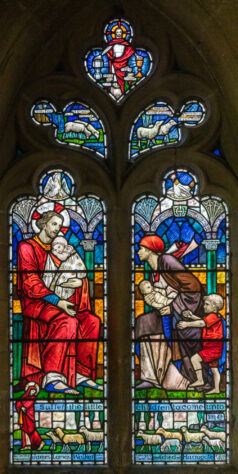
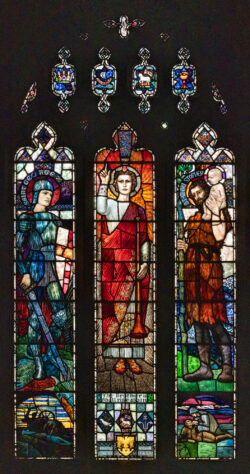
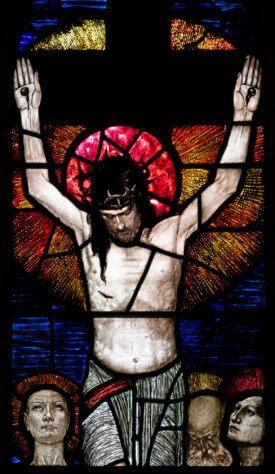
An Túr Gloine (The Tower of Glass)
An Túr Gloine (the Tower of Glass) was a studio founded on cooperative ideals for stained glass artists, with a sideline in opus sectile mosaic, which was established in Dublin in 1903.
In 1901 Sarah Purser, the established Irish portrait painter, arranged with Christopher Whall, the leading English arts and crafts stained glass artist and educator, to send his best apprentice, Londoner A.E. Child, to teach classes in the craft at the Dublin School of Art and in parallel establish a new studio that would employ the cream of his students, and so An Túr Gloine was inaugurated on 1 January 1903 at 24 Upper Pembroke Street. Purser funded the enterprise and for the next four decades played a key role in selecting artists, liaising with patrons and promoting the enterprise while Child held the role of official manager. Michael Healy and Catherine (Kitty) O’Brien were the first recruits, followed by Beatrice Elvery and Ethel Rhind, and in 1911 by Wilhelmina Geddes. All the artists were encouraged to develop their own styles and, as advocated by Whall, take sole responsibility for all aspects of their individual windows from inception to completion, with support from skilled glaziers. The studio soon established a reputation for creative and craft excellence, always using the best materials.
An outcome of the First World War was many war memorial commissions, so much so that a new artist, Hubert McGoldrick, was invited to join the studio. Around this time the studio began to enjoy overseas success with orders for Britain, North America and New Zealand but it was not until the mid-1920s, largely due to its promotion by leading American stained glass artist Charles Connick, that it received several plum commissions in the United States. In 1924 Geddes, who with Healy was one of the two most talented artists, departed An Túr Gloine and relocated to London.
The final artist to join the studio, in the mid-1930s, was the abstract and cubist painter Evie Hone, despite an initial rebuff from Purser. Hone developed a close professional relationship with Healy, and immediately began creating daringly modern stained glass. She received commissions from the Irish state, the most important being a large window for the 1939 New York World’s Fair. Despite her success and the injection of creative energy, the studio struggled financially during much of the 1930s. A.E. Child died in 1939 with Rhind retiring around the same time. The following year Purser, aged 92, announced her decision to discontinue her involvement in the studio. Healy died in 1941 and three years later An Túr Gloine was formally dissolved with O’Brien buying out the studio and contents while Hone established her own studio in Rathfarnham, County Dublin.
London-born Patrick Pollen, who had Irish family connections, relocated to Dublin in 1952 and rented half of An Túr Gloine from Catherine O’Brien. Other younger artists also availed of the studio from time to time. Following a disastrous fire in 1958 O’Brien rebuilt the studio. After her death in 1963 it was bought by Pollen, though within a few short years he built his own studio at his home in south Dublin.
Source: Dublin’s Stained Glass, A guide to the finest twentieth-century windows by David Caron (Four Courts Press, 2025)