


Church of All Saints, West Winterslow, Wiltshire
Overview
The window highlighted here is one of 10 selected by Sarah Lear, as part of a special Theme dedicated to the work of Karl Parson.
A full list of the windows chosen Sarah can be found by following the link above, where you will also find a paper by Sarah introducing the artist. Details of all the windows selected by both Sarah and other contributors can be found on Karl Parsons’ artist page.
Highlight
North aisle window of the Adoration of ChristArtist, maker and date
Designed by Karl Parsons and made at Lowndes & Drury, 1931Reason for highlighting
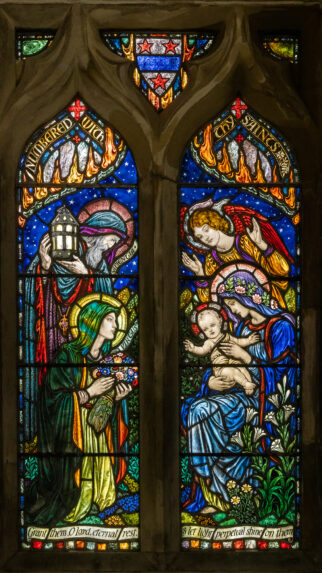
Parsons repeatedly used a rather naïve version of Mary in many of his windows, think Queen of the May. This is exemplified by his two light north-facing Adoration of Christ.[1] Here the Virgin is shown in doting profile, youthfully beautiful, seated and clad in blue draperies edged with ruby trim. She gazes tenderly at the child on her knee and is charmingly crowned with floral hedgerow circlet over her mantle.
As in other similar images, the stable-esque setting is enhanced with flowers, traditional lilies and the white Star of Bethlehem as well as floral and foliate diapered patterns on the ground. Whilst each light is complete in itself, there is a perfunctory nod to the tradition of Gothic framing as the lights are bordered above in fire, with both set against a deep starry blue background to create a picture across the intervening mullion.
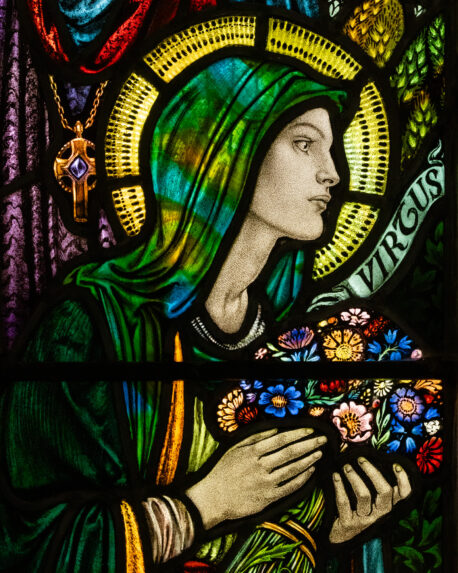
Other figures lean towards the child to create the tableau. An angel peers just over Mary and the left hand light contains another young woman, Virtus, and an older man with lamp, Sapientia. Two legends explain the window – Numbered with thy Saints across the top two lights and Grant them, O Lord, eternal rest & let light perpetual shine on them at the foot – which is a memorial to local benefactors Robert and Juliana Benita Poore.
It is worth noting how cleverly Parsons has made use of silver staining, flashed and plated glass to create the colours of glass in Virtus’s bouquet. Like his friend Harry Clarke, such techniques were a speciality of his. He has created the deep cobalt background by using hydrofluoric acid to remove the blue flashed layer away to stud the sky with stars. The window also shows his trademark flames and fabulous foliate backgrounds.
[1] Other examples can be found at St. Bride’s, Glasgow; St. James the Less, Pangbourne; All Saints, Porthcawl, St. Laurence’s, Ansley.
Artist/maker notes
Karl Parsons (1884-1934) was born in Peckham, South London, and grew up in a Christian household. His sister, the garden painter Beatrice Parsons, was involved in apprenticing him to the leading Arts and Crafts master craftsman, Christopher Whall. Parsons learnt much from Whall, working on the incredible Gloucester cathedral Lady Chapel windows, following his master’s footsteps to teaching at the Central school of Arts & Crafts and providing the illustrations for Whall’s famous text Stained Glass Work in 1905.
They began to disagree on Whall’s commission for Johannesburg cathedral and Parsons established his own studio at Lowndes and Drury’s Glass House in 1908. His first commissions for St. Alban’s, Hindhead are impressive and although he never achieved the fame and success of Whall, his creative iconographic work is peppered with signature motifs – such as flames, animals, children and plaited hair – and there is much use of lavish deeply coloured tones of superb quality Norman slab glass. These combine to make spectacular windows and he was able to capture light and movement in an idiosyncratic manner. After learning his trade and gaining experience in a superb workshop, Parsons came into his own by advancing Whall’s beautiful work with his own subtle twists to create stunning Arts and Crafts windows.
Sources:
Cormack, Peter, Arts & Crafts Stained Glass (Yale University Press, 2015)
Cormack, Peter, Karl Parsons 1884-1934, exhibition catalogue (London: William Morris Gallery, 1987)
Lowndes & Drury was formed in 1897, by the artist Mary Lowndes (1857-1929) and the craftsman Alfred John Drury (1868-1940), with the aim of providing facilities for independent artists to design and make stained glass windows. They moved from cramped conditions in Chelsea to newly purpose-built premises, The Glass House, Fulham in 1906. The firm continued after the founders’ deaths, under Alfred Drury’s son, Victor, until he retired in the early 1970s. However, The Glass House premises continued in use under Carl Edwards and subsequently his daughter, Caroline Benyon, until she moved her studio to Hampton in 1992.
Source: The Journal of Stained Glass, Vol. XLI, 2017