


St. James the Less, Pangbourne, Reading, Berkshire
Address
Church of St. James the Less, Pangbourne Hill, Pangbourne, Reading RG8 7AXOverview
The window highlighted here is one of 10 selected by Sarah Lear, as part of a special Theme dedicated to the work of Karl Parson.
A full list of the windows chosen Sarah can be found by following the link above, where you will also find a paper by Sarah introducing the artist. Details of all the windows selected by both Sarah and other contributors can be found on Karl Parsons’ artist page.
Highlight
East windowArtist, maker and date
Designed by Karl Parsons and made at Lowndes & Drury, 1919Reason for highlighting
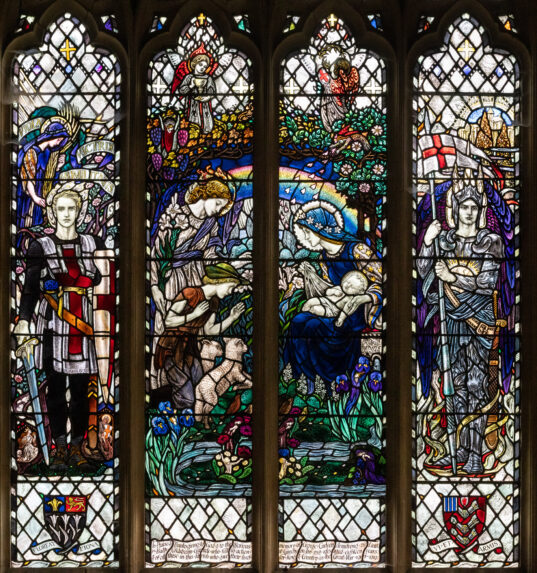
Parsons produced a highly unusual memorial window to commemorate Lieutenant George Carlyon Armstrong, whose portrait is carried by St. George. We have Parsons’s own words to explain this window and its exquisite details:
The Window commemorates Youth and Youth’s chivalrous sacrifice. But it was felt, both by the Donor and the Artist that, though a War Memorial, it should be a window expressive of Peace: a looking backward to the Divine messages of Brotherhood and Goodwill, and forward to its ultimate fulfilment. The Nativity, therefore, was chosen as the central theme, and the treatment should be understood as ideal and contemplative, rather than dramatic and historically representational.
In the conception of a Madonna of the Flowers, and the single worshipping shepherd-boy, an endeavour has been made to express the promise which is felt in all that is youthful and innocent and significance of natural beauty in its unspoiled freshness.
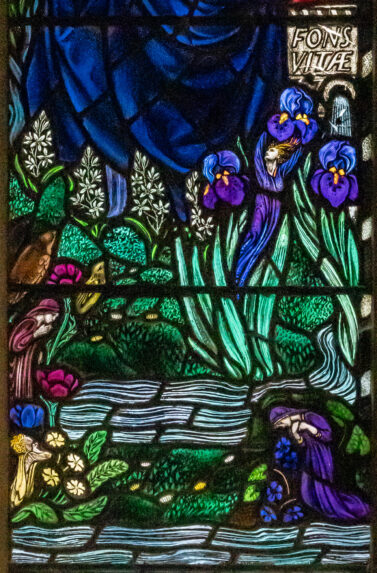
The lesson of the great Benedicitie Psalm, echoed again in such charming legends of the Nativity as those of the budding ash tree and the Christmas Rose, suggested the introduction of adoring “Flower Spirits” among the various groups of flowers. “The earth is the Lord’s: Let everything that has life praise Him.” The Rose and Vine, symbols of Christ, intertwine in a canopy overhead. The Rose throws down her petals and the Vine reveals a spirit clothed in the sacrificial chasuble. Kneeling angels above the Vine and the Rose bear, respectively, the Chalice and the Crown of Thorns. The Stream is the Water of Life. The shadow of the Cross falls on the little kneeling lamb. The Angel might be the guide and guardian of innocent beauty. The rainbow is – God’s reassurance.
St George has a background of Roses (for England.) The Violet clothed figure bearing the palm amplifies the idea in the words “Viola Victrix Humilitatis” She is meant to be “flushed with victory” and the heavenly light streams down on her and him. Tiny lurid panels below show the symbolic fight with the dragon, and the anguished princess.
St. Michael Banner – bearer of the Hosts of Christ. The sun on his breastplate suggests Power and Light. A little ‘vision’ of the heavenly city behind. The whole figure an attempt at something mysterious, flame-like, elusive.
Sources:
Unpublished notes from Karl Parsons or the Armstrong family
Selwyn, Susan, Queen of the Blazing Border (Bristol: Studio Baum, 2022)
Artist/maker notes
Karl Parsons (1884-1934) was born in Peckham, South London, and grew up in a Christian household. His sister, the garden painter Beatrice Parsons, was involved in apprenticing him to the leading Arts and Crafts master craftsman, Christopher Whall. Parsons learnt much from Whall, working on the incredible Gloucester cathedral Lady Chapel windows, following his master’s footsteps to teaching at the Central school of Arts & Crafts and providing the illustrations for Whall’s famous text Stained Glass Work in 1905.
They began to disagree on Whall’s commission for Johannesburg cathedral and Parsons established his own studio at Lowndes and Drury’s Glass House in 1908. His first commissions for St. Alban’s, Hindhead are impressive and although he never achieved the fame and success of Whall, his creative iconographic work is peppered with signature motifs – such as flames, animals, children and plaited hair – and there is much use of lavish deeply coloured tones of superb quality Norman slab glass. These combine to make spectacular windows and he was able to capture light and movement in an idiosyncratic manner. After learning his trade and gaining experience in a superb workshop, Parsons came into his own by advancing Whall’s beautiful work with his own subtle twists to create stunning Arts and Crafts windows.
Sources:
Cormack, Peter, Arts & Crafts Stained Glass (Yale University Press, 2015)
Cormack, Peter, Karl Parsons 1884-1934, exhibition catalogue (London: William Morris Gallery, 1987)
Lowndes & Drury was formed in 1897, by the artist Mary Lowndes (1857-1929) and the craftsman Alfred John Drury (1868-1940), with the aim of providing facilities for independent artists to design and make stained glass windows. They moved from cramped conditions in Chelsea to newly purpose-built premises, The Glass House, Fulham in 1906. The firm continued after the founders’ deaths, under Alfred Drury’s son, Victor, until he retired in the early 1970s. However, The Glass House premises continued in use under Carl Edwards and subsequently his daughter, Caroline Benyon, until she moved her studio to Hampton in 1992.
Source: The Journal of Stained Glass, Vol. XLI, 2017
Other comments
In the tracery here, Parsons depicts Fortitude and Hope (Spes) from an iconography he had used twice before at All Saints, Eastchurch, Kent and St. Mary’s, Tenby, Pembrokeshire.