


Church of St Michael, Highgate, London N6
Address
Church of St Michael, South Grove, Highgate, London N6 6BJRecommended by
Highlight
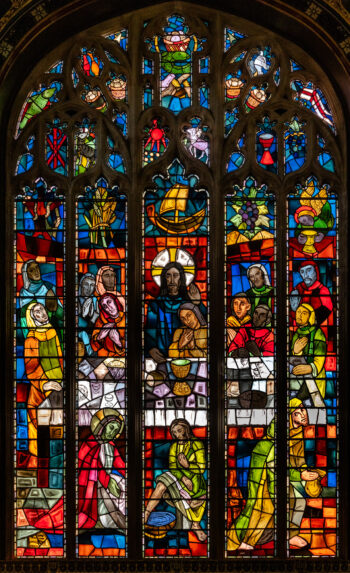
East window - The Last Supper, and Christ Washing the Feet of the DisciplesArtist, maker and date
Evie Hone, made in her Marlay Park studio, Rathfarnham, County Dublin, 1954Reason for highlighting
A particularly fine example by Evie Hone though it was made by her while ill, a year before her death, and combines her distinctive approach to pictorial and narrative stained glass with her love for incorporating Christian symbols. Hone secured this commission on the back of her enormous and much lauded window for the chapel at Eton College (1949–52), with which it shares the subject of the Last Supper – though the Eton window also features the Crucifixion in the upper register.
Gothic windows, such as the one in St Michael’s (and in Eton), seemed to work particularly well for Hone who was inspired by continental medieval stained glass, among many other, often disparate, influences. Deep reds and blues, with smaller amounts of yellow, and this instance quite a bit of green, even on occasion for faces and hands, make for a rich, full-bodied visual experience.
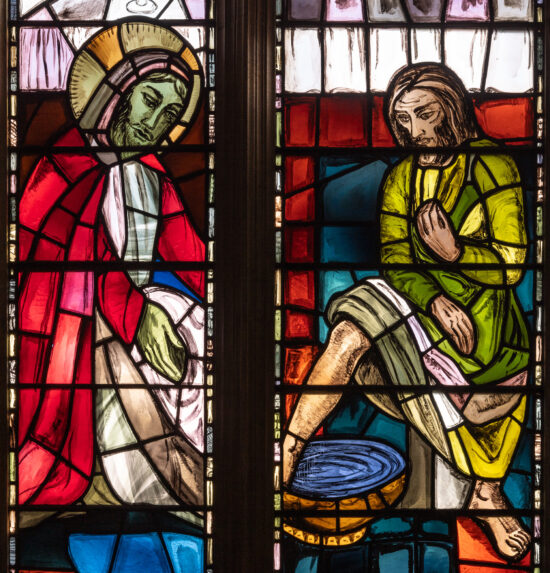
As with many of Hone’s windows, there is more than one narrative; in the left foreground Christ washes the feet of one of the disciples and to the right we see Judas making his hasty exit with his bag of thirty pieces of silver, both events, though unconnected, are associated with the Last Supper. The multiplicity of symbols which fill the upper sections of all five lights and the many pieces of tracery recall Hone’s slightly earlier rose window, Symbols of the Passion and of the Sacraments (1952), for the Jesuit Fathers’ church, Farm Street, London.
Artist/maker notes
Evie Hone (1894–1955) was born into a life of privilege and comfort, though one not without tragedy and misfortune; her mother died two days after Evie’s birth, much of her childhood was solitary, and she contracted polio aged 12 followed by periods of hospitalisation. As a young adult she travelled to France annually with her close friend Mainie Jellett to study cubism, initially under André Lhote, and then with Albert Gleizes.
By the early 1930s Hone, then an accomplished painter, began to explore the possibility of working in stained glass and approached Sarah Purser about joining An Túr Gloine. She was initially rebuffed but later admitted subsequent to studying briefly under Wilhelmina Geddes in London and Richard Ronald Holst in Amsterdam. At An Túr Gloine, Hone’s fresh, modernist approach was recognized by the new Irish state and commissions for two army barrack’s chapels were followed by her large My Four Green Fields for the Irish pavilion in the New York World Fair of 1939.
When An Túr Gloine was being dissolved as a cooperative in 1944 Hone opted to establish her own studio at Marlay, Rathfarnham, County Dublin. In addition to many commissions for religious settings, Hone made approximately 150 small panels. Her largest single order, which took her three years to complete, was The Crucifixion and Last Supper for Eton College’s chapel.
Sources:
I would like to acknowledge the research of Dr Joseph McBrinn who is currently writing Hone’s biography
Joseph McBrinn’s biographical note on Hone in the Gazetteer of Irish Stained Glass (Irish Academic Press, 2021)
Other comments
The majority of the remaining windows in the church are from the Victorian era or the early twentieth century. The exception is a new window by Helen Whittaker installed in 2024.