
Holy Trinity Church, Bardsea, Cumbria
Address
Holy Trinity Church, Bardsea, Ulverston LA12 9QTRecommended by
Highlight
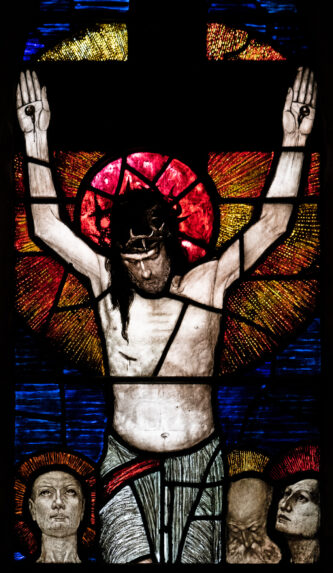
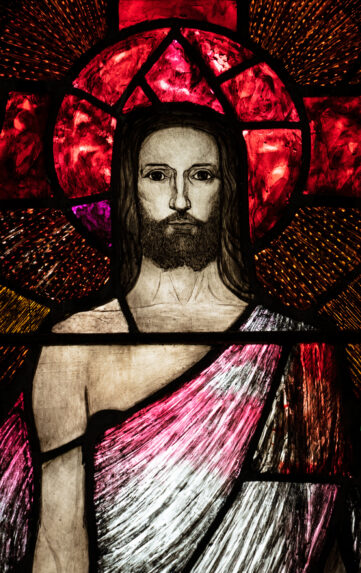
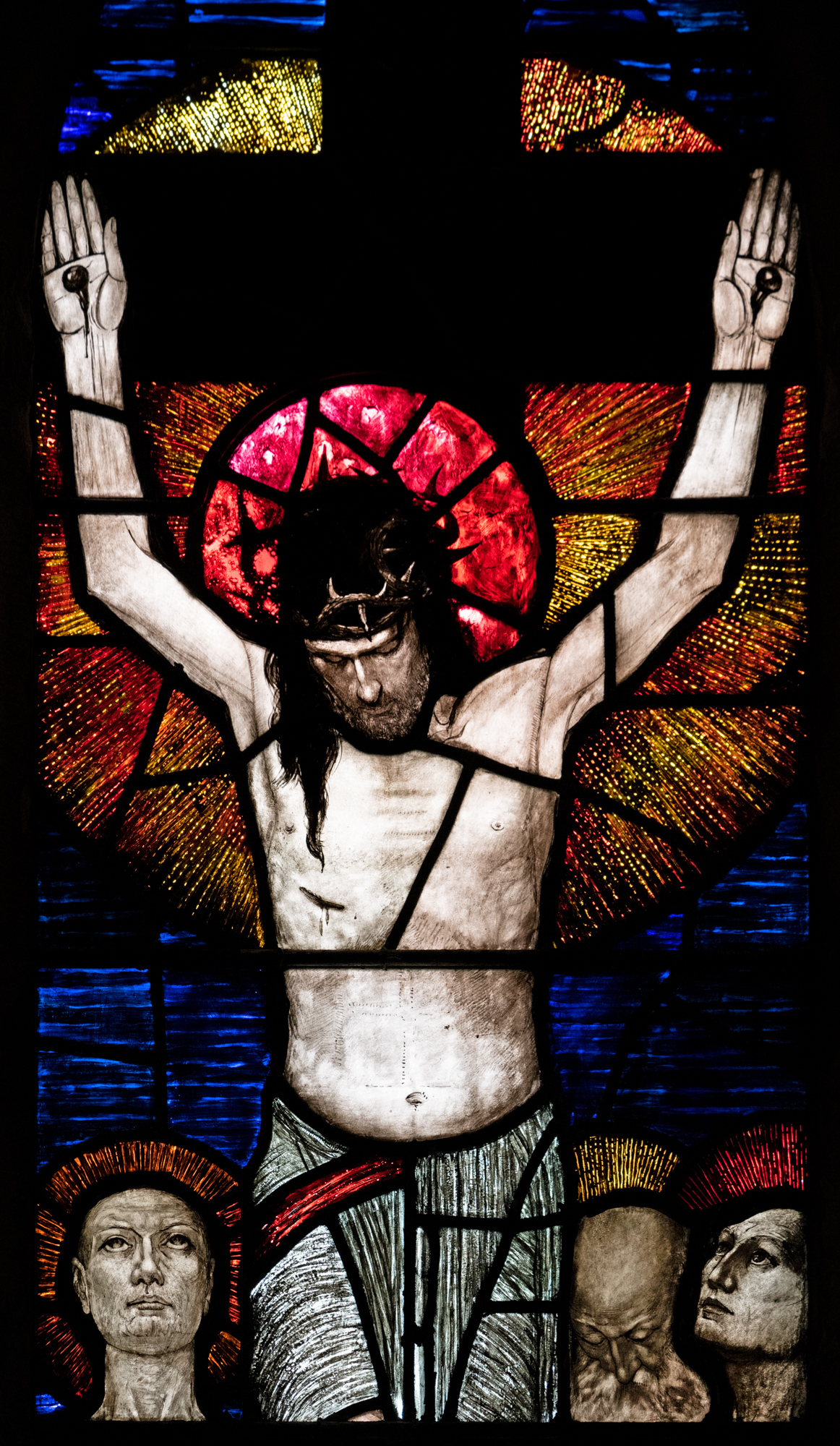
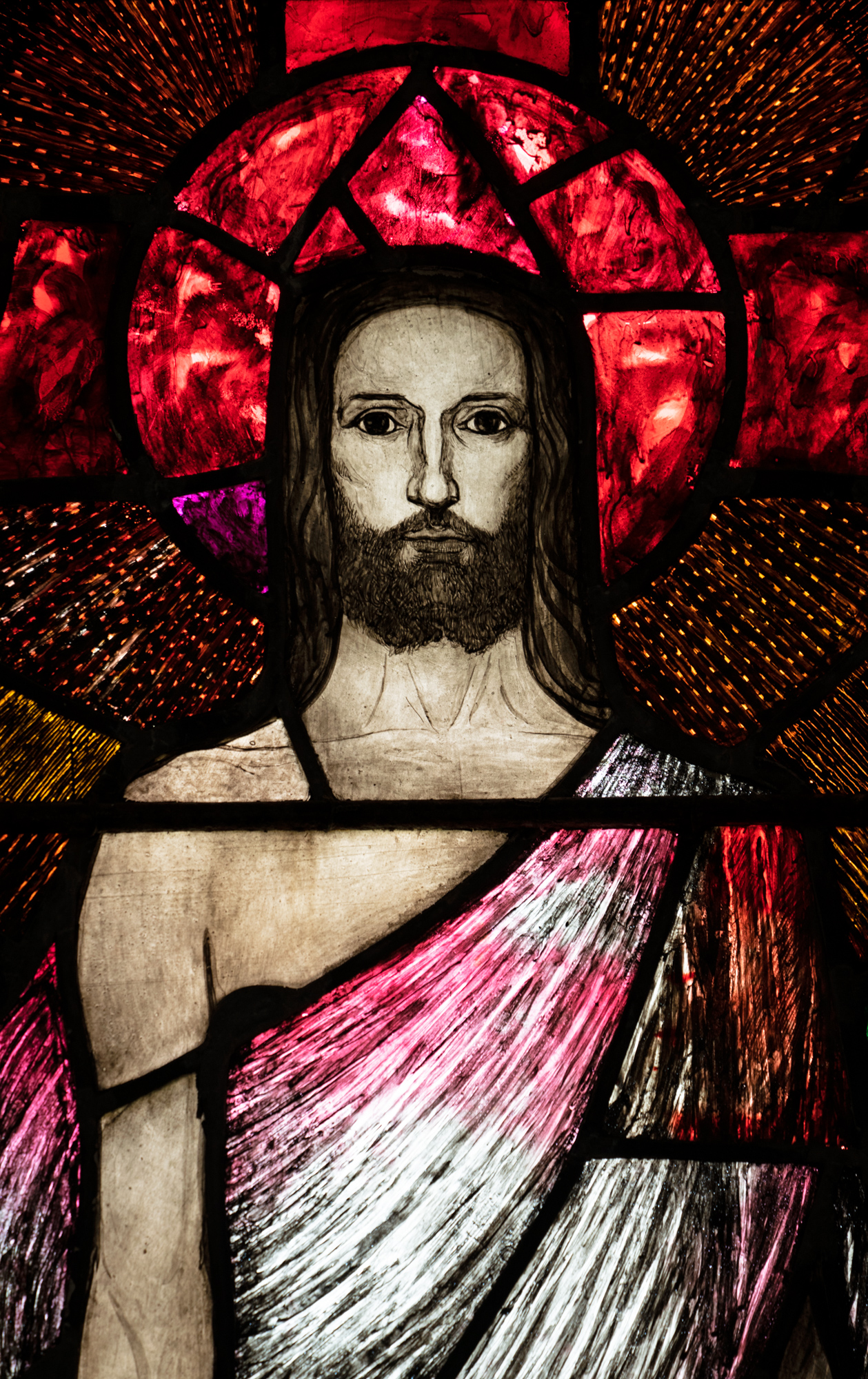
East window - The Baptism of Christ, The Crucifixion and The ResurrectionArtist, maker and date
Wilhelmina Geddes and Michael Healy, made at An Túr Gloine, Dublin, 1923–4Reason for highlighting
A rare example of the synthesis of two great twentieth century Irish stained glass artists in the creation of a trio of east windows for Bardsea church. In 1923 Wilhelmina Geddes made the small-scale sketch designs for the set of windows which had been commissioned by the Irish vicar but due to her increasingly troubled mental health she was not sufficiently well to undertake their execution. Her colleague at Dublin’s An Túr Gloine (Tower of Glass) studio, Michael Healy, stepped in and drew the cartoons and painted the glass. Thomas McGreevy (who later became director of Ireland’s National Gallery) was a fan of both artists and viewed the windows in the studio upon their competition; he observed that ‘Mr Healy has tried to be scrupulously fair to her designs, but inevitably something of the extraordinary force of Miss Geddes’ own work has disappeared, and something of the peculiarly poetic quality of Mr Healy’s has crept in.’ The end result is powerful and sublime, and arguably owes more to Healy than Geddes.
Artist/maker notes
Wilhelmina Geddes (1887-1955) was a vital figure in the Irish Arts and Crafts movement and the 20th century British stained glass revival.
Raised in Belfast, she attended the city’s school of art from the age of 16 achieving successes in drawing, watercolour and graphic design. An illustration she exhibited in Dublin in 1910 caught the attention of Sarah Purser, and discerning a potential for stained glass she invited Geddes to An Túr Gloine to explore her suitability for the craft. The following year Geddes made a set of three small panels for Purser which confirmed how her confident drawing and painting style could easily translate to this medium. Purser fostered her talent, bringing her to view medieval glass in Paris and Chartres in 1912 and 1914, though Geddes also found inspiration elsewhere including gothic and Romanesque sculpture. Over the next few years Purser assigned her increasingly larger windows for prominent Belfast and Dublin locations.
Geddes remained in Ireland until 1925, when she moved permanently to London and established a studio at The Glass House, Fulham.
Her output in terms of windows was relatively modest, a mere forty windows (not all completed by her) and a handful of small panels, partly a result of ongoing health issues, and partly because she undertook some very large, labour-intensive commissions such as her astonishing 5-light war memorial window for the Church of St Luke, Wallsend, and her monumental 89-light Te Deum rose window for Ypres Cathedral, Belgium. Her last large work was her window for the Church of St Peter, Lampeter, installed in 1946.
Recent appreciation of her work includes Peter Cormack’s estimation that ‘Many would consider the powerfully expressive work of Wilhelmina Geddes, in particular, to be among the Arts & Crafts movement’s highest accomplishment in any medium’ while her art is described by her biographer as having ‘unique power and originality’.
Michael Healy (1873-1941) was born in Dublin into abject poverty and in his late twenties had the good fortune to be recommended to Sarah Purser when she was looking for new recruits for her nascent An Túr Gloine studio, although he had yet to work in the craft. Throughout his near four-decade career at the studio he created around one hundred windows for churches throughout the island of Ireland, for England, and for as far away as Newfoundland and New Zealand. A skilled draughtsman and technical innovator, his windows convey everything from austere majesty to tender humanity, often revelling in beguiling narrative detail. Reclusive by nature, Healy was a habitual recorder, mainly in rapid pencil and watercolour impressions, of Dubliners going about their daily business, often done on his lunch break from An Túr Gloine.
Source: Michael Healy 1873–1941, An Tur Gloine’s Stained Glass Pioneer by David Caron (Four Courts Press, 2023).
An Túr Gloine (the Tower of Glass) was a studio founded on cooperative ideals for stained glass artists, with a sideline in opus sectile mosaic, which was established in Dublin in 1903.
Source: Dublin’s Stained Glass, A guide to the finest twentieth-century windows by David Caron (Four Courts Press, 2025)
Other comments
Both Michael Healy (1873–1941) and Wilhelmina Geddes (1887–1955) were recruited to An Túr Gloine by the distinguished painter and unofficial manager, Sarah Purser; he in 1903 and she in 1911. Although no sustained friendship developed between them there was a deep mutual regard based on their artistry and commitment to the craft.