


Oundle School Chapel, Northamptonshire
Address
The Chapel of St Anthony, Oundle School, Milton Rd, Oundle, Peterborough PE8 4ADRecommended by
Highlight
Two exceptional schemes. Sanctuary windows above the altar, and the nave and chapel entrance windowsArtist, maker and date
The sanctuary windows above the altar designed by John Piper, made and painted by Patrick Reyntiens, and installed by G. King & Son, 1956.Nave and chapel entrance windows by Mark Angus, 2002-05.
Reason for highlighting
Two outstanding schemes of post-World War Two stained glass make the chapel one of the most important locations for top-quality modern English stained glass.
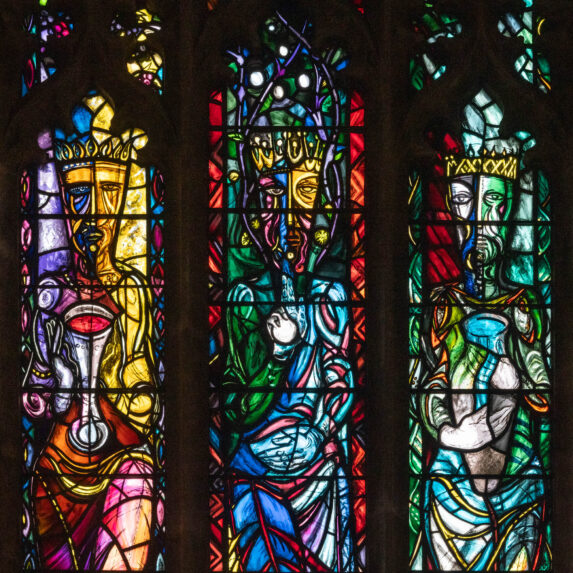
In 1956, the School celebrated its quatercentenary, and for it The Grocers’ Company commissioned the artist, John Piper to design the three windows for the sanctuary high above the altar. Even before they were made up, the windows were recognised as being by far the most innovative work of their time in this country, combining tradition with modernity. The windows show Christ in nine stylised forms: The Way, Truth and Life; the true Vine, Bread and Water; the Judge, Teacher and Shepherd. The figures were strongly influenced by the carved portals of Chartres Cathedral and the mask-like faces drawn by Picasso, both of which Piper admired. A young Patrick Reyntiens interpreted Piper’s designs between 1953 and 1955, and they were unveiled to universal acclaim in May 1956. It marked the start of one of the most significant collaborations in the history of English stained glass.
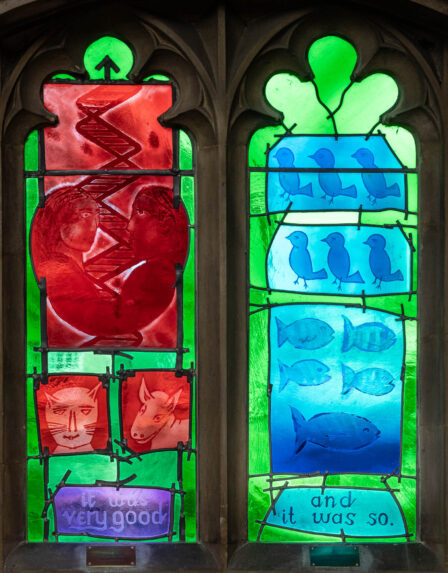
To celebrate the Millennium, the school commissioned Mark Angus to create a new series of thirty-six stained-glass windows which fill the entrance to the chapel [four saints] and the lower aisle windows of the nave illustrating Old and New Testament themes: the creation of the world, the seasons and the four elements and ending with the Last Judgement on the south side; important stories from the Old and New Testaments on the north from the Patriarchs and the Exodus to the Nativity, Crucifixion and Resurrection, telling the story of man’s salvation. Stylised figures and deceptively simple but thought-provoking representations of events, both figurative yet abstract, in brilliant colours. The scheme can be appreciated on a number of levels and speaks to all groups, from children up to the intellectual viewer who understands the tradition of Christian symbolism; ‘an apparently childlike imagery actually presents a complex philosophical network’ [Mark Angus]. The windows were given by Alexander Patrick in memory of his brother Andrew who died as a pupil while Alexander was still at school.
Other comments
Also of special note are a series of war memorial windows on the theme of The Seven Ages of Man by Hugh Easton installed in 1949 in a low-level ambulatory passage behind the altar. Based upon the famous speech in Shakespeare’s As You Like It, starting with the infant mewling and puking and ending with second childhood, ‘Sans eyes, sans teeth’ etc. The seven lights are at low level and comprise memorials to pupils and staff of the time. Each has a roundel of glass with an image of the subject and a quotation to match. The strap-work surrounding these follows the spectrum of the rainbow, which is an allusion to the Divine Mercy, God’s Covenant with mankind. Opposite is a shockingly long list of the old boys of the school killed in the two World Wars.
The one other window in the Chapel is in the north wall of the north transept. It shows St Cecilia and is by Paul Quail (1957).