


Church of St Michael and All Angels, Northchapel, West Sussex
Address
Church of St Michael and All Angels, Northchapel, Petworth, West Sussex GU28 9HPRecommended by
Highlight
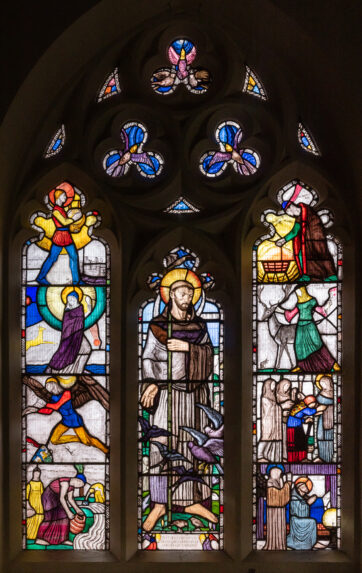
West window of the north aisle - St Francis of Assisi and His ‘Canticle of Creation’Artist, maker and date
Wilhelmina Geddes, made at Lowndes & Drury / The Glass House, Fulham, 1930Reason for highlighting
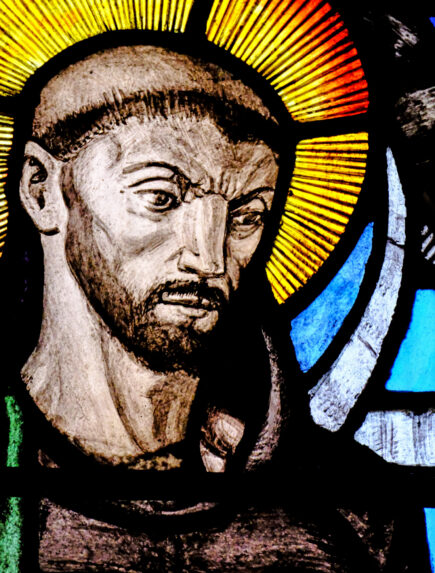
This beautiful window is typical of Geddes’ classic approach of combining a single full-length figure surrounded by a series of vignettes, in this instance a pensive, reflective St Francis of Assisi surrounded by vignettes interpreting his multi-verse ‘Canticle of Creation’. The window was erected by one Bostonian woman, Grace Treadwell, in memory of another, Louisa Lee Sargent, who at one stage shared summers together in Northchapel. According to Geddes’ biographer, Nicola Gordon Bowe, it remains unclear as to how Treadwell became aware of Geddes and why she selected her as the artist, though Gordon Bowe proposes several credible scenarios.
The outer lights, subdivided into essentially square panels, depict (on the left), Brother Sun, Sister Moon, Brother Wind, Sister Water, (and on the right) Brother Fire, Sister Mother Earth, those who bear Infirmity and Tribulation, Sister Bodily Death. Unusually for Geddes, she has incorporated a lot of white matted glass and this would seem to be in response to concerns about the level of light coming into the church. The pale glass and absence of much background detail in the vignettes means that many of the smaller figures create strong, dynamic silhouettes. Visually there are parallels in terms of composition and colour palette with her slightly later window, St Joseph of Arimathea – Wheler Memorial Window (1933) for the Chapel of St Lawrence, Otterden, Kent.
Artist/maker notes
Wilhelmina Geddes (1887-1955) was a vital figure in the Irish Arts and Crafts movement and the 20th century British stained glass revival.
Raised in Belfast, she attended the city’s school of art from the age of 16 achieving successes in drawing, watercolour and graphic design. An illustration she exhibited in Dublin in 1910 caught the attention of Sarah Purser, and discerning a potential for stained glass she invited Geddes to An Túr Gloine to explore her suitability for the craft. The following year Geddes made a set of three small panels for Purser which confirmed how her confident drawing and painting style could easily translate to this medium. Purser fostered her talent, bringing her to view medieval glass in Paris and Chartres in 1912 and 1914, though Geddes also found inspiration elsewhere including gothic and Romanesque sculpture. Over the next few years Purser assigned her increasingly larger windows for prominent Belfast and Dublin locations.
Geddes remained in Ireland until 1925, when she moved permanently to London and established a studio at The Glass House, Fulham.
Her output in terms of windows was relatively modest, a mere forty windows (not all completed by her) and a handful of small panels, partly a result of ongoing health issues, and partly because she undertook some very large, labour-intensive commissions such as her astonishing 5-light war memorial window for the Church of St Luke, Wallsend, and her monumental 89-light Te Deum rose window for Ypres Cathedral, Belgium. Her last large work was her window for the Church of St Peter, Lampeter, installed in 1946.
Recent appreciation of her work includes Peter Cormack’s estimation that ‘Many would consider the powerfully expressive work of Wilhelmina Geddes, in particular, to be among the Arts & Crafts movement’s highest accomplishment in any medium’ while her art is described by her biographer as having ‘unique power and originality’.
Lowndes & Drury was formed in 1897, by the artist Mary Lowndes (1857-1929) and the craftsman Alfred John Drury (1868-1940), with the aim of providing facilities for independent artists to design and make stained glass windows. They moved from cramped conditions in Chelsea to newly purpose-built premises, The Glass House, Fulham in 1906. The firm continued after the founders’ deaths, under Alfred Drury’s son, Victor, until he retired in the early 1970s. However, The Glass House premises continued in use under Carl Edwards and subsequently his daughter, Caroline Benyon, until she moved her studio to Hampton in 1992.
Source: The Journal of Stained Glass, Vol. XLI, 2017