
Salisbury Cathedral, Wiltshire
Address
Cathedral Church of the Blessed Virgin Mary, North Walk, Salisbury SP1 2EJTheme
Overview
The cathedral is famous for retaining some fine thirteenth-century stained glass, including some of the most important examples of grisaille work in the country. There is an interesting comparison to be made between the real 13th century grisaille and the work of A. O. Hemming (1895) in the north transept (window 13 in the cathedral’s own notes), which is made to look like old grisaille. Hemming had previously installed the collection of old grisaille in the south east transept (window 33).
A very different aesthetic is represented by the three light Moses window, 1781, by James Pearson, set within the eastern gable above the high altar, which was created using coloured enamels on plain crown glass.
The nineteenth century saw a return to more traditional techniques, and the cathedral has a fine collection of Victorian and Edwardian stained glass from some of the leading studios. Particularly striking is a three light window (window 13) in the north-east transept by James Powell & Sons, to a design by J. W. Brown, 1908.
Twentieth-century glass includes the famous 1980 ‘Prisoner of Conscience’ east window in the Trinity chapel (window 24) by Gabriel and Jacques Loire of Chartres. While the twenty-first century is represented by the Army Air Corps Golden Jubilee window by Caroline Swash, 2007 (window 4a).
Highlight
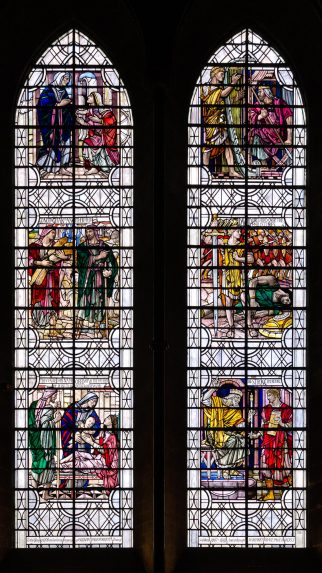
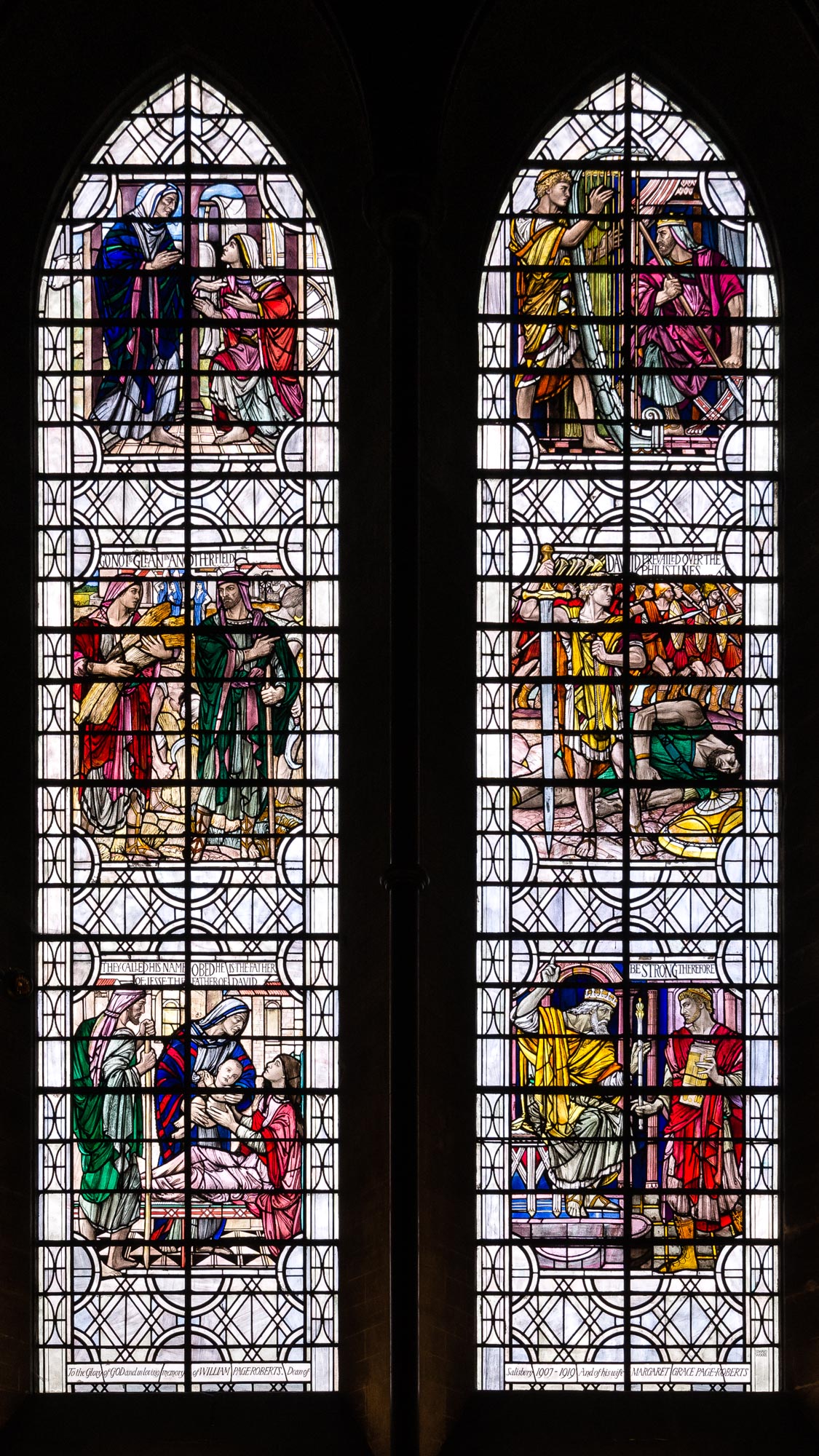
North aisle window (No. 19)Artist, maker and date
Edward Woore, 1919Reason for highlighting
Spread across two lights are six bold and finely paint panels surrounded by slightly tinted glass within an intricate framework of leading. This window is a joy and rightly regarded as one of Woore’s finest windows.
Artist/maker notes
Edward Woore (1880-1960) was born in Derby and after school obtained a scholarship to the Central School of Arts and Crafts, in London. There he took up stained glass under the tuition of Christopher Whall, with whom he would later work, and where he would meet two other pupils and assistants, Karl Parsons and Arnold Robinson. Both Woore and Parsons would provide illustrations for Whall’s famous text Stained Glass Work in 1905.
Woore served in France during the First World War, where in 1917 he was wounded and lost the sight of one eye. Returning to England he renewed his connection with Christopher Whall, while also establishing his own studio and workshop, first in Hammersmith and then in Putney.
For a short period around the time of Whall’s death in 1924 he helped to manage the studio, and in 1933-34 assisted Karl Parsons with his final commissions.
In 1923 his friend Arnold Robinson had bought Joseph Bell of Bristol and the two would collaborate on many commissions over the following decades.
His work shows great imagination and strength, and while inspired by Whall, is very individual in character and outlook. Among his many windows in England, New Zealand, and South Africa, the series at Fenham, Northumberland, and his window in the north aisle of Salisbury Cathedral are especially remembered.
Sources:
Edward Woore’s obituary in The Journal of Stained Glass Vol. XIII No. 2 1960-61
Stained Glass Marks and Monograms. Complied by Joyce Little (London: National Association of Decorative and Fine Art Societies, 2002)
Comments by
Peter Hildebrand