
Christ Church, Fulham, London SW6
Address
Christ Church, 67 Studdridge St, London SW6 3TDOverview
The window highlighted here is one of 10 selected by Sarah Lear, as part of a special Theme dedicated to the work of Karl Parson.
A full list of the windows chosen Sarah can be found by following the link above, where you will also find a paper by Sarah introducing the artist. Details of all the windows selected by both Sarah and other contributors can be found on Karl Parsons’ artist page.
Highlight
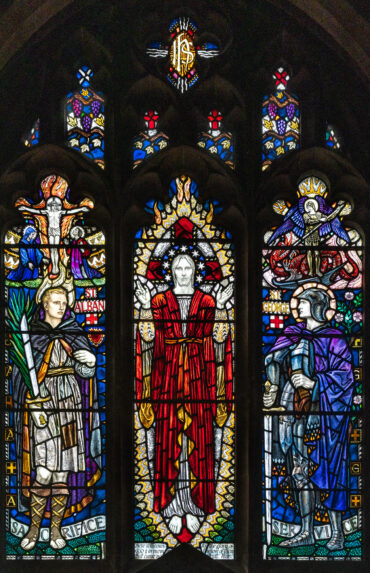
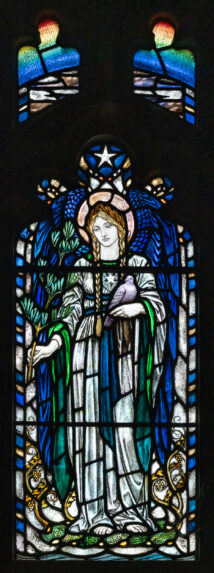
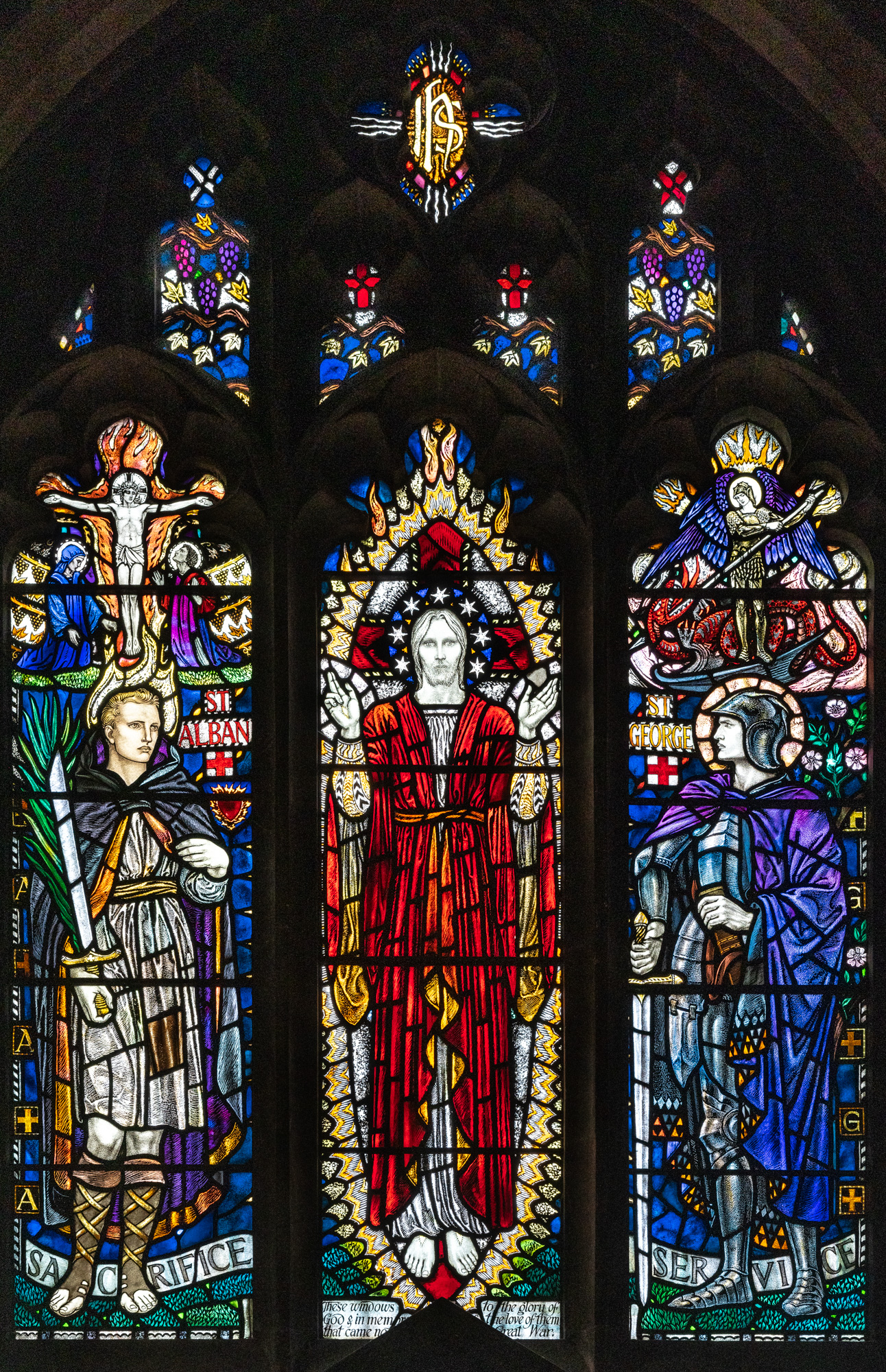
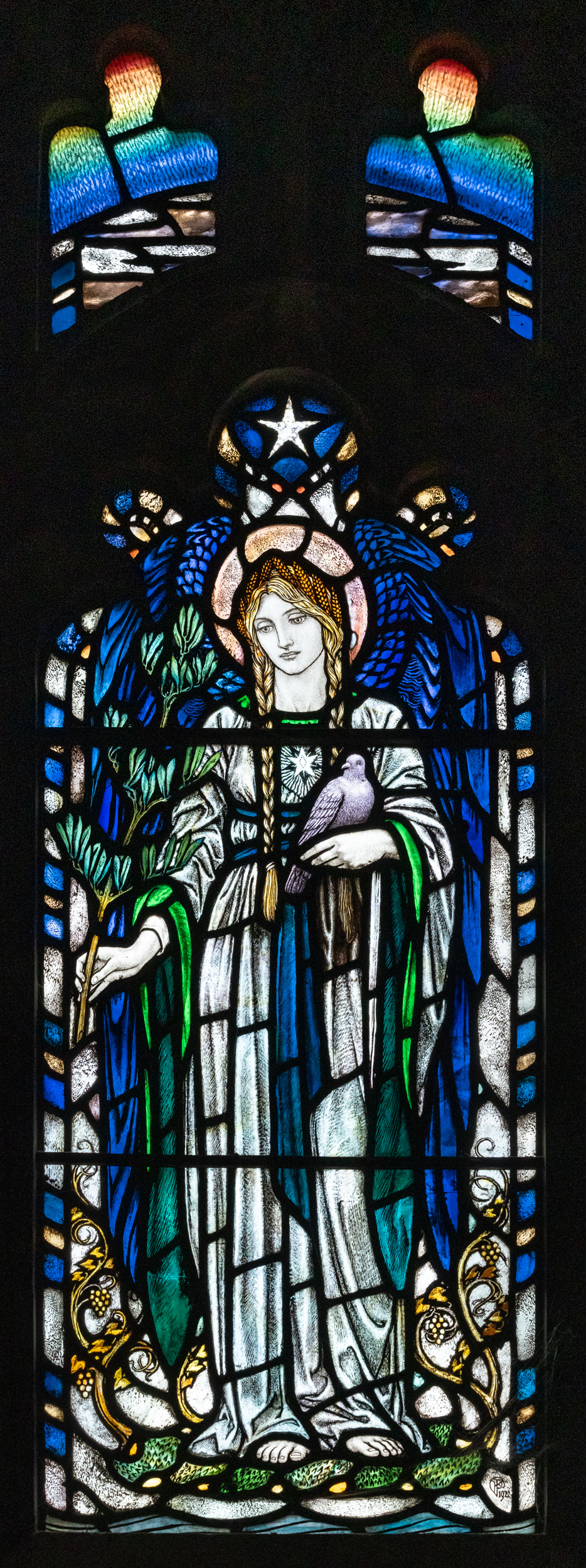
West windows - St. Michael; Christ with St. George and St. Alban; Angel of PeaceArtist, maker and date
Designed by Karl Parsons and made at Lowndes & Drury, 1922Reason for highlighting
The location of this church is near the studio that Parsons had at the Lowndes and Drury Glass House and he may have used these windows to showcase his work.
The three lancet windows depict a central Christ floating in a flaming mandorla. To the left is a cloaked St. Alban speaking of Sacrifice with small Crucifixion and Saints scene above. The other flank has St. George in the appearance of a medieval knight above which is Archangel Michael lancing a dragon to overall represent Service. The legend below explains that these are in memory of those who did not come home after the Great War.
Although such imagery was used by Parsons for commemoration purposes throughout the country, he did not scrimp on his trademark details in this window. In the smaller Cross scene, Christ is wrapped in flames ascending from St. Alban’s fiery halo and is set against a background of eucharistic symbols. The miniature dragon is exquisite showing details of teeth, scales, tongue and Michael’s feathers. The resurrection cross in Christ’s background reminds viewers of His eternal perspective on earthly life; his sleeves are delicately striped and patterned as well as gesturing blessing with his right hand. As usual, Parsons ensures that natural elements are apparent with St. George surrounded by roses and even painting individual blades of grass under the feet of many characters.
Peace and Archangel Michael are beautiful scenes for individual lancets. The iconographic details of Peace bear a resemblance to the Angel of Earth that he put in the bottom right of the East window at St. Philips, Leicester. In particular note her hair made of wheat ears and Parsons’ use of plaits which was an unusual hairstyle in glass. Also the rainbow above her showcasing his skills in producing multiple colours on one piece of glass through staining, aciding and plating techniques. The flames surrounding Archangel Michael highlight his use of streaky glass par excellence in a similar way to Fortitude at All Saints, Eastchurch.
Artist/maker notes
Karl Parsons (1884-1934) was born in Peckham, South London, and grew up in a Christian household. His sister, the garden painter Beatrice Parsons, was involved in apprenticing him to the leading Arts and Crafts master craftsman, Christopher Whall. Parsons learnt much from Whall, working on the incredible Gloucester cathedral Lady Chapel windows, following his master’s footsteps to teaching at the Central school of Arts & Crafts and providing the illustrations for Whall’s famous text Stained Glass Work in 1905.
They began to disagree on Whall’s commission for Johannesburg cathedral and Parsons established his own studio at Lowndes and Drury’s Glass House in 1908. His first commissions for St. Alban’s, Hindhead are impressive and although he never achieved the fame and success of Whall, his creative iconographic work is peppered with signature motifs – such as flames, animals, children and plaited hair – and there is much use of lavish deeply coloured tones of superb quality Norman slab glass. These combine to make spectacular windows and he was able to capture light and movement in an idiosyncratic manner. After learning his trade and gaining experience in a superb workshop, Parsons came into his own by advancing Whall’s beautiful work with his own subtle twists to create stunning Arts and Crafts windows.
Sources:
Cormack, Peter, Arts & Crafts Stained Glass (Yale University Press, 2015)
Cormack, Peter, Karl Parsons 1884-1934, exhibition catalogue (London: William Morris Gallery, 1987)
Lowndes & Drury was formed in 1897, by the artist Mary Lowndes (1857-1929) and the craftsman Alfred John Drury (1868-1940), with the aim of providing facilities for independent artists to design and make stained glass windows. They moved from cramped conditions in Chelsea to newly purpose-built premises, The Glass House, Fulham in 1906. The firm continued after the founders’ deaths, under Alfred Drury’s son, Victor, until he retired in the early 1970s. However, The Glass House premises continued in use under Carl Edwards and subsequently his daughter, Caroline Benyon, until she moved her studio to Hampton in 1992.
Source: The Journal of Stained Glass, Vol. XLI, 2017
Other comments
A reconfiguration of the interior means that the west windows are now in an area separated from the rest of the church, where most of the windows were glazed by Morris & Co in 1909-12 and 1933, using designs by Burne-Jones created between 1867 and 1874. The market for stained glass was dominated by the large studios and independents such as Karl Parsons. However, there were also contributions from more usual quarters, although results could be mixed. One such is a north nave window (1934) by George Farmiloe & Sons, who were primarily suppliers to the building trade.