
Church of St James and St Basil, Fenham, Tyne & Wear
Address
Church of St James and St Basil, Wingrove Road North, Fenham NE4 9EJRecommended by
Highlight
Complete scheme designed by George Jack and Edward WooreArtist, maker and date
George Jack and Edward Woore, 1929-31Reason for highlighting
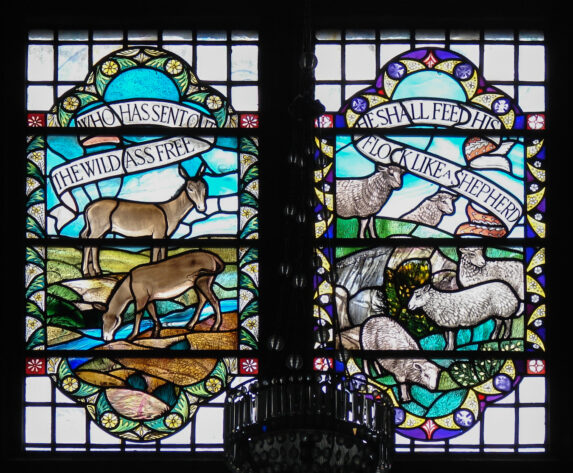
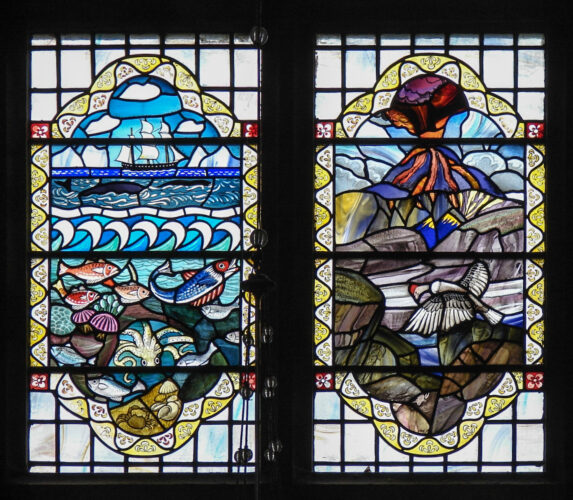
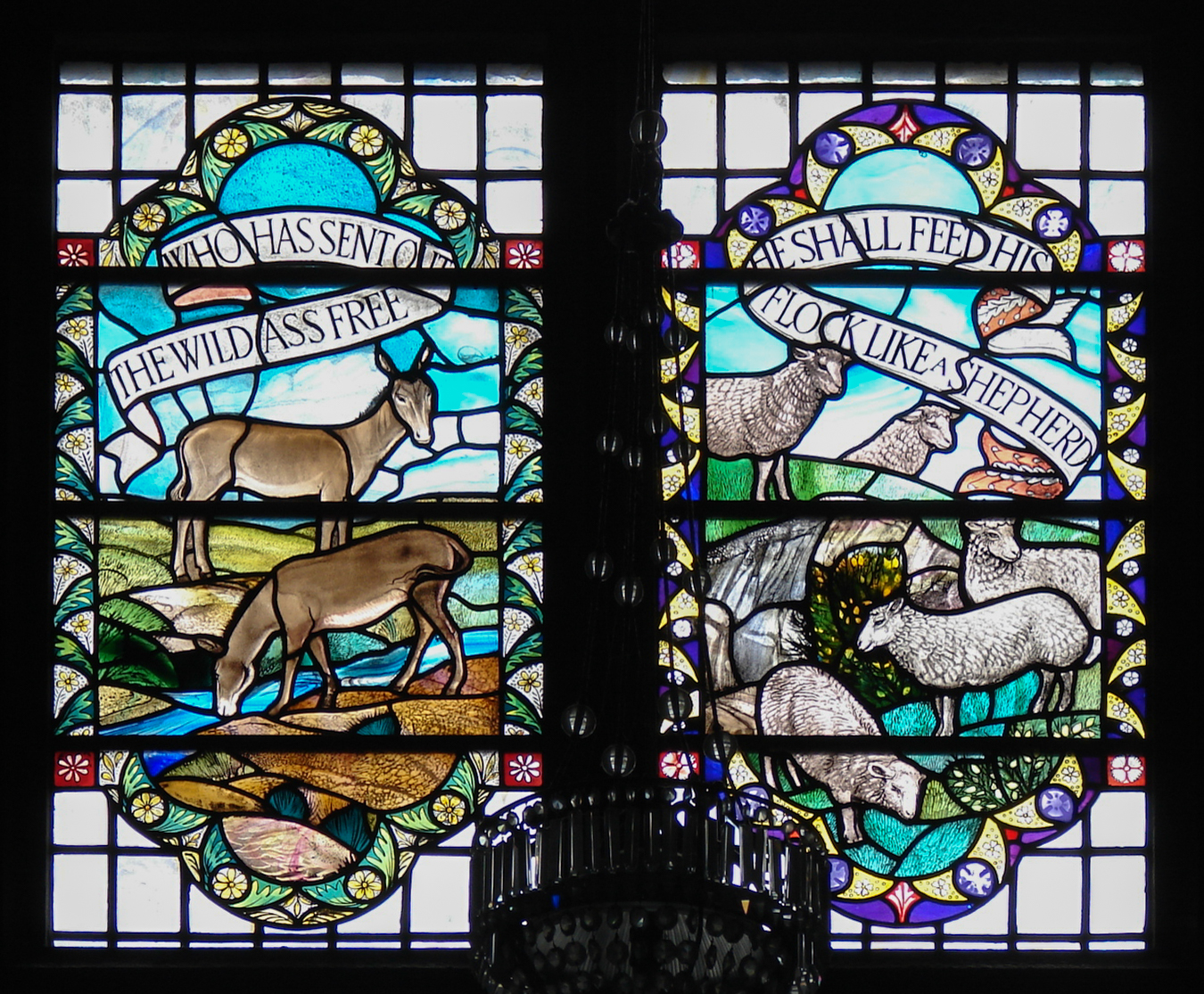
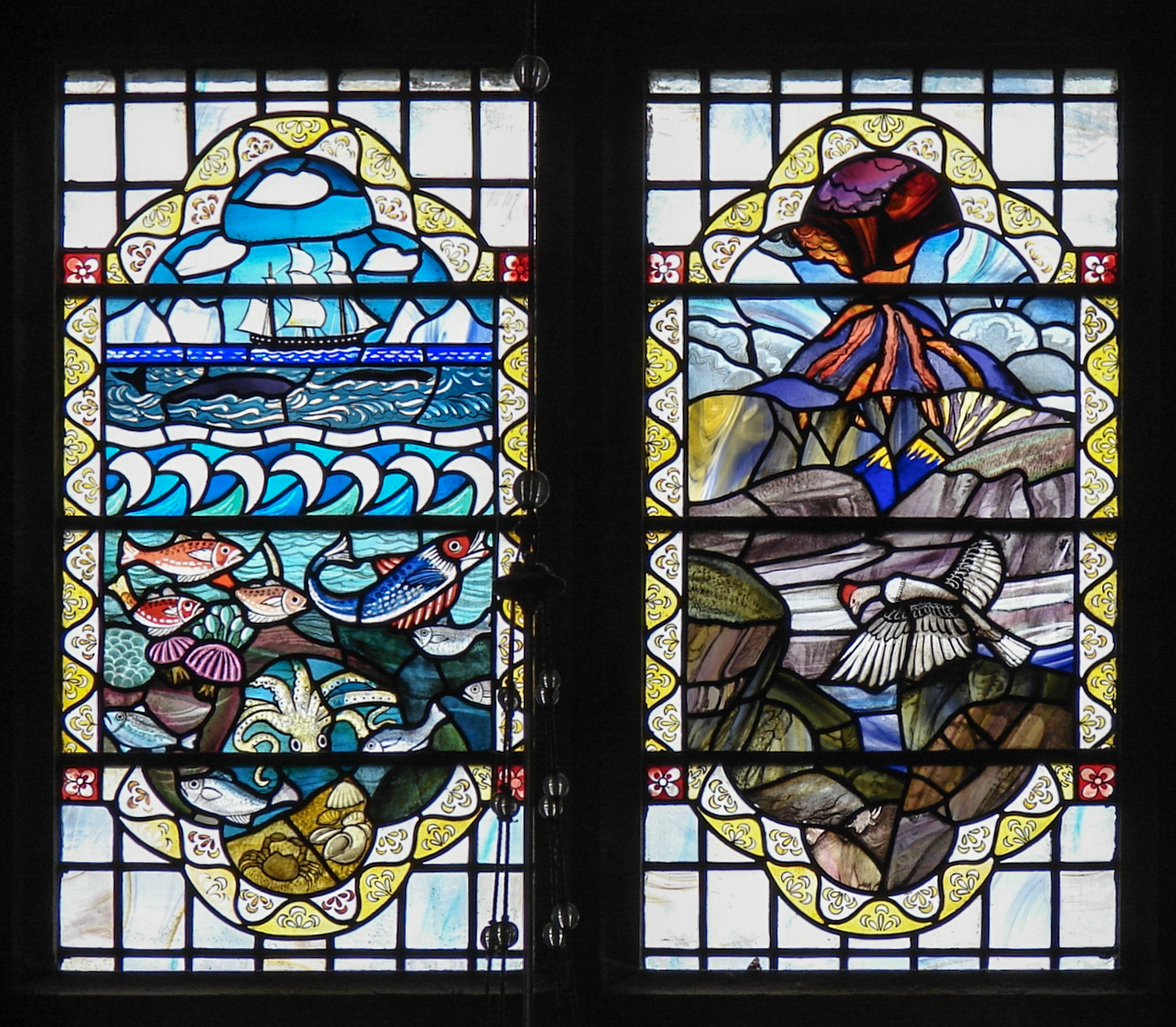
The Woore windows are a free and exuberant set of biblical images. Five of the thirteen windows were designed and made by Woore alone – the “Life and Passion of Christ”; the “Children’s window”; the east window of the memorial chapel and two windows high on the north side of the choir. The rest were designed by George Jack and realised under the tender guiding hand of Woore, with the possible exception of the “Adam and Eve window”, which may have been made at Lowndes & Drury.
The examples opposite are from a scheme by Jack based on Psalm 104, giving the opportunity for whimsy and delight – condors, whales, storks, mountain goats, not to mention an octopus and a crab: donkeys – ‘the wild asses quench their thirst’; and a volcano – ‘He toucheth the hills and they smoke.’
Artist/maker notes
George Washington Henry Jack (1855-1931) was an architect, but principally known for wood carving and furniture design. He worked with Morris & Co. as a furniture designer from 1885. He joined the office of Philip Webb in 1880, and took over the practice after Webb’s retirement in 1900. He taught wood-carving at the Central School of Arts and Crafts and the Royal College of Art. He published Woodcarving, Design and Workmanship in 1903, still a standard text.
He designed mosaics for Westminster Abbey and for the Anglican Cathedral in Seoul. He worked alongside Laurence Turner from about 1890 on decorative plasterwork. He also designed embroidery and cast-iron fireplaces.
Jack was a founder member of the Arts and Crafts Exhibition Society in 1887 and participated in all their exhibitions in London from 1888 to 1916. He exhibited at the Royal Academy in London in 1902, 1903 and 1910. He was elected a member of the Art Workers Guild in 1906.
Sources:
Arts & Crafts Churches by Alec Hamilton (Lund Humphries, 2020)
Jack, George Washington Henry 1855 – 1931 on Art History Research.net
Edward Woore (1880-1960) was born in Derby and after school obtained a scholarship to the Central School of Arts and Crafts, in London. There he took up stained glass under the tuition of Christopher Whall, with whom he would later work, and where he would meet two other pupils and assistants, Karl Parsons and Arnold Robinson. Both Woore and Parsons would provide illustrations for Whall’s famous text Stained Glass Work in 1905.
Woore served in France during the First World War, where in 1917 he was wounded and lost the sight of one eye. Returning to England he renewed his connection with Christopher Whall, while also establishing his own studio and workshop, first in Hammersmith and then in Putney.
For a short period around the time of Whall’s death in 1924 he helped to manage the studio, and in 1933-34 assisted Karl Parsons with his final commissions.
In 1923 his friend Arnold Robinson had bought Joseph Bell of Bristol and the two would collaborate on many commissions over the following decades.
His work shows great imagination and strength, and while inspired by Whall, is very individual in character and outlook.
Sources:
The Journal of Stained Glass Vol. XIII No. 2 1960-61
Stained Glass Marks and Monograms. Complied by Joyce Little (London: National Association of Decorative and Fine Art Societies, 2002)
Other comments
Sir James Knott (1855-1934), a prosperous shipowner (the Prince Line), sold up at 60, intending to devote his life to good works. He had the church built (1927-31) as a memorial to two of his sons killed in the early days of the Great War.
His architect was Eric Edward Lofting (1888-1950), who had also served in the war. Lofting came recommended by, and under the protective wing of, Professor W R Lethaby, then Surveyor to Westminster Abbey.
The windows commemorating the sons – Captain Henry Basil Knott and Major James Leadbitter Knott DSO – are by George Jack, another colleague of Lethaby’s, who was far better known as a wood carver: he made the naturalistic choir stall fronts for Lethaby at his archetypal Arts & Crafts church, All Saints, Brockhampton, Herefordshire. The windows at Fenham appear to be one of Jack’s only two glass commissions. (The other is at St. Margaret’s, Barking, London c.1929-31.)