


Chapel of St John the Baptist, Matlock Dale, Derbyshire
Address
Chapel of St John the Baptist, St John's Road, Matlock Dale, Derbyshire DE4 3PQRecommended by
Highlight
East windowArtist, maker and date
Louis Davis and Lowndes & Drury, 1897Reason for highlighting
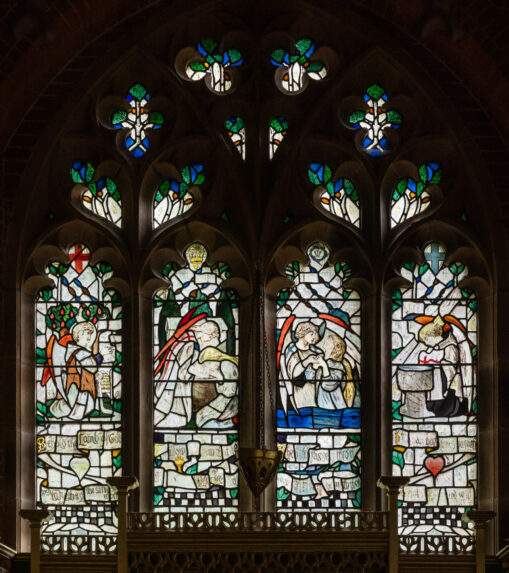
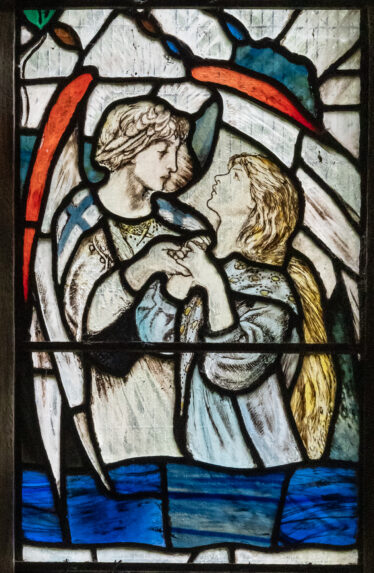
This set of four small windows is both aesthetically charming and theologically odd. According to Benjamin Bryan in his Matlock Manor and Parish (1903), pp 176-7, “… as the church is built over a spring, the subject of the window generally is the symbolical use of the word ‘water’ in the Bible. Each compartment shows an angel ministering to mankind in connection with water. On the right, an angel holds a child at the font; in the next light, one guides a soul through the waters of Death; in the third, one ministers the “Water of Life” by means of the Holy Communion; and on the left, a fourth angel, clad in the garb of John the Baptist, guides the stream of the Water of Life, which flows through a vessel in his hand on to the ground.”
Revd John Drackley, a Matlock historian who took a special interest in this church, was puzzled. “The iconography is really very odd. Why dress an angel in the garb of St John rather than show the saint himself ? The viewer is bound to see the image, and identify it with the Baptist unless he has the esoteric private information of Bryan’s history.” He added, “…it was an extraordinary aberration to dress an angel in St John’s camel hair outfit etc. ….very strange and unprecedented.” It is perhaps worth noting however, that, in the Orthodox tradition icons of John the Baptist often show him with wings.
However, the lack of a clear dividing line between angel and Saint in the minds of Louisa Sophia Harris, who commissioned and paid for the church, and Louis Davis perhaps suggests their modern, rather relaxed approach to Christianity. Mrs Harris was not much interested in orthodoxy. (The church includes a memorial tablet to her dog!) It is also notable that all the angels are little girls.
Artist/maker notes
Louis Davis (1860-1941) was an English watercolourist, book illustrator and stained-glass artist. As Cormack notes, “Amongst English artists of the Arts and Crafts progressive school of stained glass, only Louis Davis approached Christopher Whall’s pre-eminent position.”
Davis was born and raised in Abingdon, where his artistic talent was recognised by the local school. His early career involved watercolours and book illustrations, but he was increasingly drawn to stained glass and by 1891 he had become one of Christopher Whall’s first students. Lodging and working with Whall in Dorking led to a firm friendship, reflected in one of Whall’s children being named Louis.
In 1893 Davis moved to Pinner where he had a house and studio built, which would be his base for the rest of his life. Davis worked with a number of firms, including being one of the first to work with Lowndes & Drury. However, his most productive partnership was with James Powell & Sons. They could not only supply the high quality glass he demanded, but also, through Thomas Cowell (1870-1949) they provided an experienced and skilful painter, who became a sympathetic collaborator.
Many of Davis’s most important commissions are in Scotland, including Paisley Abbey, St Colmon Parish Church, Colmonell and Dunblane Cathedral, all of which came through a close relationship with the architect Robert Lorimer (1864-1929) to whom he was introduced by Whall in the summer of 1896.
Sadly the Dunblane commission marked the end of Davis’s fully creative career as he and his wife, Edith, were both nearly asphyxiated by a faulty anthracite heating stove at their home in Pinner. Although Edith recovered, Davis health was permanently compromised resulting in designs being adaptations and reworkings of earlier designs.
Sources:
Arts & Crafts Stained Glass by Peter Cormack (Yale University Press for the Paul Mellon Centre for Studies in British Art, 2015)
Louis Davis on Wikipedia
Lowndes & Drury was formed in 1897, by the artist Mary Lowndes (1857-1929) and the craftsman Alfred John Drury (1868-1940), with the aim of providing facilities for independent artists to design and make stained glass windows. They moved from cramped conditions in Chelsea to newly purpose-built premises, The Glass House, Fulham in 1906. The firm continued after the founders’ deaths, under Alfred Drury’s son, Victor, until he retired in the early 1970s. However, The Glass House premises continued in use under Carl Edwards and subsequently his daughter, Caroline Benyon, until she moved her studio to Hampton in 1992.
Source: The Journal of Stained Glass, Vol. XLI, 2017
Other comments
The building is a picturesque example of the inclination of rich people around 1900 to build their own church. Louisa Harris inherited considerable wealth from an aunt and uncle. Her family, the Leacrofts, had memorials in the medieval parish church. How much swankier to build a new one!
The architect was Guy Dawber, who, like Davis, was a member of the Art Workers’ Guild. The plasterwork ceiling is by George Bankart, coloured by Davis. The entire interior was redecorated under Dawber’s eye in 1929, and the colouring restored in 2012.
The tablet to Mrs Harris’s dog is hard to find – a small, undated plaque under the westernmost south window, ‘In most loving memory of Vida’ – her dog. The chapel was never consecrated, so Mrs Harris could effectively do as she pleased.
The church is in the care of Friends of Friendless Churches.