


Church of St Peter and St Paul, Great Bowden, Leicestershire
Address
Church of St Peter and St Paul, Dingley Road, Great Bowden LE16 7ETRecommended by
Highlight
South aisle windowArtist, maker and date
Designed by Louis Davis and made by James Powell & Sons, 1909Reason for highlighting
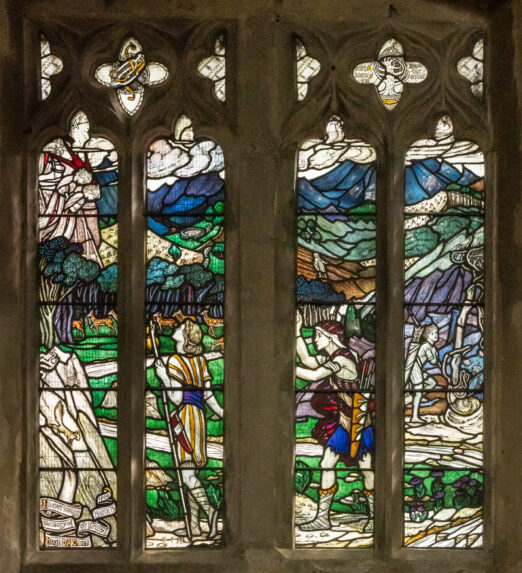
Davis is one of my favourite designers and the glass here knocks you for six!
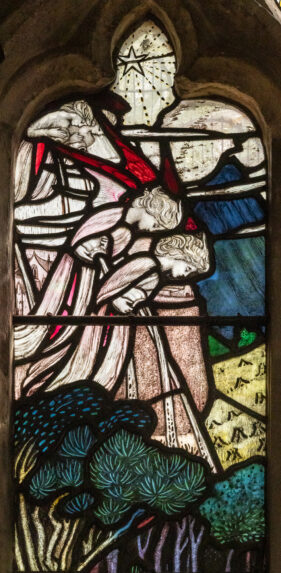
It is a memorial window to Hugh Owen who was a keen Meltonian huntsman, killed while hunting in 1903, aged 56. Angels look down from the top left on to a rural landscape with deer, a river and rocks and, very suitably for the hunting heritage of Leicestershire, a fox is depicted below. The main scene shows David and Jonathon at what turned out to be their last meeting on earth owing to King Saul’s anger against David. Above them there is a sower in a ploughed field and a sheepfold with two shepherds. On the right is a young man with a quiver full of arrows on his back. In the tracery windows is a tree with an inscription in Latin, Post hiemem sequitur aestas, meaning- after winter comes summer; in other words, a promise of resurrection and new life.
Artist/maker notes
Louis Davis (1860-1941) was an English watercolourist, book illustrator and stained-glass artist. As Cormack notes, “Amongst English artists of the Arts and Crafts progressive school of stained glass, only Louis Davis approached Christopher Whall’s pre-eminent position.”
Davis was born and raised in Abingdon, where his artistic talent was recognised by the local school. His early career involved watercolours and book illustrations, but he was increasingly drawn to stained glass and by 1891 he had become one of Christopher Whall’s first students. Lodging and working with Whall in Dorking led to a firm friendship, reflected in one of Whall’s children being named Louis.
In 1893 Davis moved to Pinner where he had a house and studio built, which would be his base for the rest of his life. Davis worked with a number of firms, including being one of the first to work with Lowndes & Drury. However, his most productive partnership was with James Powell & Sons. They could not only supply the high quality glass he demanded, but also, through Thomas Cowell (1870-1949) they provided an experienced and skilful painter, who became a sympathetic collaborator.
Many of Davis’s most important commissions are in Scotland, including Paisley Abbey, St Colmon Parish Church, Colmonell and Dunblane Cathedral, all of which came through a close relationship with the architect Robert Lorimer (1864-1929) to whom he was introduced by Whall in the summer of 1896.
Sadly the Dunblane commission marked the end of Davis’s fully creative career as he and his wife, Edith, were both nearly asphyxiated by a faulty anthracite heating stove at their home in Pinner. Although Edith recovered, Davis health was permanently compromised resulting in designs being adaptations and reworkings of earlier designs.
Sources:
Arts & Crafts Stained Glass by Peter Cormack (Yale University Press for the Paul Mellon Centre for Studies in British Art, 2015)
Louis Davis on Wikipedia
James Powell & Sons was formed when James Powell purchased Whitefriars Glass, an old established glass works, in 1834. His sons developed the business to be one of the major firms of the Victorian and Edwardian eras. Especially notable is their work with Charles Winston in the 1840s and 1850s to improve the quality of glass available, and the many fine designers with whom they worked. The company’s innovations extended beyond stained glass, with the company developing a formidable reputation in a number of fields, including tableware glass, where Whitefriars Glass remains highly collectable. The stained glass department finally closed in 1973, and the company in 1980.
Source: James Powell & Sons, Whitefriars by Jacqueline Banerjee, PhD, Associate Editor, The Victorian Web
Other comments
The poet, painter and critic, Arthur Tomson (1859-1905) summarised Davis’s skill in a posthumously published article in The Art Journal, 1907: ‘Mr Davis does not place before you, as do many glass designers, a perfect torrent of colour, one tint as it were, toppling over the other in its hurry to strike the topmost note. He uses white in all its degrees, as to the best of my knowledge, no other designer of this kind does. He uses transparent whites and dull whites; some that are translucent, and others that are as suggestive as an opalescent cloud. To these he applies brilliant colour sparingly, but he puts his gem like notes always in the right quantities, and always in the right places, so that their connection is never lost; so that they always in themselves make rhythmic pattern, and so that the eye, whilst wandering over the plainer spaces that intervene between these brilliant accents, is still always to some extent under their influence.’