
Christ Church Over Wyresdale, Lancashire
Address
Christ Church Over Wyresdale, Abbeystead, Lancaster, LA2 9BERecommended by
Highlight
The Hireling Shepherd windowArtist, maker and date
Carl Almquist and Shrigley & Hunt, 1891-3Reason for highlighting
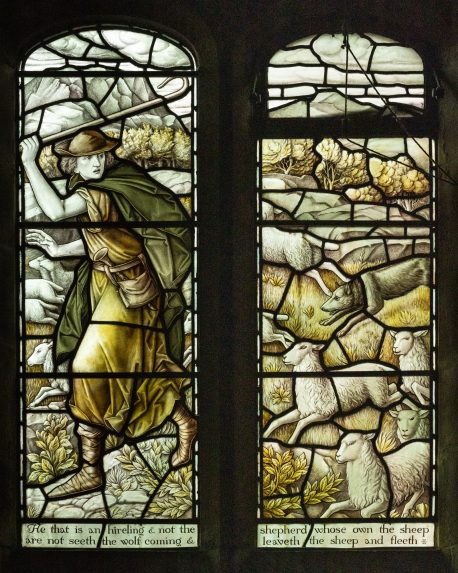
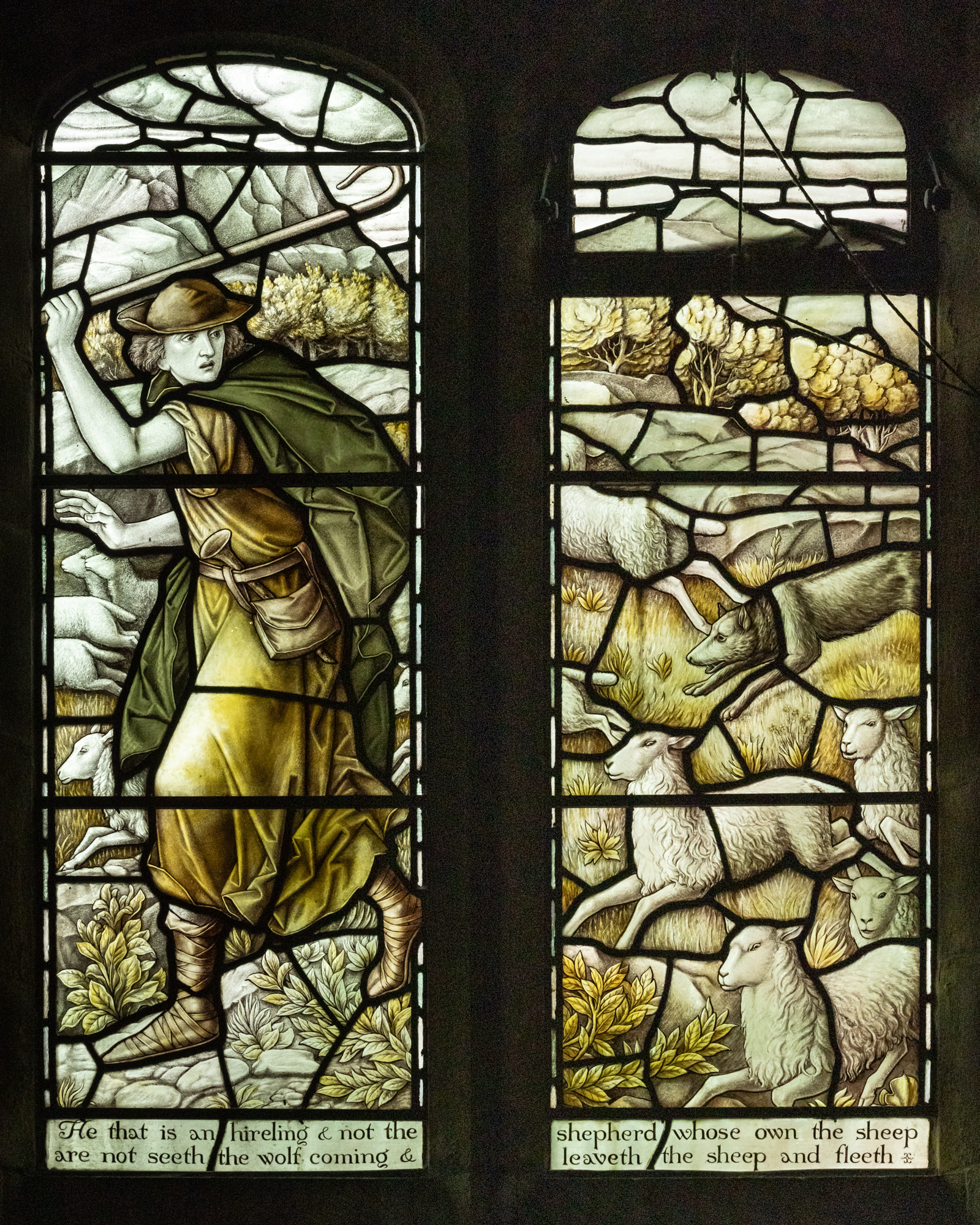
This window, on the subject of the Hireling Shepherd, is one of the most striking of an ensemble by Shrigley & Hunt at Christ Church. Known as the Shepherds’ Church, the little building has an entire glazing scheme by Carl Almquist of the firm on the theme of sheep and shepherds. In this scene the story runs across two lights. It shows frightened sheep scattering as they run from the wolf, while the hireling shepherd flees and abandons them. he looks behind him fearfully, holding his shepherd’s crook uselessly aloft. The details of his garb, satchel and horn are typical of the care with which Almquist approached his subjects. In the background, woodland with bare mountains rising above, beneath a cloudy sky. Lively and memorable, the windows are executed in the pale tones required for the low light levels of the building.
Artist/maker notes
Shrigley & Hunt was one of the major provincial suppliers of stained glass, represented especially well in North-West England. Based in Lancaster, the firm was founded by Arthur William Hunt (1849-1917).
Arthur Hunt (1849-1917) had worked as an apprentice for Heaton and Butler & Bayne before moving north to Lancaster in the early 1870s to join the decorating firm of Hudson & Co., previously run by Joseph Shrigley. Expanding into stained glass the firm initially used experienced freelance designers, such as John Milner Allen. However, while at Heaton, Butler & Bayne Hunt had become friends with Carl Almquist (1848 – 1924), a pupil of Henry Holiday, and in 1876 he persuaded Almquist to move to Lancaster, where in 1877 he was joined by a second young and talented artist, Edward Holmes Jewitt (1849-1929). Together Almquist and Jewitt eliminated the need for freelance designers and paved the way for three decades of widely admired stained glass designs.
Hunt died in 1917, but the firm continued until 1982 under the leadership of Joseph Fisher (1911-82), who progressively modernised the output of the firm. John Blyth designed for the firm in the 1950s, as did Harry Harvey from the 1950s until the mid-1970s.
Sources:
Damozels and Deities: Pre-Raphaelite Stained Glass 1870–1898 by William Waters (Seraphim, 2017)
Stained Glass from Shrigley & Hunt of Lancaster and London by William Waters (Lancaster: Centre for North-West Regional Studies University of Lancaster, 2003)
The Arts and Crafts Movement in the North West of England: A Handbook by Barrie Armstrong and Wendy Armstrong, (Oblong, 2005)
Victorian Stained Glass by Martin Harrison (Barrie & Jenkins, 1980)
Carl Almquist (1848–1924) was born in Sweden, but fulfilled his ambition to work in stained glass, in Britain. Thanks to a local benefactor, in 1870 Almquist came to London to train with Henry Holiday. At the same time he had access to Powells, Heaton, Butler & Bayne and Burlison & Grylls, as well as occasionally helping Harry Ellis Wooldridge. His talent was spotted by Arthur Hunt, who in 1876 persuaded him to join his new venture, Shrigley & Hunt, in Lancaster, so starting a long and fruitful collaboration.
After arriving in Lancaster, Almquist continued his training at Lancaster School of Art, but keen to learn more soon wished to return to London. Hunt recognising his talent supported the move by opening a London studio, which proved to be a successful business move. The collaboration drew to a close when , with failing eyesight, Almquist retired to Hove in 1920.
Sources:
Stained Glass from Shrigley & Hunt of Lancaster and London by William Waters (Centre for North-West regional studies, 2003)
Damozels & Deities Pre-Raphaelite Stained Glass 1870-1898 by William Waters and Alastair Carew-Cox (Seraphim Press Ltd, 2017)
Other comments
The church is in an isolated spot overlooking the fells of the Forest of Bowland. It is of early 18th century date, with an inscription over the door: ‘O ye shepherds hear the word of the Lord’. Subjects of the other windows include the Lost Sheep, the Annunciation to the Shepherds and David tending Jesse’s flock. The theme was chosen by the Sefton family of nearby Abbeystead House, in particular Lady Rose Molyneux, the Earl’s daughter, who gave detailed instructions on the subjects and their treatment.